28 June 2010

Feedback and advice: which boat is right for me?

From a recent email to Gnarlydog News:
>>
G'day Mate,
...I love the ocean paddles, my boat is a second hand plastic Tasman Express.
Having no knowledge of what to buy as a kayak I bought the first boat I saw.
The Tasman has done me proud and I am now looking to upgrade to glass.
I became a member of the sea kayak forum a short while ago and love everything on it, but yesterday I decided to have a look at your blog.
I have never had a look at anything like it before, I have to say I am blown away by your fantastic writings and knowledge.
I can hardly get away from the pc because you have so much for a bloke like me to read and study.
... I have paddled the new P.H. Cetus, a Valley, Shearwater, Tui, Sea Bear, Raider x and express, I can't make up my mind on what to buy and after reading just a small portion of all your information I am back at stage one....
Half an hour ago I read about how you made a new seat and a new back support and also the water storage system behind your seat.
Bloody hell, I'm out of me depth here I thought, this bloke Gnarly dog is a Whiz kid, how fantastic is your knowledge and the ability to pass it on to people like me.
My skill level is at the stage where I want a skeg boat because even in the Tasman I don't use the rudder unless I need it and that is only because the Tasman does not like a side wind, the rudder generally has to be used, except on the day where it packed up in two metre seas and twenty knot winds and I still paddled without the rudder by just sweeping and edging.
Now that was one hell of a day over thirty kms in heavy conditions, loved it...

....Do I just continue on trying out different boats till I feel comfortable with the way I handle it, do I buy a rudder or a skeg boat, remembering our conditions in the West similar to all Aust. Terry (...) has told me not to buy a boat without a rudder because why should I have to edge a boat and use a paddle to brace etc. when I can just move my big toe and the boat will steer.
That's Terry's thoughts and as you probably know he has done many thousands of miles in a kayak...
My idea is: I want to work on getting my skill level as high as possible.
I love the rough conditions and love winter paddling because my skill level accelerates pretty quick in the rough.
Les's boat looks and goes well with the people that bought one, and if I get one off him it will be custom made to suit me, my build and skills and be light enough for an old bloke like me to lift...

After all this writing here it only comes down to me wanting to say G'day to you and thank you for such an interesting reading blog.
Any ideas on boats etc will be appreciated, and I have weeks more reading to do just on your own web site...
Thanks again.

<< Dear "Reader",
thank you for your email and for your comments.
While some of my thoughts are somehow expressed in my blog there are a lot of ideas that I don't want to publish since a lot of paddlers (especially local ones) might get offended.
Please remember that in the end they are just the opinions of an average paddler with no formal qualifications.
I have however always had a critical eye for technical things.
While the industry tries to accommodate for so many different styles and tastes occasionally they produce untested or badly designed gear.

From what you say, you seem to be very active in the outdoors (way more than myself as weekend warrior).
I am familiar with only some of the boats that you mention: Cetus, Seabear, RaiderX.
You probably know my opinion about rudders: they are great for racing or comfortable cruising.
My skeg kayaks are generally slower and more demanding.
I often compare the two to cars: stick shift versus automatic.
What would I rather have? on a winding mountain road? or in day-to-day city traffic?
While I would love to drive a racy car on traffic-less sweeping-corners road the reality is that I drive an automatic car in city traffic.
Why? Because it’s easier than clutching and shifting gears all the time.
What has that got to do with kayaks?
For me paddling is fun, not just going form A to B with the minimal fuss.
If I paddled the way I drive chances are my kayaks would have a rudder.
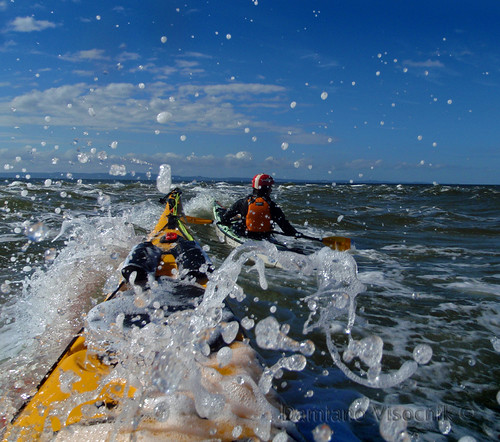
rough waters (c)
I like to maneuver my kayak with my body, roll and occasionally surf. A ruddered boat is not generally ideally designed for that.
I had ruddered kayaks and they were good but not for what I wanted to do.
If my goal would be covering long distances in rather non demanding conditions with the minimum input from the paddler (myself) I would use a ruddered kayak.
I also have broken a few rudders in surf, but never a skeg.
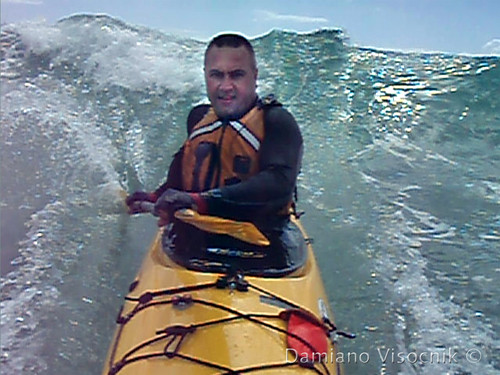
Currumbin_surfing5 (C)
I cut myself on rudders in choppy waters, I damaged boats when rafted up with rudders and I caught towing lines in rudders… they just aren’t for me.
I do however use a bit more effort in edging my skegged kayaks in following seas while cross winds are taken care with the deployment of the skeg.
While ruddered kayaks are often the preferred choice for some expeditioners, just as often I see skegged boats used for demanding long trips too.
It’s a personal choice.
I do however have strong reservations towards ruddered kayaks that are very difficult to paddle in conditions (wind or waves) with the rudder retracted.
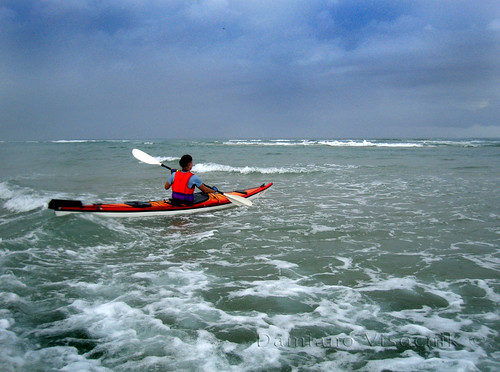
Storm kyking (c)
Imagine a rudder failure (quite an occurrence) on a long trip.
Most skegged kayaks are relatively easy to paddle with a malfunctioning skeg (has not happen to me yet) while most rudder dependant kayaks are sometimes impossible, when windy.

A kayak should be your choice not somebody else’s.
What suits very well one paddler does not necessarily suit me. Boat fit, weight and skill level will dictate what the perfect boat is for you.
And "perfect" is only a perceived attribute that will probably last for a relatively short time.
As my skills progressed and my objectives changed the “perfect boat” suddenly became limiting or boring.
I have owned only a limited number of boats and I can see myself getting a few more (maybe selling the current ones, one day….) as my skills will progress and my goals will change.
Will I own a ruddered boat again?
I can’t see that happening right now, maybe in the future if I become lazy and I want to take it easy. I can't see myself racing :-)

Once you have decided on the style of kayak you want/need for the goals you have in mind, boat fit should be the deciding factor.
I like good contact with my upper thighs (not knees) on the thigh braces (some cockpits lack decent thigh braces, some don’t have thigh braces altogether).
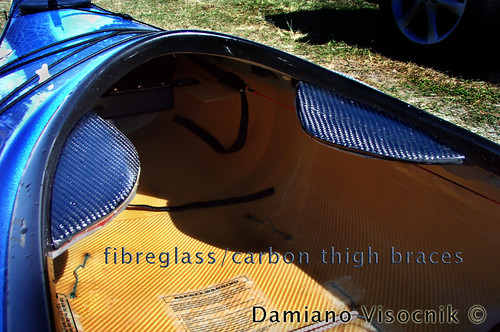
Sean's Arctic Raider_braces
I also like a bit of wiggle room for my legs too.
A kayak that finds me with the legs always stretched out to the floor is going to cramp me.
For a kayak that I spend paddling all day I like to see a bit of a bend in my knees.
While a comfortable seat does not determine the ultimate purchase (I have the skills to fabricate one that fits me) a person without the ability of customizing a seat should be wary of the seat that gives the dreaded “dead legs”.
And finally I look at the boat’s strength.
I have occasionally discarded a boat that I loved test paddling but that in my opinion was badly constructed.
While I can reinforce/modify/repair a kayak, I think that an top price brand new kayak should be right from the get-go and not spend weeks in my garage getting reinforced/modified.

Thank you for reading GnarlydogNews.

Best Regards.

Damiano

PS I would like to publish in GnarlydogNews your query (part of it) and my answer to you.
I would like to maintain your anonymity though...

21 June 2010

Surfing with a stick

Defying popular belief that traditional paddles are just for show and really not suitable for rougher waters, I have been using Vanstix (Aleut paddles) for small surf fun for some time now.
through the surf with the stick_lg (c)

Van stick surfing (c)
Vanilla carving it with a Vanstix
Surfing with a traditional paddle: works for me...


reversing on wave (c)
Adventuretess with a 'Greg Schwarz' hollow core GP

fun
here I am using a Black Stick by Greg Schwarz
brace turning (c)

11 June 2010

SHOP: joiner for a timber paddle

It's been more than a year since I have happily transitioned from Euro paddles to traditional paddles and I have not looked back.
One advantage that my former paddles have over my sticks is the ability to split the paddle in half to be able to store it on the deck of the kayak.
While some split GPs are available locally reports say that they aren't all that strong.
So, I have decided to make my own split traditional paddle.
I wanted a simple joiner that would require minimal fuss and no need to source special parts overseas.
I decided on a simple stainless steel bolt and (long) nut system.
While very primitive compared to some other offerings it is dead simple to install.
The loom of a traditional paddle is not round like in a Euro one but oval or tear shaped.
I measured the half way point of my Vanstix and cut it carefully in half.
Then I reduced the diameter of the loom in two progressive steps
I needed to reinforce the ends of the split paddle or any inserted fitting would compromise the strength of the loom.
Two staggered layers of carbon sleeve were epoxied onto the recessed loom.
The second sock layer protruded beyond the recess and later was sanded down.
Once the resin cured I cut the carbon sleeve flush.
I then removed 1 cm of the timber at the end of the cut loom leaving just the thin carbon sleeve.
An oversized tapered hole was drilled into the centre of the cut loom, deep enough to accommodate the long sleeve/nut.
I filled the hole with a mix of thick epoxy glue (microfibre filler) tinted black.
I threaded the sleeve/nut onto a long bolt and sunk it into the hole making sure that the resin would fully encase the stainless steel hardware.
The temporary bolt was greased up so it would not stick to the epoxy mix and be removable.
excess epoxy mix to be sanded back once cured
I positioned the paddle horizontally clamping it to a work bench.
I supported the bolt with a spacer to make sure it would be positioned parallel to the loom.
Once cured I removed the bolt and sanded the end surface smooth and square to the loom.
I repeated the same procedure on the other half this time inserting the cut-down stainless steel bolt.
bolt end squared to be glued into epoxy mix
I filled the second half with epoxy mix and joined the two halves to create a uniform joined surface.
I waxed up the first half of the paddle to prevent it from gluing together to the second half.
excess epoxy mix spilling as the two halves are brought together
After the resin cured the paddle was separated and a very thin plastic spacer inserted as mating spacer to create a very positive joiner when the paddle is assembled.
This paddle joiner worked out great.
I am now working on a different style split that requires a lathe to fabricate the carbon joiner pieces.

02 June 2010

Gnarlydog News advertising philosophy

Gnarlydog News following has grown in recent times.
It captures the attention of readers around the world and some seem to really like my postings.
The blog's popularity (still very meager compared to some teen based topic related blogs) has attracted the attention of some commercial operators.
I have been asked a few times if I would be interested in promoting, reviewing or advertising certain products or services.
While I love to test new products that personally interest me, I have declined offers that don't follow my philosophy.
I prefer to review items that I would personally use.
I have rejected requests to advertise products that don't meet my criteria of solid design and construction.
I have also declined to advertise for services that I don't believe in.
You might also have noticed that some of my reviews are not all honky dory and occasionally I don't exactly praise or hold back on a product that has failed on me.
I try to give you, the reader, an honest opinion of what I think.
While the web might be full of reviews for certain items that you would like to know the durability/performance of, just about all reviews seem commissioned.
There are several magazines that do the same: stellar reviews on ALL the products they test...
Hmmm, does not that smell a bit fishy to you? ...it does to me ;-)
Dilbert.com

Occasionally Forum/Blog administrators will pull non favorable comments from end users that may damage the advertising of a certain manufacturer.
It is rather difficult to get an honest opinion these days.
Some advertising masquerades behind "reviews" from consumers however for me it's often easy to spot the story that reeks of commission.
You will hear from me when I like a product but at the same time I will also let you know if something just ain't right...
I might not win myself any favors with some manufacturers (or individuals) but I won't say something that is not true.


"The currently fashionable idea that marketers can manipulate social media to serve their needs is largely a delusion. Yes, there will be isolated successes. But most web users are far too savvy to confuse honest social commentary with contrived social media "marketing." Social media is currently an effective way for companies to maintain good customers relations, and for smallish retailers to deliver sales promotion messages. "
(from The Ad Contrarian 25MAY10)

28 May 2010

GEAR: Reed spraydecks and clothing


Aquatherm is a unique fabric used by Reed Chillcheater to make kayak spraydecks and clothing.
Like no other fabric on the market it addresses a couple of very important features.
The fabric is firstly waterproof but also breathable.
Many fabrics have achieved that (Gore-Tex for example) but what sets Aquatherm apart from the other fabrics is its elasticity.
Almost as stretchy as Lycra the fabric is coated with a unique rubber-like membrane that makes it waterproof and windproof.

What ultimately distinguishes it is the ability to dry very fast compared to other fabrics.
Since the outside of the fabric is smooth (no knit) the rubber sheds water like nothing else.
The face fabric does not saturate with water that would take a long time to dry.
After a few minutes my Aquatherm gear is touch dry.
So what's the big deal of keeping the fabric dry; isn't it enough that water does not get to your body?
You might have noticed how a wet garment chills you when saturated with water if the air is chilly and there is a bit of wind.
Think of a wet T-shirt in a bit of a breeze...
The evaporative action (fabric drying) uses an incredible amount of energy (heat) and that translates to heat loss and therefore the cooling effect.
Just like a "swamp cooler" works on that principle to cool the air, the wet fabric is cooling your body.
Sounds desirable in the heat of summer, but it can prove to be a real bummer (often more than that) when temperatures are in the low teens (centigrade).
paddling away (c)
With winter approaching, fellow novice paddlers are seeking recommendations on suitable paddling attire.
While I also own a Gore-Tex paddling jacket I always reach for the Reed gear.
Aquatherm tops are excellent for rolling too since they are so much less bulky than a jacket.
Even though they don't keep me dry when rolling (water still goes down my neck) they are excellent for cruise paddling.
In a jacket (unless it's a "dry" top) the sleeves fill up with water and rarely drain..
Van floating (c)
Being breathable they keep the "steam" that I exert from my body away from my skin keeping my underlayer (when cold) dry.
I find Aquatherm suited for mild weather (read Queensland winter); if necessary I layer with a thin fleece underneath.

Reed also makes spray decks.
Sunset while rafted up (c)
If Aquatherm is excellent to keep me warm as a garment, it excels to keep me cool when used in a spray skirt.
How can that be?

As mentioned, the fabric "breathes" and prevents the steam to build under the enclosed deck.
Since I have been using Reed spray decks I have been much more comfortable when paddling in the heat of summer (30C-86F). I no longer feel the little rivulets of sweat drip along my legs...
I am not sure how warm the skirt would be in really cold waters (Qld ocean temps rarely drop below 20C) but its perfectly suited for my paddling conditions.

Now the bad part; there always is one :-)
User reviews say that Aquatherm skirts are not as durable as good quality neoprene skirts.
Despite the manufacturer claiming that they are 5 times more abrasion resistant than neo, I have not found that.
The fabric is rather thin and its fairly easy to puncture when assisting rescues and sliding the rescued kayak over the cockpit rim. I am not the only one lamenting this problem.
Furthermore, a couple of skirts have delaminated prematurely.

While Reed does offer a 12 month warranty against manufacturing defects, it is the fabric in some skirts that failed, in some cases before warranty ran out.
Reed is happy to replace them only within the specified warranty period.
I was hoping that my skirts would last longer than 12 months and that I should not need to replace them soon after.
Interestingly enough only some skirts are effected by this.
Could it be that there was a bad batch of fabric and that the local retailer got the bulk of those defective skirts?
Will I replace the Reed skirts with the same one?
Yes. I will give Aquatherm another go and hopefully my problem was isolated.
The fabric is just too good to go back to neoprene.
Tess with Black Stick_2(c)

24 May 2010

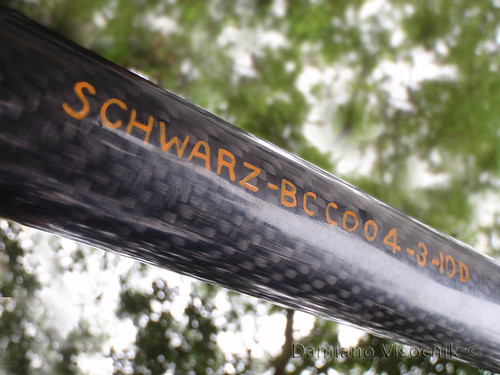
Black Stick by Greg Schwarz

Schwarz_Black Stick_4_lg (c)

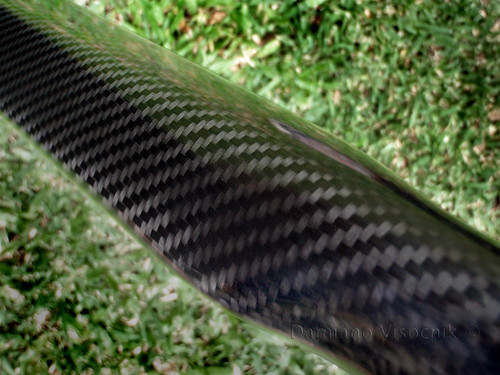
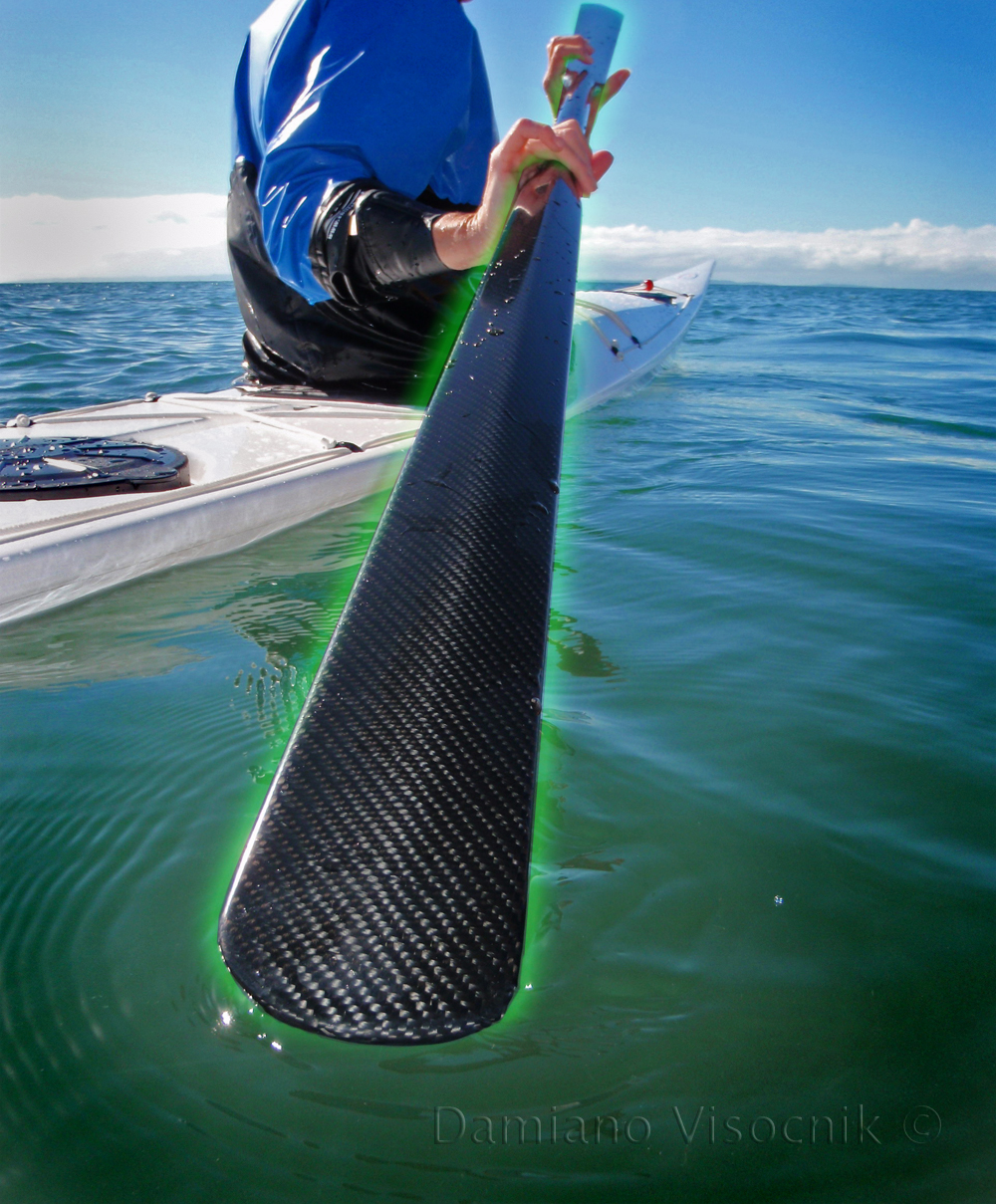
The latest creation from Greg Schwarz: a high density laminated balsa core with carbon skin Greenland paddle.
If his previous hollow core paddles were art this one is pure magic.
This is a one-off (not a production paddle) since it takes an insane amount of time to manufacture.
Schwarz_Black Stick_3 (c)

The Black Stick is a paddle like no other I have tried.
The surface is extremely smooth but not totally mirror shiny.
Greg finished the paddle with a coat of boiled linseed oil to give it a bit of grip.
I found the paddle to have no slip with my gloves on while others said that it felt less grippy than a non-shiny timber GP.


The shoulders of the paddle have a rather soft transition from the loom and sliding the hand to the blade is noticeable but not "notchy".
Surprisingly the paddle displays relative good flex considering it is skinned with carbon fiber.
Other carbon GPs I have tried were more rigid and a hollow carbon one was particularly stiff and noisy.
Paddling with the Black Stick had a similar feel of solid timber.
Black Stick_2 (c)
This paddle is slightly different in shape to Greg Schwarz's timber hollow core one: a slightly more pronounced ridge makes just a bit more diamond shaped.
I believe that it offers a more neutral feel and less canting is needed to avoid flutter.
It gave me a very reassuring feedback and compared to Greg's timber ones it was easier to use, considering my rather limited time since I have swapped from Euro style paddles to GP.
I thought it required a bit more precise technique than my Aleut paddles (which have a strong dihedral ridge) but less than a flatter faced GP. A beginner would probably find this paddle easier to use.
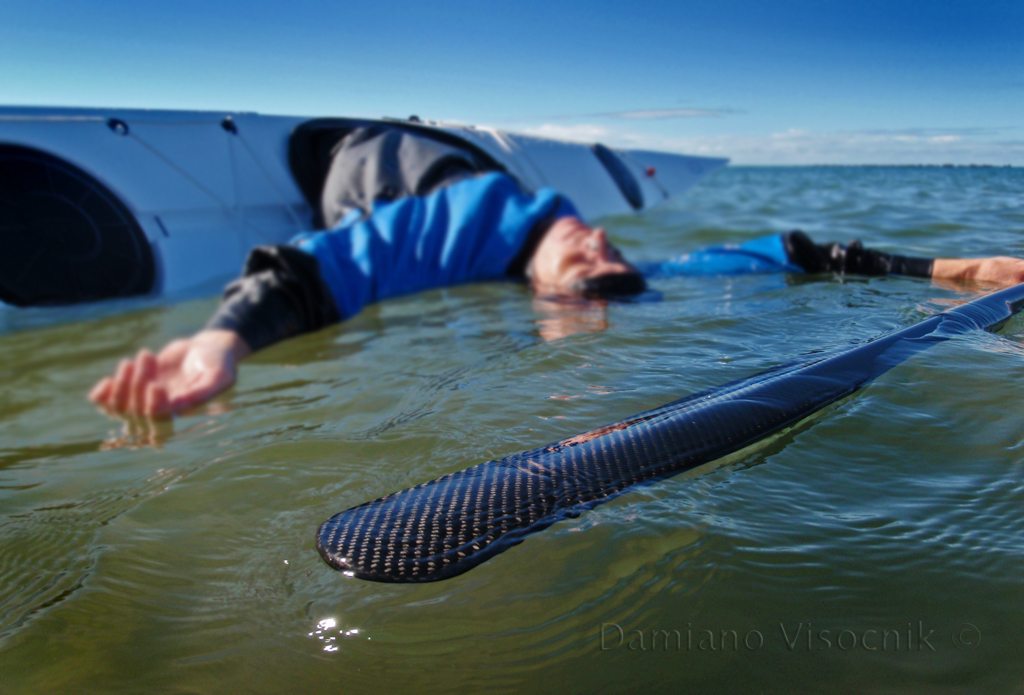
Rolling with this paddle is outstanding.
It offers ample buoyancy and the blades, having a rather fine edge, allowed for superb sculling.

It is butter smooth through the water offering very good lift.
Black Stick_1 (c)
The Black Stick made my limited sculling skills look so much better than when I use an Aleut paddle :-)
However it still does not offer the raw power of the Aleut.
Vanstix have more surface area than the GPs I own and consequently will still probably be my choice for confused waters or surf play.
Interestingly enough most paddlers transitioning from Euro paddles seem to prefer the Aleut ones (myself included).
Once the paddlers become accustomed to the new paddling style, Greenland paddles seem to be easier to use than earlier on.
Just like kayaks: each one has its own strength and best suited for a particular situation/style.
The Black Stick complements my fast expanding quiver of traditional paddles and possibly might become my favorite all rounder.

11 May 2010

Sea kayak rental

When travelling abroad to remote locations it's not always possible to transport your favorite kayak with you.
One option is to rent locally, if possible.
However the style of kayak that you might end up is not always what you expect :-)


inspecting a "caballito"


click on images for larger view

*all photos: M. Visocnik_ used with permission

27 April 2010

SAFETY: choosing your paddling companions.

I choose to sea kayak in the company of other paddlers.
I believe that with the right companions the experience is enhanced and the safety on the water is increased.
Some of my paddling buddies are friends while others are just trusted people.
While I do lead trips for the Club (or participate on trips led by others) where the skill level and the seamanship can be rather basic, those trips are usually brief and not demanding.
Easy day trips are safe occasions to asses one's ability and character.
Put in at Cleveland (c)
A few years ago I learned that I should never take a paddler on an extended trip if they have not paddled with me on a simple paddle first.
On one occasion the visiting paddler from USA (that I have not met before) assured me that she had paddled for years in demanding conditions and she was a very proficient sea kayaker.
Fooled by her assurance I agreed to have her on a multi day trip.
It became evident right from the start that this person was no expert, actually quite a beginner.
I would have escorted her back to the shore and sent her home except she had gotten a ride with somebody else (she didn't have a car herself).
Fortunately for her the rest of the group agreed to slow the pace to a crawl and eventually tow her for the rest of the weekend (conditions and locale were very easy).
Lesson learned: don't believe what a paddler says about his/her ability, assess them on a low grade day trip first.
roll me over..

On a different occasion the situation was way more serious.
An interstate visiting kayaker joined a Club group paddle along a shore with surf landings.
Silvio Testa, an experienced local kayaker, was the leader of the trip.
The visitor was a friend of another Club member who did not participate in the trip.
The Club member vouched for the visitor's ability.
While this visitor certainly displayed the skills needed for the surf, he did not understand seamanship.
His character lead him to bully the group and take over the leadership which resulted in Silvio almost drowning.
With his commanding authoritarian voice he egged the group away from the leader (with the pretext that we were running out of daylight) and abandoned him alone on the beach.
The second-in-charge did not have the spirit to salvage the situation and simply agreed to abandon Silvio.
Unknown to us, while scouting for a camp spot, Silvio got dumped on the shore when trying to launch and rejoin the rest of the group.
For some reason he could not wet exit and nearly came to grief.
Silvio admitted that was real luck that he didn't drown.
If we were present at the mishap, one of us could have surfed in and offered assistance.
Needless to say that this visitor got an tongue lashing about his behaviour and incredibly, his behaviour, did not improve the following day.
The group was however wiser now and ignored him.
Needless to say he was no longer invited on Club trips.
From that incident I learned: there is only one leader and he/she calls the shots, know your paddling companions well before committing to a demanding/long trip.

On my trips to the Whitsundays (2 weeks+) I select the participants very carefully.
Late landing (c)
While the skill level required is a given, I put emphasis on group dynamics, objective of the paddlers and ability to perform under pressure.
I have read one too many accounts of trips in the same area that deviated wildly from the plan because the paddling group was not suitable (skill wise or conflicting personality).
On the account of one well known sea kayaker's trip to Hinchinbrook Island, he admitted that despite having paddled with the participants before, he believed half of them had a skill level unsuitable for the extended trip that he led for the two weeks.
The short time he spent paddling with them prior to the trip was obviously not sufficient to judge their ability/spirit for a long trip.

It puzzles me now why my Club has suddenly changed the policy and has decided to allow inexperienced paddlers (with Club outings) to join any grade trips of any duration.
The rules have now been changed to allow a visitor to join any trip, of any skill level (even very demanding ones) and of any length.
In confidence, I have been informed that one of the members of the Club's newly formed Safety Committee (a highly experienced Sea Kayak Instructor) is strongly opposed to this new foolish decision.
I have made my inexperienced fellow Committee Members aware of the dangers but obviously my view didn't dissuade them.
While we all make mistakes, I try to minimize mine so they don't escalate to a situation of real danger.
Learning from other experienced paddlers has always been my priority: there is no need to have first hand bad experiences to understand that something is just too risky.
Whitehaven sunset (c)

25 April 2010

Technique: the Magnum® roll

After attempting this elusive roll repeatedly in a Nordkapp LV, it was finally performed for the first time by Adventuretess in a Tahe Marine Greenland.
The Magnum® roll is a highly advanced Greenland roll that possibly will be included in future Greenland rolling competitions :-)

Review of the Tahe Marine Greenland: here

20 April 2010

SHOP: modifying the stern of a sea kayak


SeaBird Designs NorthSea: stern modified
Of the modification I have done to my kayaks, this one certainly was the most daunting one: modify the hull!
In my early days of paddling I quickly understood that the shape of a hull in a kayak is detrimental to its handling.
While kayak designers often spend years perfecting the hull shape I don't always find their designs perfect.
I have very little knowledge in naval engineering (read: about zero) but I can feel when a kayak is not performing the way I desire.
My first attempt to fix a kayak that was in my opinion "too loose" was simple: I added a little fin (fixed skeg) to the stern. The kayak improved dramatically.
Apparently modelled on a Nordkapp hull (probably an early version) the stern on the Arctic Raider seems to be cut away more than the current hulls on the VCP Nordkapps.
The Arctic Raider is designed to be paddled with a rudder.There is less keel on the stern.
The Arctic Raider weathercocks really strongly when the rudder is not deployed (like when surfing).
Storm kyking (c)
Arctic Raider
Adding the fin helped to the stern from laterally drifting when windy stabilizing the stern.
On my Seabird Designs NorthSea carbon/Kevlar core sea kayak I had the opposite problem: the boat leecocks.
Soudkapp (c)
SeaBird Designs NorthSea before the mods
Originally designed to be used with a rudder I removed it and installed a skeg.
The NoprthSea paddled very neutral in low winds but became a bit of a handful in high winds.
Above 20 knots the bow will turn downwind and it was hard to maneuvre.
However the kayak will surf very well: no broaching there.
I moved the seat forward and that changed the trim a bit and made it OK to paddle.
Maneuverability however was still slow: edging the kayak would not release the deep keel line in the stern.
I finally decided to modify the hull.
How much should I modify my stern?.... hard to say/quantify.
I worked out a rough estimate (modelling it on the design of my other kayaks) and marked the stern with tape.

Once I was confident that the cut line would be appropriate I fired up my Dremel tool and took the plunge: hacked into the hull.

It took only a few minutes to cut away the section from the stern.

I made sure that both sides were symmetrical and cut even.

I then cleaned all the dust and any possible salt residues from the surface inside the hull to make sure my epoxy glue would stick to the existing surface.
I mixed up some West System 105 resin/207 UV stabilized hardener mix, tinted it to match the hull color and added microfibre to the consistency of peanut butter.
I generously filled the gap that I created by cutting of the stern with this epoxy mix.
I used tape to reduce the gap: squeezed the hull sides by hand and applied tape to hold the new shape. Surprisingly there was not a lot of tension on the tape.

Once the epoxy glue cured (overnight) I removed the tape and filled the remaining gaps (left by the tape area) with more epoxy mix.
Shaping the final fine keel line was relatively easy with some sand paper.
A smooth finished was achieved with a last coat of clear 105/207 mix.
PIC to come
I tested the new stern shape of my SeaBird kayak over the weekend.
The wind was ideal (up to) 20 knots and the kayak was lightly loaded.
I could definitely feel the stern being more loose now.
In beam winds it finally would weathercock slightly.
I paddled along a Norkapp LV and about the same amount of skeg was needed to correct weathercocking.
While I had no chance yet to test the kayak fully unloaded (I had about 20 Kg of gear with me over the weekend) it appears now to be handling much more like my other British style kayaks.