Showing posts with label storm. Show all posts

15 June 2015

Hail hell

by Tess Dodd_Adveturetess

 I am almost halfway across, enjoying leaving the demands of a busy morning further behind me with every paddle stroke. My thoughts are filled with plans to paddle in Alaska.

Reading Audrey Sutherland’s books (87 days solo kayaking in Alaska, swimming and kayaking remote sections of the Hawaii coast); I recognized her spirit and felt inspired by her adventures. I spend many hours vicariously sharing her inflatable canoe. A deep rumble draws my attention to my right. I was no longer sharing Audrey’s inflatable canoe in Alaska, but alone in my Nordkapp in Moreton Bay.
Looking south, I can see darkness on the horizon. It’s distant and appears to be moving across the lower bay, out to sea, away from me. I can see the strip of white sand where my friends are camped. I know it’s not far for me to paddle now. I stop day dreaming and increase my cadence, keen to reach the beach before any rain falls. I don't fancy setting up my tent in the rain.

 Loud rumble. The storm is moving closer to me but still appears to be tracking out to sea. I stop paddling to hydrate and consider my options: I am closer to my destination than any other land.
If the storm moves towards me and not out to sea, no matter which direction I take now, I am going to get wet. I decide to continue my original course.
Before I move on, a sea turtles large head breaks the surface nearby, taking a huge gasp of air before sinking below. I notice a large shadow to the right, too big for a turtle, maybe a dugong? The shadow moves closer, rising from below to bump my boat, moving it with its body. Far out, a shark! It brushes my kayak as it moves away; I drop my drink hose, pick up my paddle and get moving.
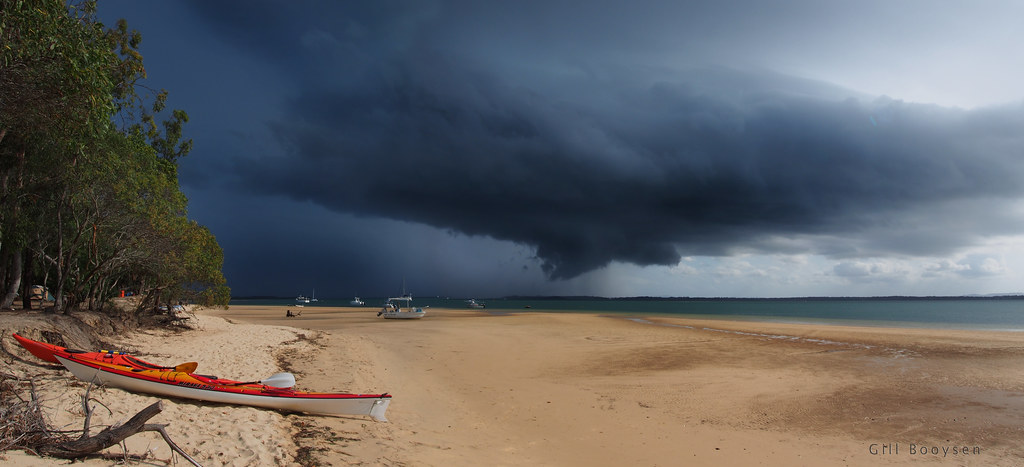
Hail storm at Bakesleys_Gill
Storm approaching, viewed from Blakelseys Landing _photo Gill Booysen

 I can see 2 motor launches near the island heading for anchor. Other watercraft have disappeared. At least I won’t have to worry about being hit by a boat out here.
BOOM… a BIG thunder clap. Louder. Closer.
The cell is moving as fast as my heart is beating – fast! I know I will soon be engulfed by this heaving beast. OK Tessie, don’t panic. Relax, think clearly, and make a plan. Stow the sail securely on deck. Point the kayak into it. Prepare to brace. (Larry Gray ‘storm brace’ technique – it works).

I glance behind me and see sunshine and blue sky. Bizarre. Ahead, I see people moving about on the beach, the storm cell has not quite reached them. I think about my friends and wonder if they can see me out here, knowing they can’t. I don’t want them to be worried about me. I wish I was with them right now. Looking into a sky that is now a deeper green than the water, I realize it’s going to hail.

I think of Australian Ironman Grant Kenny who was out training on his ski when a sudden hailstorm hit. The hail stones cut his head open. He flipped his ski over and used it for protection until the storm passed.
After the earlier shark bump, I was really hoping I would NOT end up in the water today, but knew I may not have a choice. I also hoped for small hail stones and a fast storm. The transforming beast of green and black was almost upon me. I could feel my body trembling, adrenaline I guess.

BOOM. …BOOM…crackle…The vibrations travel through me. I can no longer see the beach. The wind increases slightly as large drops of rain begin hitting the water around the kayak. It is a strangely beautiful moment. A bird sitting in the water just ahead dives below and does not reappear. Darkness wraps around me. Shit! A wave of anxiety washes through me. My senses tingle as I wait. Suddenly, a raspy sound becomes an almighty roar, heralding it’s arrival. I try to point the bow into it, bracing. The ferocious blast is more than I have ever experienced in the kayak before, EVER.


meanwhile on shore...
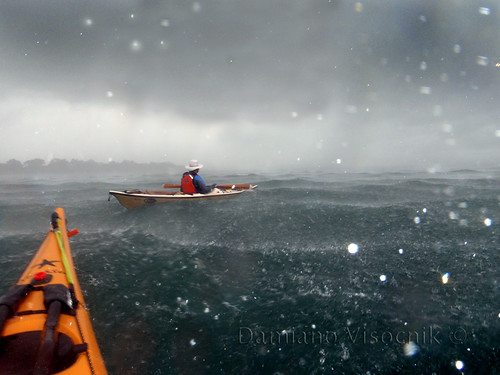
I struggle to stay upright, my ears fill with the roar of the wind, waves wash over my deck, my body is physically forced backwards over the deck. I bend forward trying to lessen the effects of the wind on my body. The drops of rain become bigger and the waves smaller. My saturated hat brim is down around my face. I can’t see or hear over the roar and have no idea what’s coming next. I focus on staying upright. A new sound joins the melee. Crack. Crack. Crack. Then, I feel it. HAIL! Hailstones begin hitting my head, my arms, my hands. Hail ricochets off the kayak painfully hitting my face and teeth! The hailstones increase in size. Taking one hand off the paddle, I cover the top of my head until my fingers hurt from the stinging ice. There is no relief. The noise is deafening. The hailstones bruise and sting where they hit my body. If this continues, I will have to get in the water for shelter. I don’t know how long the storm lasts, but neither of my hopes comes true. The hailstones are large and the storm is not over quickly. I endure an icy beating from Mother Nature until the storm cell eventually moves over me, the hail and wind easing to leave only gentle rain hitting my bruised face and body.
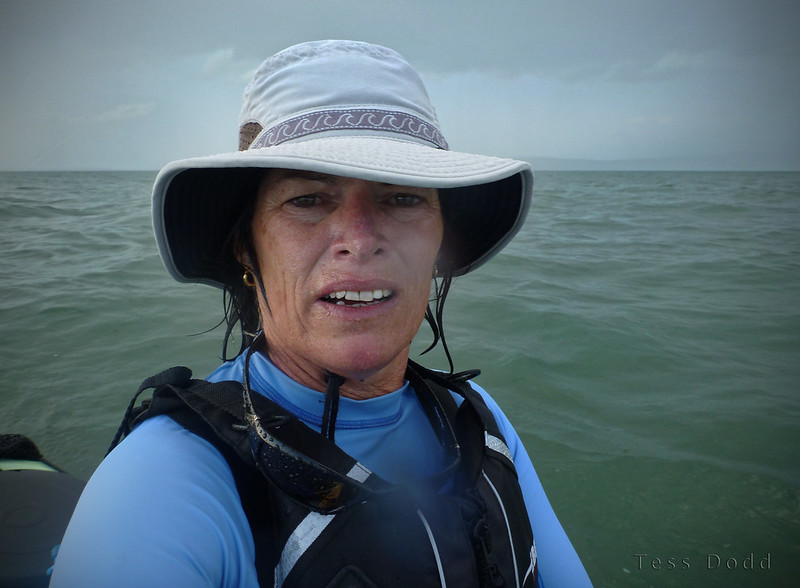
After storm selfie
After storm selfie
 Once again able to see, I look towards the island. It is further away but, in front of me is the bizarre sight of half the beach covered in grey sky, half blue sky with a rainbow…half storm, half rainbow! I self-assess. My kayak is still upright. I am beaten up but OK. I am close to tears, instead of crying, I begin laughing. Strange, stress relief laughter. I feel spent, alone and ready to resign the ‘Adventure’ from AdventureTess.
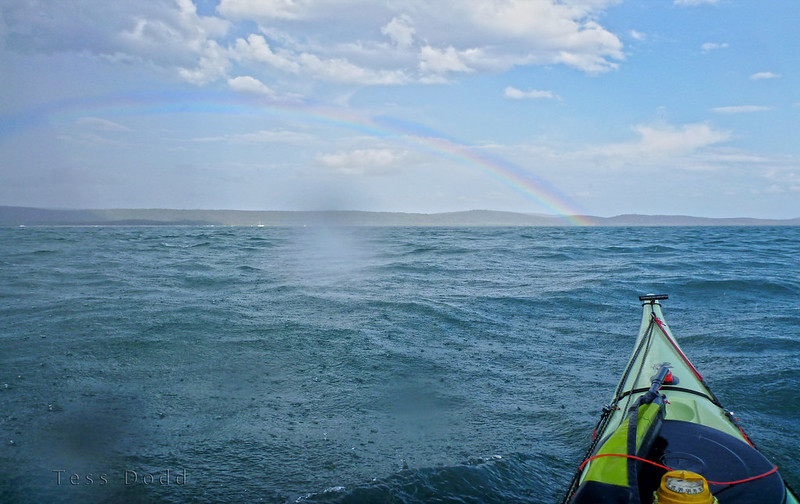
AFter the storm_Tess

But, I am in the middle of the bay and need to get moving again. The storm is north of me now, cutting a swathe over the water and Dunwich on the west coast of the island. I have a clear view of blue sky either side of this intense black and green field of energy. Eager to see my friends, I pick up my paddle and begin the work to reach them. I have been blown away from the island, so have additional distance to make up. While paddling, I reflect on the experience and my choices that day. I believe I made good choices and would have felt some comfort with company, but would company have created an additional concern? Using the last of my energy, I reach the beach. People are moving about, fixing campsites, and checking boats. I see my friends and call out. Relief floods through me as they make their way to the water’s edge to meet me.
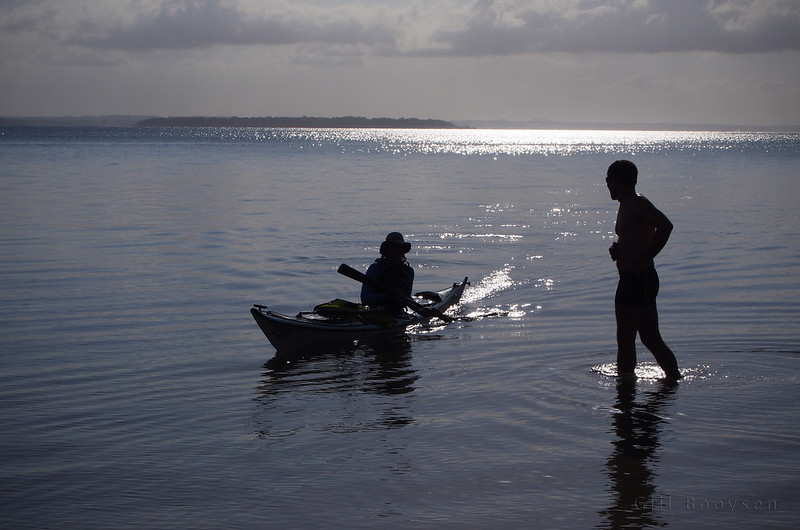
Tess' arrival_Gill

Note: I launched just after lunch to paddle 10km to meet my friends, who were waiting at camp. Conditions were mild. The water was bumpy with a 10 to 15kn headwind. A possible late thunderstorm was forecast. It was early and there were no signs of a storm when I launched. I often paddle alone and am familiar with this stretch of water. I have been asked about the wisdom and safety of my paddling alone. Even for these short distances in familiar water. I enjoy social paddling with a few close friends but feel confident in my skills and decision making ability to kayak alone.
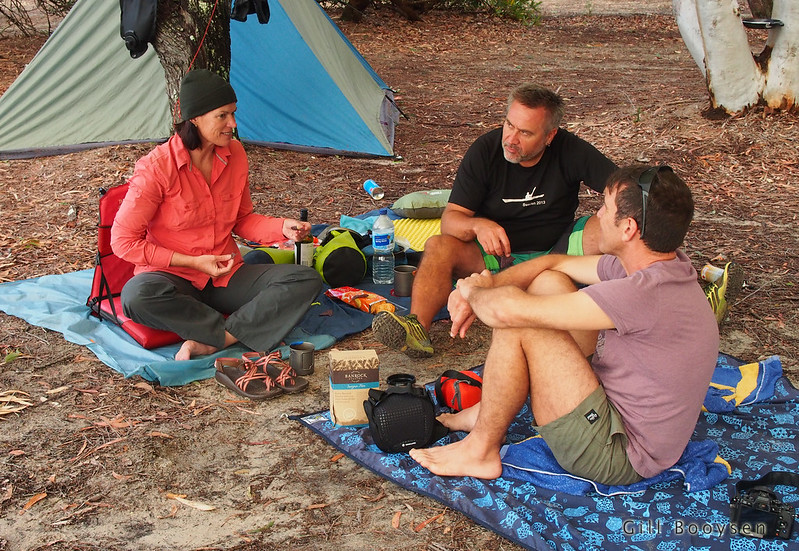
Recounting the story_Gill
great campsite story...                                                                                                                                       photo: Gill Booysen

.
17 September 2013

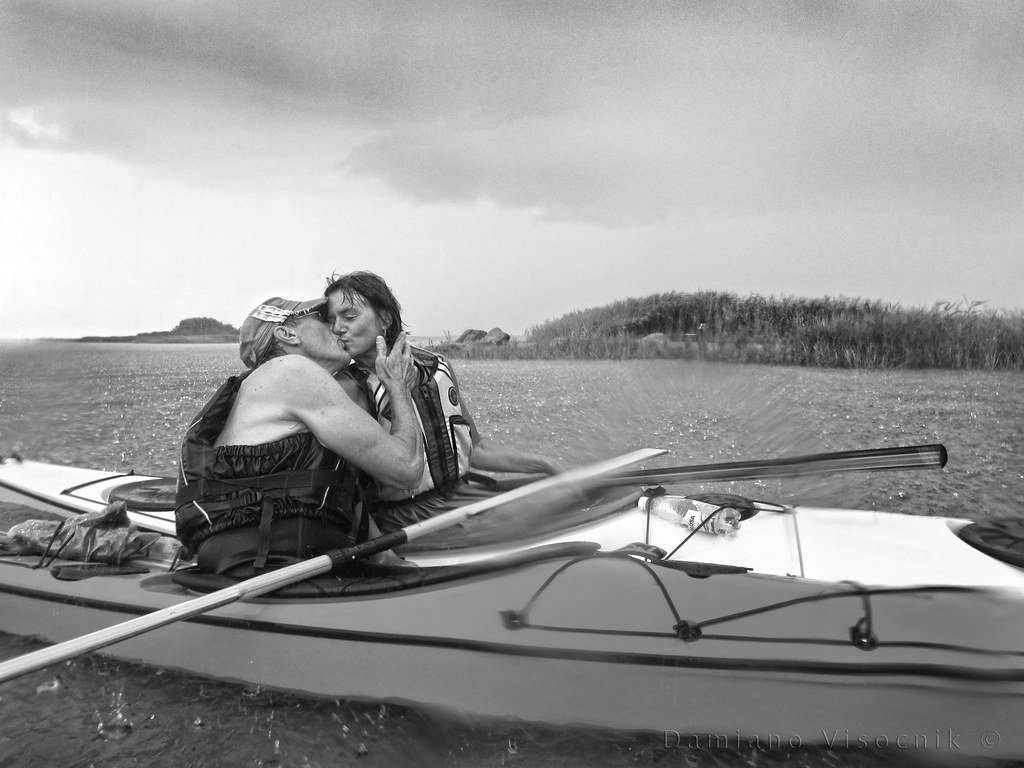
Photo: Kiss in the Storm

.

Kissing in the rain_c

A summer storm can't dampen the spirit of love.

.

10 September 2013

Destination: Magic Island

.
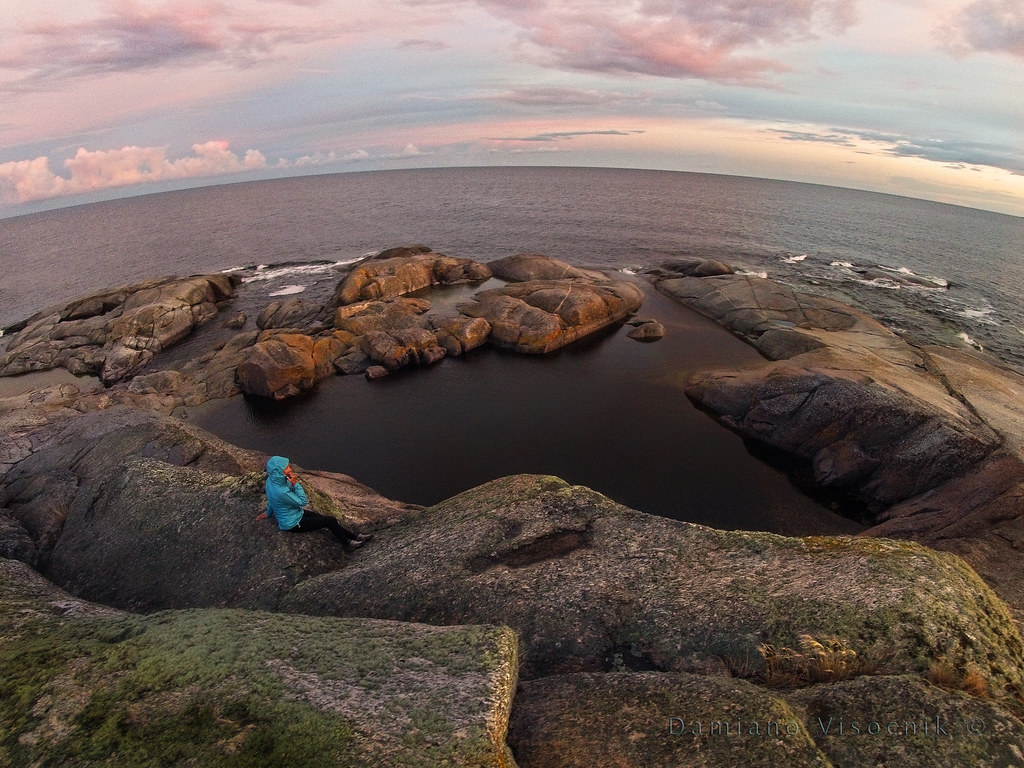
There is a place on the East Coast of Sweden, in the Baltic Sea, that I named “Magic Island”; I paddled to it on my recent Scandinavian sea kayak trip.
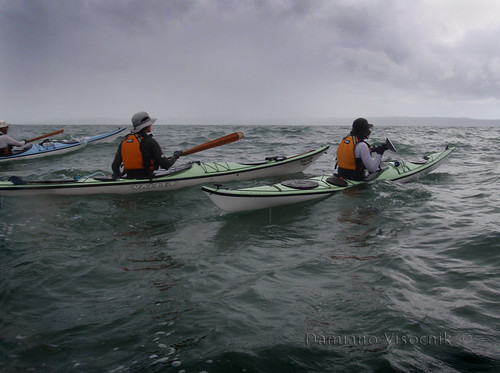
The seas were bumpy, created by the waves rebounding the rocky cliffs hitting the outer islands. I was paddling unprotected waters and the steady breeze from the preceding  days was sending a decent swell in my direction. My paddling companion Petra was a little concerned as her paddling experience was mostly limited to very different waters of land locked Austrian lakes; the last time she paddled salt water was in Pacific Ocean, Australia.
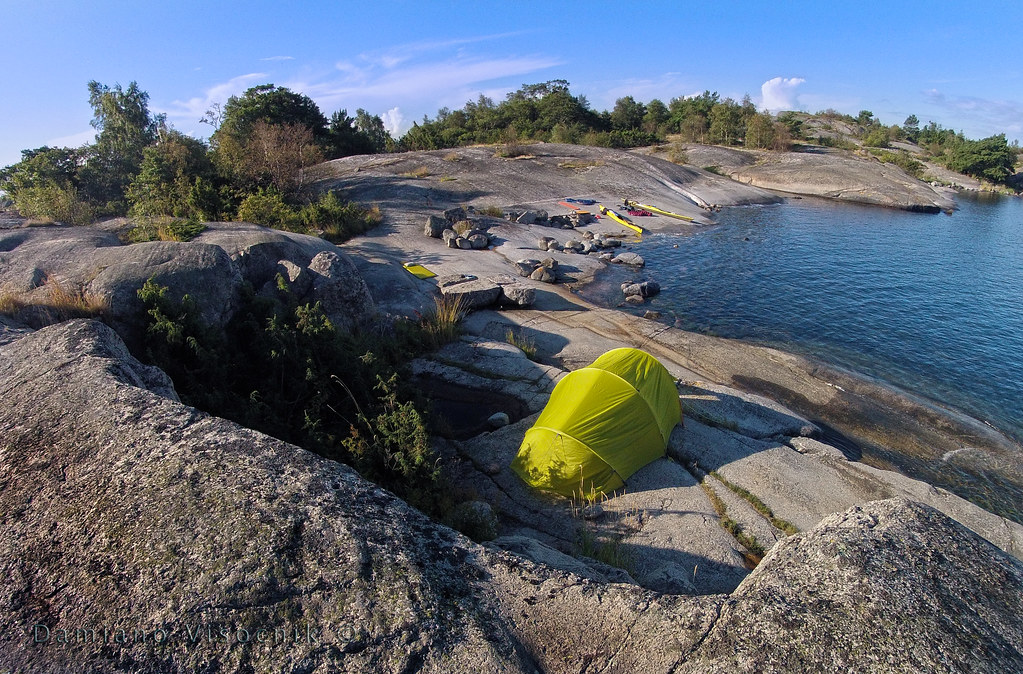
Rounding the South-East point still presented non land-able locations for a camp. The map showed a little cove but I was having a bit of trouble finding it; after all with 30.000 islands in the Stockholm archipelago alone I was now having doubts that I was in the right place… And suddenly there it was, as promised by my little map, a fantastic sheltered bay of polished granite.

Magic Is sunset_3

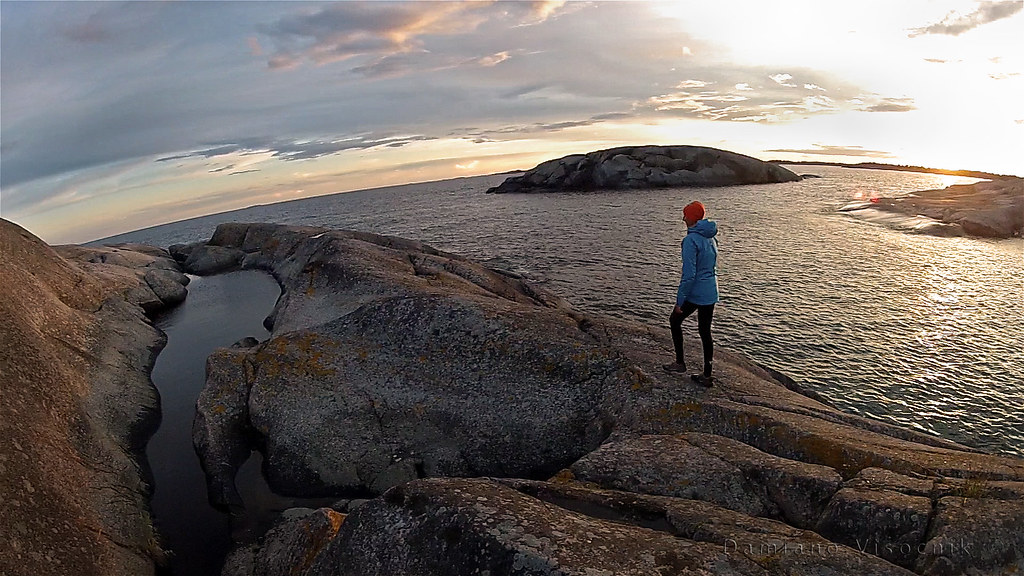
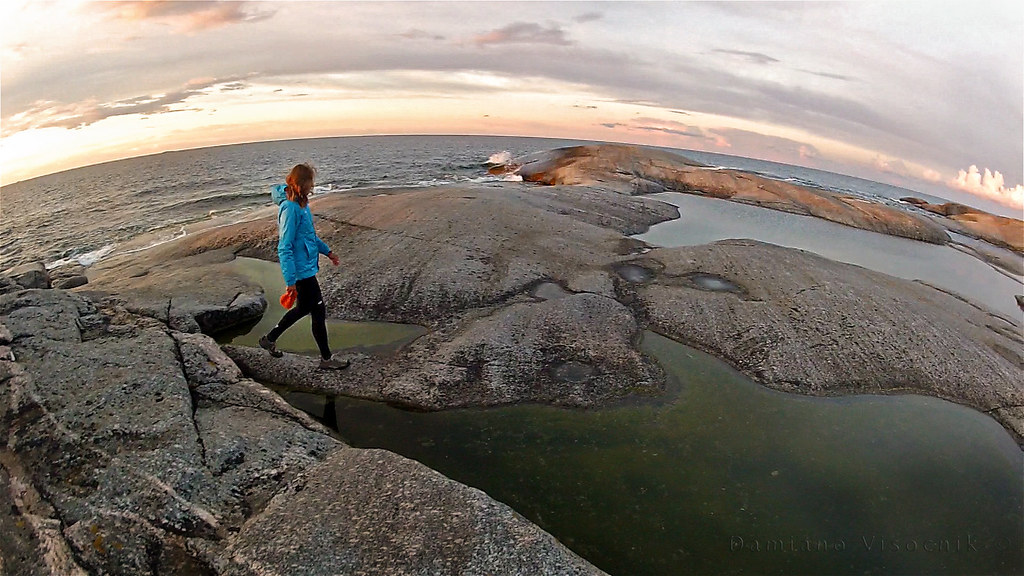
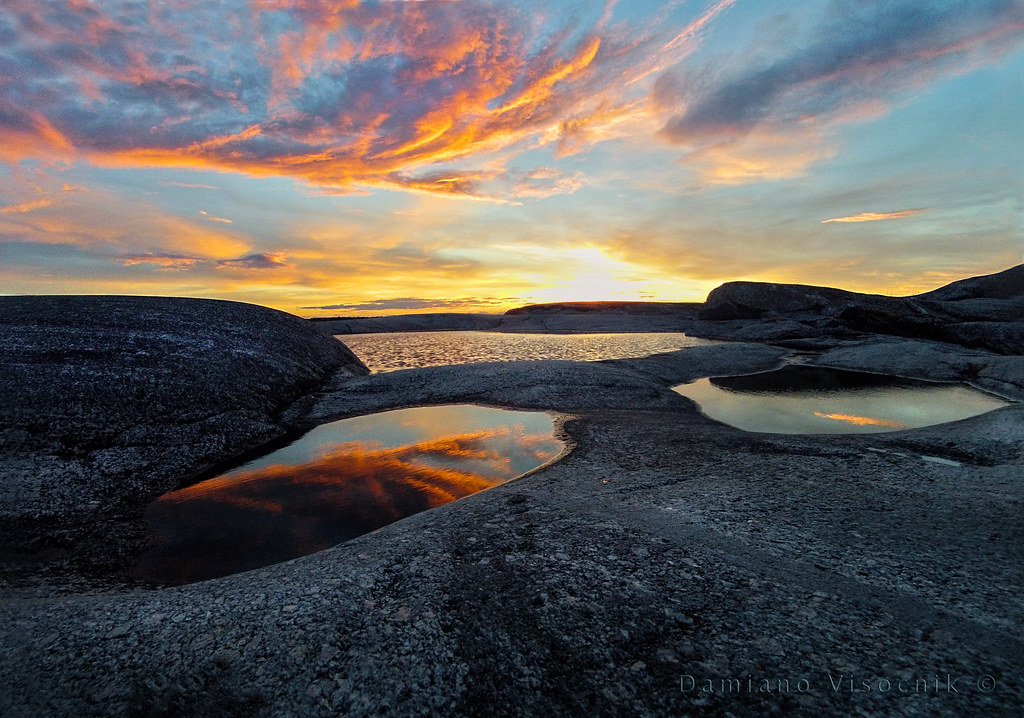
The action of the glacier of the last Ice Age some 11.000 years ago managed to shape this very hard granite into smooth rocky waves. The location of this island away from the mainland prevented a lot of vegetation from taking hold and the winter storms have dwarfed and shaped the small trees. The presence of this windy place was palpable; I felt exposed and vulnerable here. The skies turned to dark clouds and storms could be seen approaching.

Magic Is2_c

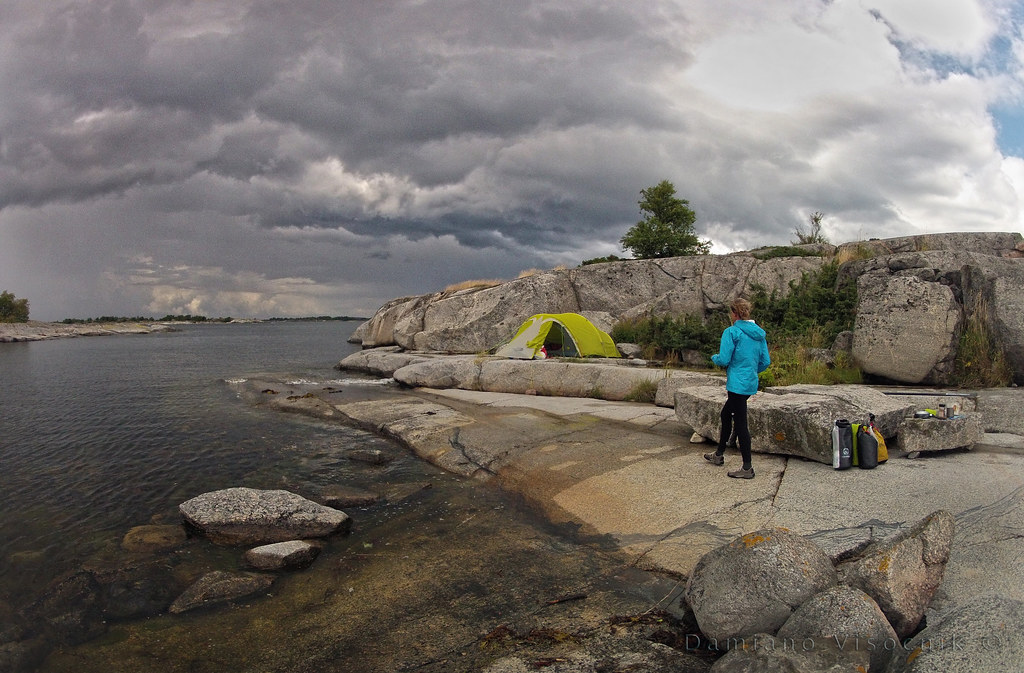
I climbed up a small rocky outcrop and could see lighting in the distance. The storm would be upon us soon and I made sure I secured our tent with extra guidelines anchored to the cracks in the granite. The wind came followed by a downpour and as we lay in the tent, I was glad that I was picky in selecting just the right tent site as small creeks ran down the smooth rocky slopes. We stayed dry and the tent proved to be solid. But as most summer thunderstorms this one did not last and eventually it passed leaving only a few puffy clouds around. The sun was getting lower and the magic hour was approaching (I borrow this term from my early inspirational photographer Galen Rowel. Galen describes the perfect time of the day to take photographs when the light is warm and the shadows long as magic hour). The rock was still wet but we wanted to see the sunset on the other side of the island, facing West.
We took a walk.

Magic Is sunset_4_c.Still002

Magic Is sunset_5_c

In Sweden, at such high latitudes, the sun sets later in the evening and the twilight lasts so much longer than at home in Australia; I did not have to rush to see the landscape in its best light but I could take my time to wonder around and pose to take it all in. Cold enough to wear a wind braking jacket I could feast with my eyes on the sensual soft shapes of granite waves sculpted by ice. A few birds were still trying to catch dinner before darkness fell and I kept on smiling, happy to be present in this magical place.

Magic Is sunset_3


Magic Is sunset_2

Video coming soon
.

14 May 2013

Photo: Landing before the storm

I am planning a trip to shores where the sun never sets.
Team members from 3 different countries will join me on a 3 week paddle in a place where granite meets the sea.

Landing before the storm_c
Photo: Tess Dodd/Adventuretess_used with permission
In the meantime I am honing my skills in my local pond (Moreton Bay) and enjoy the less crowded beaches that the colder weather brings.
I have been gathering information on the weather and coastal conditions and some locals may join me for part of my journey.
It is truly inspirational how these small boats can bring the spirit of adventure alive and create a sense of belonging to a community that goes beyond the "virtual friendship".

PS Thank you to my readers concerned about my lack of writing lately: all is good, I just have been busy :-)
.

27 November 2012

VIDEO: too windy

I believe in pushing myself in environments that are often outside my comfort level.
It is in conditions that test my skills and endurance that I gain a better understanding of my potential and abilities. I encourage others to do so too because I see it as the only thing that really improves a person's confidence, fast.
Lately I have been spending more and more time paddling in windy conditions because I feel that I greatly need to gain more skills in developed seas.
I used to dread a windy forecast; anything above 15 knots would make me reconsider my paddling plans. Now I look for winds that will oppose a tidal flow hoping for some waves that will mimic a tidal race. Bumpy is good.
Saturday's forecast was mild (up to 15 knots) but Sunday was shaping to have 25-35 knots wind against an ebbing tidal flow. I have paddled a few times there before and I knew that with onshore winds waves will form.
What I didn't know is that too much wind doesn't make for better fun.


I reefed my Code Zero Flat Earth sail to reduce it's surface knowing that a full square meter was going to be too much for me to handle.
Soon after I launched I was again glad to be paddling with a Greenland paddle remembering how much more wind effected my Euro paddles used to be in a stiff breeze.
My progress was a bit erratic and the strong wind kept on pushing my bow downwind. The British kayak I was paddling has proven a handful before I relocated the seat forward (to balance its trim for beam winds); this time her handling was really lousy. I wished I would have weighted the bow with ballast to release the stern a bit as I could barely turn my kayak around and paddle back out into the waves for another run.


I will take a weathercocking kayak over a "neutral" one any day. In a weathercocking one I can drop a bit of skeg; in a so called neutral, when the wind really blows, it suddenly becomes lee cocking, something I definitely DO NOT want.
My attempt at sailing was dismal: even with only half sail I could not get my kayak going and I quickly capsized. It was then that all the futzing with sculling training in clam conditions came handy as I managed to roll back up without having to wet exit in a rather tricky scenario. I packed the sail back on the deck and continued to just surf the messy waves.
After a few hours of battling with the wind I called it a day.
Getting the kayak back from the shore across the sandblasting beach with me leaning at a great angle into the wind, was another story.

.

15 October 2011

Weather: dodging bullets

Outings planned for the last two Saturdays had to be amended because the spring weather that has been rather erratic.
Usually a bit of wind or rain does not bother me but the recent thunderstorms have been intense, so I pay attention when they are forecasted.
Vanilla at Cape Byron_2 (c)

Lightening should be avoided when on the water since the tallest object often happens to be myself.
A carbon paddle is very conductive and, as pointed out to me by Paul at Northern Light, I did not want to become the guy who "Put another kayak on the barbie" (quoting Paul Hogan's Australiana).


A careful assessment of the forecast indicated that I had enough time for a quick outing to my favorite destination (Peel Island) and back in time before the afternoon storm.


Notice the sudden increase of wind speed!
I kept a watchful eye on the distant horizon to see if any mushroom clouds were forming but the storm only hit once I was back at home with kayaks stored in the shed :-)
A change in weather against the forecast would see me sit out the brief storm on the shore of the island to then resume my paddle once the storm had passed (it only lasted 1/2 hour).


.

17 February 2010

SAFETY: surviving a summer storm.

Nordkapp LV and Avocet LV(c)
As a leader (among peers) of sea kayak trips I have often pondered at scenarios that I might be involved in while paddling in a group.
I usually paddle with sea kayakers that have a minimum standard of proficiency (self rescue in mild conditions) and rarely with novices.

Some stretches of water involve crossings of semi protected waters (no ocean swell) of 15-20 Km.
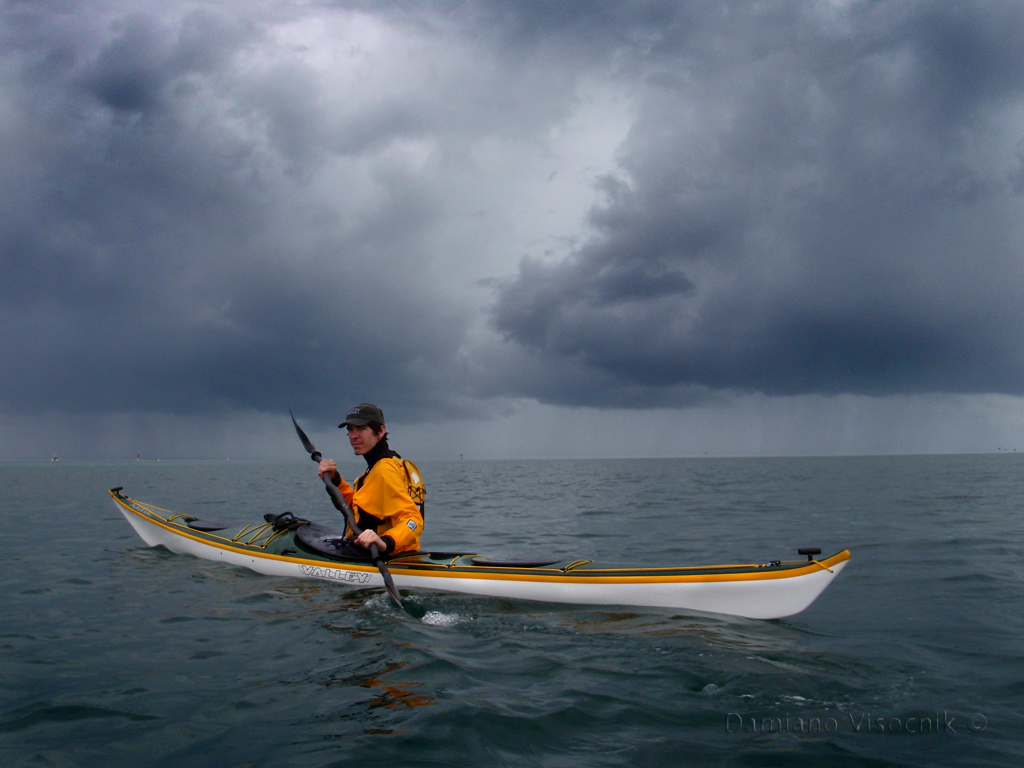
Living in a subtropical locale the possibility of sudden storms, occasionally violent, unexpected and usually brief is feasible.
While the weather forecast is religiously checked and observed before leaving shore, on multi day trips sometimes the only forecast available is via VHF radio bulletins on the morning schedule.
I have been caught out before on sudden changes of weather but luckily close enough to shore to make a hasty easy retreat.


hand towing kayaks to camp in 30+ knots wind
To better my skills and be able to handle unexpected though scenarios I sometimes seek conditions where I never see any other user on the water, let alone a kayaker.
Obviously in those conditions I chose an on-shore wind location where in case of trouble I can be blown back to safety in a short time.
paddling in 30 knots (c)
training with Greg Schwarz in 30 knots wind
In the unlikely but possible event that I should be caught out on the water in a group of 6-8 paddlers (too far from shore to be reached in time) what would be my best way to ride out a short storm (1 hour duration, for example) ?
I have asked this question on a couple of Forums and I got replies of limited value and some abusive ones too ("you should have checked the forecast", "paddle close to shore", "don't go out in bad weather" or "if you are that stupid to be out there in a storm is serves you right").

A local instructor replied to me:

click on image to enlarge
While stating the obvious, I really did not learn much from his comment.
Relying purely on the weather bureau's forecast is very shortsighted.
I believe that knowledge, skills and being prepared for the situation is my best defense.


windy conditions (1)
So I asked the question directly to highly regarded sea kayakers Nigel Dennis (of SKUK) Eric Soares (from the Tsunami Rangers) and Nigel Foster (of Nigel Foster kayaks):
"Since I believe that you have had a fair share of bad weather experience on the water, what is, in your opinion, the best way to ride out such event when paddling in a group of medium skilled paddlers?
Winds would not exceed 40 knots and waves would be of max 1.5 meter with probably braking tops.
I believe that rafting up would be hard and holding together dangerous? clipping the perimeter lines of the kayaks together to raft and leave the hands off the edge of the kayak?
I am open to suggestions"

Thankfully their replies were outstanding first hand knowledge of possible solutions for my sticky scenario.
Nigel Dennis replied:
-----
Hi Damiano,

Thanks for the e-mail. I am not sure there is a one answer. If it was me and I was caught out in strong winds with a group the best thing would be to run down wind. As the wind gets stronger this will become more and more your only option. The problem is that people will be at different levels. It will be very hard to keep the group together. Someone will need to lead from the front so they have a little control over the direction and speed of the group. Another will have to stay at the rear and be in charge of rescues. As the wind picks up you will have problem with people falling in. You can't afford for this to happen. Your only option left is to raft up. I would advise two small rafts rather than one big one but only if you have sufficient competent leaders to go in each group. Finally it would help if you used a small drogue on each raft or clipped helmets on tow lines to each raft. This will be difficult but it’s the only thing you can do. I have had to do this in the past.

Nigel
-----

sea kayaks in wind waves (2)
Eric, more specific to different levels of storm gravity and participants skill level, said:
-----
Greetings Damiano,
Here is my reply to your scenario.

1. Of course, all your friends are right who say "You shouldn't be there." Right. But as you said, you can't always forecast sudden squalls that only last an hour or so.

2. I do not recommend rafting up unless someone is very ill. The reason is as you said. Even in somewhat brisk conditions such as you describe, boats that are rafted bang together, which can hurt boaters and damage boats. It's especially risky to tie boats together, as they may get entangled, which can cause all sorts of problems, as you can imagine.

3. Form a diamond formation of four boats. If there are more than four boats, form more diamonds or parts of diamonds. A diamond formation has one boat in front, leading, another boat in the back, sweeping, and one boat on each side. Each keeps a safe distance from each other, about ten meters or so, so they don't bang into each other, but the paddlers can communicate and watch out for each other. Also, for your weaker paddlers, the formation provides a psychological structure so they feel safer and protected in a "pod". If there are say, two diamond formations, have one follow the other with the lead of the second diamond maintaining a distance of about ten meters or so behind the sweep of the first diamond.

4. From the diamond formation, (assuming the wind is 30-40 knots, w/seas below 2 meters in a semi-protected environment), FACE the wind directly and have everyone put their heads as low and forward (to reduce windage) as possible, so they are looking up to see forward. Arms (elbows especially) should be close into the body to reduce windage. This will give you a low physical profile so you are less effected by gusts and the strong prevailing wind. The leader should paddle just hard enough to make nominal forward movement, so slower paddlers can keep up. Do this for an hour until the squall passes, then resume your course. Facing the wind like this provides the most stable feel for inexperienced paddlers.

5. A formation variant: Should you have one or two truly weak paddlers, make a column formation, either by itself, or within the diamond. A column formation is a straight line. The weak paddlers draft on the strong lead paddler, so their workload is reduced.

7. Another solution: Should you have all strong paddlers, just continue on course with the wind at your flank in a diamond formation and ignore the beam seas, while doing correction strokes as needed. Or, turn with the wind, fan out (row formation), so you don't run into each other, and run with the wind for the storm's duration, then turn back toward your destination, assuming it's to the side and not behind you! These two solutions are preferred, if your paddlers are strong and bold. This is what we do!

8. If someone is unable to stay up for any reason, have a diamond of four or five paddlers raft up, all facing the same direction (ideally, into the wind and swells). Put the weakest paddlers in the middle and the two best on the outside. Hold the boats together tightly by placing paddles on your laps, with the blades extended to the boater next to you, so he can grab your paddle. Everyone holds onto the paddles, and that keeps the boats (roughly) in place, with everyone pressing toward the center.

9. These solutions to this scenario should be rehearsed, first in mild conditions, then in rough conditions--but near shore!

Happy paddling!
Eric
-----
when it rains it pours (c)
Vanilla practising in 30 knots wind (according to BOM records)

Nigel Foster addresses the training for the unexpected.
Only by being prepared and having trained in harsher conditions will give me the chance to survive a possible storm.

>>
Hi Damiano,Thanks for your patience. Recovered thanks and back on the water... and last weekend running kayak incident management courses.
Re your questions; If I could start with the concept; "fail to prepare; prepare to fail" and suggest that for the individual paddler who faces a real possibility of encountering certain conditions on open water, then the best advice is preparation. If you want to know what it's like to control your kayak in strong winds, then practice in strong winds in a safe place (such as just a short distance from shore when the wind will quickly blow you to shore if you get out of control)
If you can paddle circles or figure-of-eights in the wind, can edge and brace for balance against a side wind and make forward progress in all directions... then you are in a better position to meet similar conditions unexpectedly while on a trip or on a crossing. It's neither safe nor as much fun for the individual or the leader to play Russian Roulette on open water, knowing that there's a good chance of meeting conditions that group members have never experienced even closer to shore. But... it's really fun to learn techniques in a safe place in wild conditions that get close to or exceed your experience and current ability, especially if you're doing it with paddlers who know what to do and can offer help and advice. It makes you a better paddler.

Ideally each paddler should be confident and able to rescue others, and to perform self-rescues in conditions they might expect on any trip they choose to go on. Ideally that means practicing in similar conditions in a safer place before signing on for an open water trip where those conditions are a possibility.
What do paddlers generally find easiest? Heading straight into the wind until it reaches a certain strength... ( beyond that wind strength the kayak will prefer to be sideways to the wind.) So in the first instance, paddling against the wind through a squall will offer more ease of control for individuals, and therefore more safety so long as they can keep together as a group.
So a good practice session might include heading out from a safe shore against the wind to a nearby anchored float and paddling steadily to remain as close as possible to the float for the duration of a violent squall. Try it with a small group and try it with a larger group. If anyone gets tired, they'll be blown onto the safe beach behind.

Another useful practice session in similar conditions is to paddle a figure-of-eight path around two anchored floats. (Anchored floats can be as simple as a plastic bottle on a line anchored with a brick.) It gives practice in turning in every direction to the wind and shows how effectively you can control the kayak in that strength of wind. The more practice, usually the quicker and more effectively you can do it without getting blown onto the beach.

Other skills that are useful? Techniques for balancing while looking behind at fixed objects or other paddlers, the ability to slow down your paddling pace to match someone else's pace, the ability to turn your kayak around and position yourself to rescue someone in the conditions... and practicing anchored rescues in those conditions, which require positioning skill, tow-line skills and rescue skills... and awareness of what happens if you let go of your kayak... again practice in a safe place first.

Finally, in wind, communication gets more difficult. Practice using eye contact and head gestures rather than shouting, and keeping close as a group. Then... the squalls on open water become a treat rather than a potential hazard, and if someone capsizes, your role becomes one of making use of the situation as a useful practice session for everyone, rather than it falling on you to perform the rescue. Hope these comments help! Get back to me if you need to, and have fun out there!

nigel


There you have it.
I very much value their advice that will help me to become a more prepared leader with wiser knowledge.
Please feel free to comment on their advice and if you have anything to add, my readers would love to hear from you.

PS AUG10: a very informative discussion thread on QajaqUSA forum here.

1,2 published under Creative Commons license


08 February 2010

TRIP: when it rains it pours

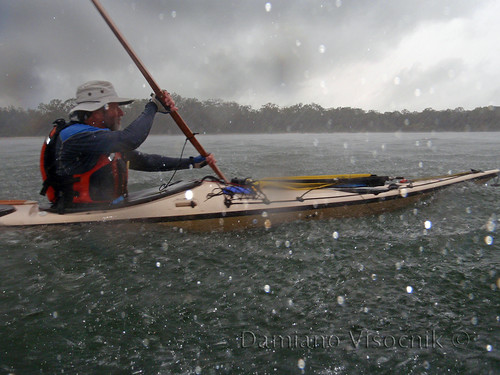
Just some fun pictures of paddling in a squall.
Full trip report by Adveturetess: here

Vansticking in the squall (c)

when it rains it pours (c)
30 knots headwind, great conditions for traditional paddles which are not affected by wind

12 October 2009

British kayaks, British weather?

The forecast was calling for possible thundery showers but I have to say that most times the weather bureau can't get it right; there are just too many variables to be able to predict the precipitation with pin point accuracy.
The wind however was going to be light and admittedly forecasting wind seems to be more accurate than rain.
Sunday paddle (c)
Morning started nice and sunny with only patchy clouds but by the time we reached our destination island 14 Km away the clouds have rolled in and prevented us to have a pic nic on the grassy shores.
The rain made us scurry for a tinned roof shelter and we quickly changed into our spare clothing trying to get warm.
The rain started to bucket and, while waiting to ease off for a quick dash to the "fish'n chips" shop just up the road, the water pouring from the field formed a stream big enough to wash one of our beached kayaks back into the sea!
We looked at our fleet of kayaks on the beach and then it dawned on us: we were all (bar one) using skegged boats, most of British origin, a couple of British style.
Steve in Nordlow (c)
Was it that such a concentration of "British boats" could cause the proverbial British weather?
I don't believe in superstition but it was an odd coincidence :-)

Funny enough though we all seemed to enjoy the weather.
On the return leg (now raining steadily) we were all smiles.
Being warmly dressed made us enjoy the situation.
heading into the squall_2 (c)
Living in Queensland we opt way too often to chuck in the sponge if the weather is not picture perfect since we can just avoid those rare rainy days and pick most other times to head outside.
What some might have viewed as "terrible conditions" became on opportunity to observe the large water droplets that created the peculiar divots into the water surface.
It looked like somebody had spilled a bag of pearls and now they were bouncing on the sea.
Needless to say we were the only "fools" to be out in such "miserable" conditions.

PS: to my cold weather climate readers: it was a still balmy 20C and not that gnarly anyway. Reed Aquatherm or a light spray jacket was all that we needed...