Showing posts with label injury prevention. Show all posts

04 January 2013

REVIEW: Buff water gloves

The brutal Queensland sun is a killer; it causes an incredible number of cases of skin cancers.
Protecting my body from the harsh sun is imperative for me. When kayaking I cover my body with a long sleeve rash guard, my head with a wide brim hat and the rest of the exposed skin with SFP 50 sunscreen lotion.
My hands tend to get very wet when paddling since there are no drips rings on my Greenland paddle; sunscreen would wash off too soon and gloves are my best defence against the sun.
In the search for the best gloves for paddling for years I used several brands of sailing gloves.
Some half fingers styles did not work for me where the fabric would bunch under my thumb and cause blisters. I also find sailing gloves too bulky with all that padding in the palm of the hand; they are designed to handle ropes (sheets) where padding is desirable to prevent rope burn.
As most of my sailing gloves started to fall apart after a year of regular paddling, I really wanted thin gloves, with no padding, that were durable.
Then I stumbled upon a different offering from a company famous for their head/face scarfs: Buff.
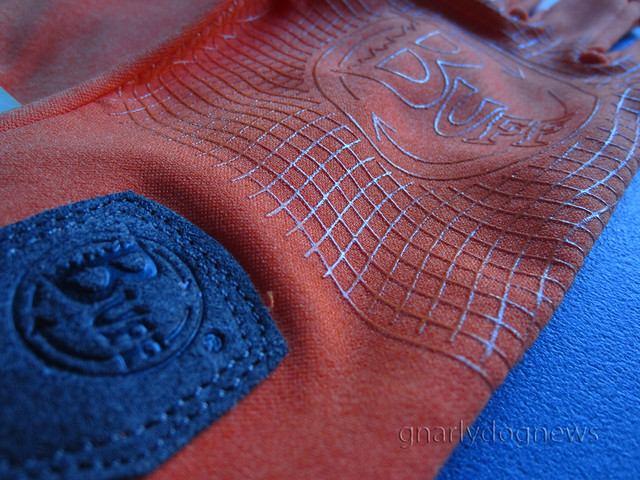
Buff water glove silicon detail_c
silicon texture detail on the palm
In their line they have a glove mainly designed for fishing where protection from the sun is the key.
I ordered a pair a year ago and initially I was dubious about the durability of the product; the thick Lycra style fabric was not convincing me as I thought that they would not last long, similarly to my cycling gloves.
Surprisingly however the gloves are outstanding.
The lack of bulk allows me to grip my paddle easier with no bunching-up in the palm of the hand.

Buff water glove palm_c

Furthermore the palm has a grid of textured silicon that gently grips the paddle. Without gloves some of my carbon Greenland paddles would occasionally slip forcing me to have a dead grip to keep them in my hand. With the Buff gloves the paddle feels more secure and after a year the silicon is still in place and doing its job.
The very long cuff allows me to create a decent overlap at my wrist between glove and rashie, something that the sailing glove did not. I no longer have funny looking sun-burned strips around my wrists that I am sure some folk thought were caused by some "kinky" bedroom games :-)
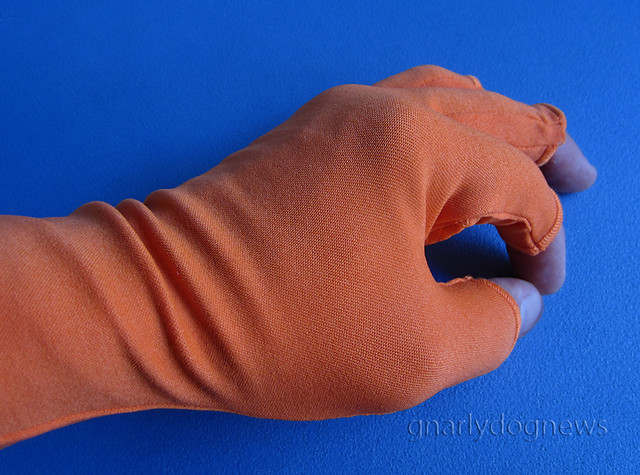
Buff water glove_c

The stitching is superb and nothing has failed after a year of paddling.
Where occasionally I used to stitch-up my other gloves on the sewing machine, the Buff gloves have not failed.
Originally I ordered a size L-XL for my hands but I always felt that the gloves were just a bit too loose, so I got myself a Xmas present and ordered some "safety" orange new ones in M-L that fit me like a, ... doh, glove.

Buff glove_c

This product review is independent, unsolicited and unrenumerated. No swag, no perks, no glory.
Bought the gloves on eBay from Utah, USA.

26 June 2012

TECHNIQUE: Greenland paddles used in all conditions

.
The popularity of Greenland paddles has been growing rapidly. I no longer feel like being the "ugly duckling" when I meet other paddlers on the water and while there is still some disdain in certain circles the majority of the paddlers are accepting GPs as an alternative style to the high angle big blade Euro paddling.
But like all things that are different and don't conform to the status quo, they attract resistance by the old school masters. Ironically Greenland paddles are one of the oldest forms of paddles, it's just that modern materials have allowed for advancements in paddle design that led to short and wide blades that then became the norm and the old form was nearly forgotten (even tho short and wide was not unknown, just not as popular as in modern times).
The renessaince of the Greenland paddle would seem to be driven by nostalgia and would appeal to sea kayakers that work with timber and like to make their own equipment.
And that is true for the vast majority of the Greenland paddlers.

As Greenland paddles excel for rolling and plenty of paddlers practice the art of rolling with GPs, they are often also associated with paddling in calm conditions where an easy steady pace to cover distance is often sufficient and matches the speed of Euro paddling.
But things change when we talk about dynamic waters.
A lot of paddlers shake their heads when I suggest that the GP is a very useful and powerful paddle in the textured waters. Surely there is a difference between the skinny stick and the fat blade, is their argument.
Yes, there is an undeniable difference between the "big water" short blade of white water inspired sea kayak paddle and the distributed surface of a GP.
I would like to emphasize the "distributed"
A lot of Greenland paddles have a surface area that is similar to touring Euro paddles. Yep, if one measures the whole blade of the GP the numbers add up. If the GP is on the long side (230cm+)the surface area is actually surprising large and can exceed the widest Euro paddles, however I find no need to have an extra wide or long GP for playing in dynamic waters. A typical cruising GP stroke is a low angle one where often just a portion of the blade is inserted into the water.
That is actually all is needed to cruise in a sea kayak: very little effort in propelling that hull in the water.
If one wants to then push the kayak and get close to hull speed more energy is required. While the common conception is that one has to paddle "faster" (higher cadence) to go faster with a GP I tend to change the angle of insertion of the blade into the water.
Once my stroke angle becomes higher I can deliver more blade into the water (more surface) and I have more resistance (less "slipping" back of the paddle) to apply more energy to my stroke. I can travel just as fast with a GP than with a EP.
So how does that translate to dynamic water paddling?


James Manke using a Greenland paddle (Northern Light) in all comditions
I use a higher angle when paddling in the surf zone, where I want a faster acceleration with my kayak; more blade enters the water allowing me to have more grunt.
Of course, water being a fluid substance, will flow around the skinny GP easier than a fat EP and while the difference is noticeable is not impossible to overcome. It is at this moment that I apply a higher cadence to achieve the desired initial propulsion in my kayak.
I think of it as driving a smaller engine car that is delivering the desired power by revving higher than a big block V8; the feel is different but the results similar.
So, in the surf zone where acceleration is really needed I have a higher angle and a higher cadence.
It is a short burst that is needed to get me gliding along with the energy of the wave.


The biggest benefit I find in a GP is the gentle support that it offers in a high brace.
As I surf along the wave I often broach, where my kayak is suddenly in line with the wave and getting pushed along sideways. If I don't want to get tipped I use a high brace to stabilize myself, like an outrigger.
As the waves can be occasionally powerful when I broach, the paddle in a high brace position tends to get elevated to the surface of the water. I feel that with a Greenland paddle that force is never as strong as with a wide bladed EP where a high position of my elbow could risk getting me a dislocated shoulder.
I seem to be able to contain that force and try to keep my arm in a much safer location.
Few can demonstrate the validity of the of the GP as an all rounder paddle better than Warren Williamson can in this video of extremely fast and turbulent waters of Deception Pass in WA, USA.


And while the current record of paddling around Vancouver Island is held by Joe O'Blenis with a Greenland paddle, we even have the Brits joining in the retro revolution with paddling around their big island .

.

01 June 2012

GEAR: the kayak sled by Hybrid

I busted my back lifting a kayak to my shoulders and carrying it to the beach.
X-rays revealed some spinal degeneration that apparently is caused by an accumulation of accidents.

The quack asked me:   "Have you had any falls on your back in your past, even as a child?"
Me:   "About one a year, if not more..."

The back injury is probably a manifestation of a life full of crashes on skis, motorcycles, mountain bikes and who knows what other back blows that I used to just shrug off when occurring. They are now catching up with me :-(
I am also sure that my current sedentary lifestyle (desk jockey) and lack of regular exercise during the week contribute to my now bad back. What bugs me is that I can't carry my kayak solo on my shoulders and look macho, even though I feel some of my kayaks are not exactly ultra light.
So, my back got bad again schlepping my boat across a bank of sand onto shore and into a back yard. Not a  long distance but long enough to compress my spine out of whack; I need a trolley even for that short of a stretch.
The kayak carts I have are bulkier than I would like; they also have wheels.
Wheels and the shallow small lagoon I have to cross don't mix: the axle would clog up and the bearing would suffer.
I then remembered attending a presentation at a kayak fest (NSWSKC Rock&Roll in 2009) where a kayak designer showcased a "sled" that required no wheels.


Hybrid kayak sled presented at Rock&Roll 2009
I needed something like that.
I contacted Andre Janecki, the brilliant designer behind the Hybrid 550 sea kayak and founder of the Hybrid Foundation. Andre has been tinkering and inventing all his life; his expertise spans from architecture to industrial design, including his passion for sea kayaking.
Andre is also a philanthropist seeking funds for producing a sea kayak that will enable wheel-chair bound paddlers to access the water unassisted, in a kayak. (More info here)

I asked Andre for details on the "sled" and he immediately offered to help sending me a new sample that he showcased a few years back.
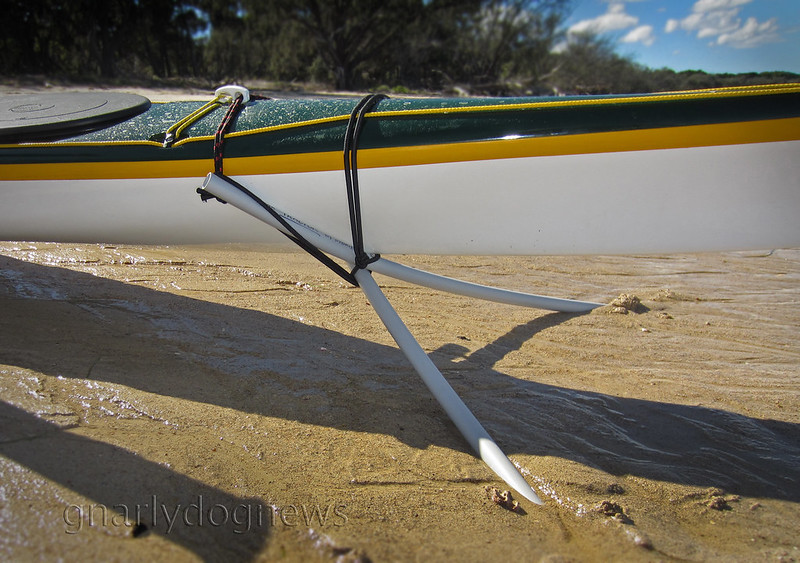
Here is the "Kayak Sled"

sled mounted_c
Mounted on the stern, the bungee cords are not essential to the operation of the sled
Simple in design the sled is a good alternative to wheels, providing it doesn't get dragged over pavement too much. I would like to quote A. Einstein: "Anything should be made as simple as possible, but not simpler"
It weights slightly more than a water bottle and takes almost no space inside the hatch, when folded.
It doesn't rust and costs so little to fabricate that even the kayaker on the tightest budget can afford.


Adventuretess testing the Hybrid Kayak Sled
While they are easy to replicate, Andre Janecki holds the copyright to the design. He is happy to share his invention with all paddlers who donate $25 into the Hybrid Foundation account.
Chasing up individuals that want to forego his request is not his intention but I am sure he would have a legal team onto a commercial operation trying to swipe his idea.
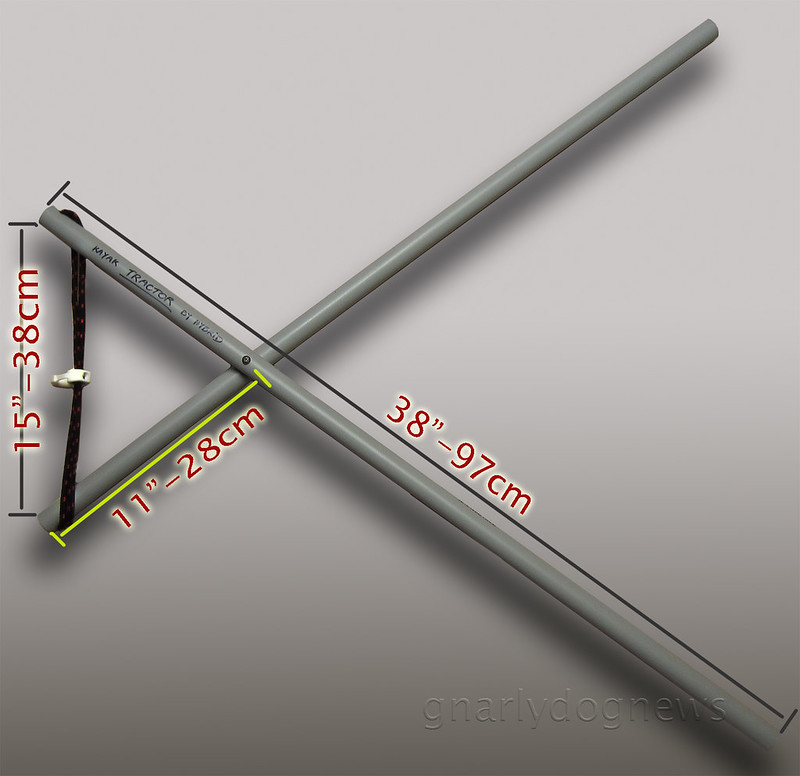
For exact dimensions and details, please email Andre Janecki and support his project.

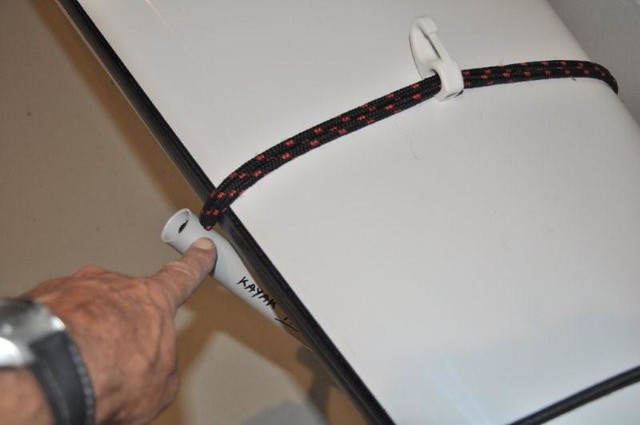
Included are a few shots of the   "Kayak Sled" showing general proportion as well as some details of the design.
Hybrid kayak sled_2
The double (or single) rope (shown with the white plastic hook) should be securely clipped to the deck fitting/s
The 316 Stainless Steel screw is 60mm long x 5mm thick and the nut is the nylon-lock type.
The PVC tubes are standard stock size 25mm  O/D diameter, sourced from an electrical/plumbing supplier.
Kayak sled_1
The Hybrid kayak sled folded
The 25mm tubes are further stiffened with the 20mm inner tubes. Please note: the inner tubes run top and across to approx. 2/3rd length only. This configuration assists with bending and distributing the load as much as possible.
CSC_6166
IMPORTANT: the cord exit point from the PVC tube should be against the hull

P.S. Of course, the cheap PVC tubes have only a very limited carry load capacity.
Andre informs me that the commercial version will use very different materials, including a custom made cross section, etc.

.

06 March 2012

Kayaker's Ear - L'orecchio del Kayaker

A first for Gnarlydog News, here is a bilingual guest post from Marco Ferrario, a Gnarlydog News reader.
The English text is in YELLOW, the Italian text (original) is in GREEN.
Questa e` la prima pubblicazione di Gnarlydog News bilingue, cortesia di Marco Ferrario.
Il testo in VERDE e` in Italiano

KAYAKER’S EAR – L’ORECCHIO DEL KAYAKER
Rolling and tinnitus - Eskimo ed acufene


Il kayaker appassionato di rolling (eskimo) è un soggetto a rischio di acufene (tinnitus)?
Forse molti kayakers si chiederanno cosa centrano gli acufeni con il kayak da mare, ebbene ...


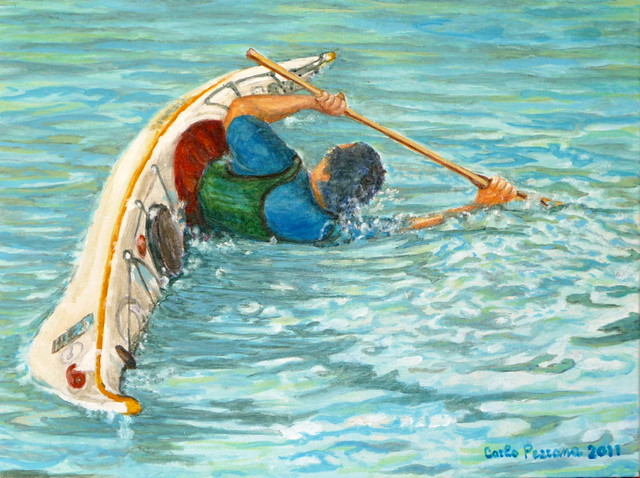
Eschimo - KayArt - quadro
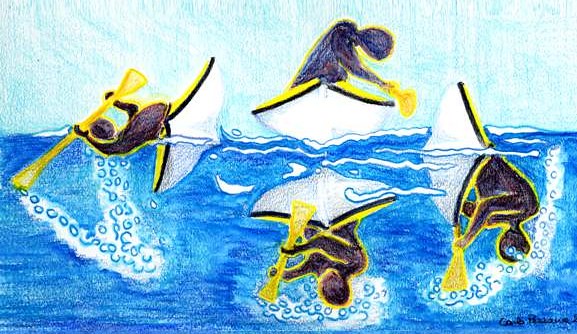
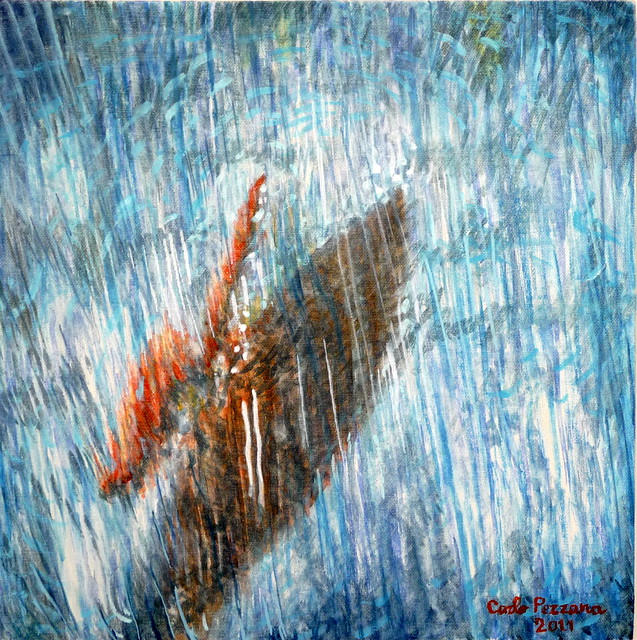
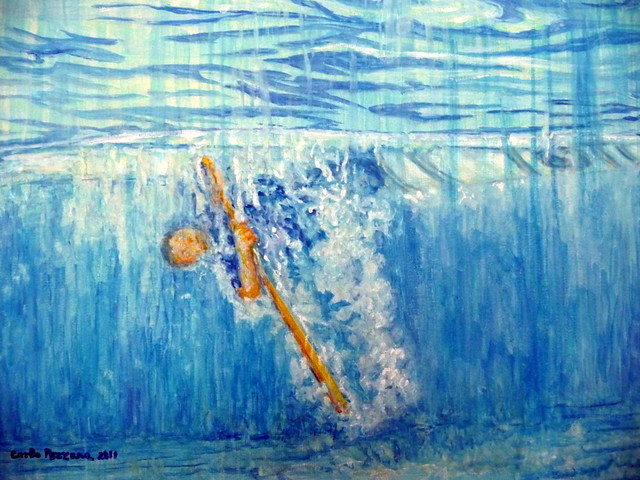
Image of KayArt - di Carlo Pezzana (http:/www.kayart.it)
Nel 1996 feci il mio primo corso di eskimo (rolling) in piscina.
Dopo le prime lezioni iniziai ad eseguire stentatamente i primi miei eskimo senza l’aiuto dell’istruttore.
Con soddisfazione avevo compiuto i primi passi verso questa divertente tecnica di auto-salvataggio.
Negli anni seguenti, provai più volte ad eseguire l’eschimo in mare, ma non sempre con successo , la mia esecuzione era ancora scadente.
Così, nell’inverno 2001-2002, per migliorarmi, tornai in piscina, che era a disposizione dei kayakers per una sera a settimana, per un paio d’ore.
Il divertimento e la soddisfazione nell'eseguire la manovra dell'eskimo, mi spingeva a provare e riprovare molte volte, continuativamente.
Per eseguire l’eskimo (rolling), dalla posizione seduta in kayak, si entra in acqua su un fianco, eseguendo un “piccolo tuffo” laterale, impattando contro la superficie dell’acqua.
Sequenza continua eskimo
Image of KayArt - di Carlo Pezzana  (http://www.kayart.it)
 The kayaker keen on rolling (Eskimo) is a subject at risk of tinnitus?
Perhaps many will wonder what kayakers and tinnitus have in common with  sea kayaking; well ...
In 1996 I took my first kayak rolling course in the pool.
After the first lessons I started to run my first haltingly roll without the help of the instructor.
With satisfaction I had taken the first steps towards this fun technique of self-rescue.
In the following years, 
I tried several times to roll at sea but not always successfully, my
performance was still poor.
Thus, in the winter of 2001-2002, to improve myself, I returned to the pool, which was available to kayakers one night a week, for a couple of hours. The fun and satisfaction in performing a roll pushed me to try again and again many times, continuously. To perform a roll, while sitting in a kayak, you enter the water on one side, performing a "little side dive", impacting against the surface of the water.

Il mio corpo entrava ed usciva dall'acqua e, una volta sott’acqua, rimanevo per alcuni secondi a testa
capovolta, prima di completare l’eskimo. Il fastidio dell’acqua nelle orecchie e nel naso era sopportabile, perciò non utilizzavo tappi per le orecchie e alcune volte non mettevo neanche la molletta per chiudere il naso. All’uscita dalla piscina, con la testa forse ancora un poco umida, percepivo tutto il gelo della serata invernale con temperature inferiori agli 0° centigradi e spesso avevo la sensazione di avere le orecchie chiuse e piene d'acqua. A volte l’udito, per i primi minuti, era ovattato e rimbombante, poi le orecchie si stappavano e il problema si risolveva, perciò non ho mai dato molta importanza a questo disturbo passeggero. 
Una sera, tornato a casa, non riuscii più a liberarmi della sensazione di acqua nelle orecchie.
Scuotevo la testa e mi schiaffeggiavo le tempie, ma nulla, le orecchie rimanevano tappate e persisteva la sensazione di avere ancora acqua nel loro interno.
In questa condizione rimasi per alcuni giorni, passati i quali, iniziai a percepire un miglioramento, l'orecchio si stava finalmente liberando dall'acqua, ma, alla sensazione di essersi liberati, si sostitui presto un costante piccolo fruscio. Inizialmente la sensazione fu che il fruscio provenisse dall’ambiente, ma presto mi resi conto che proveniva dalle mie orecchie.
Avevo l’impressione che un insetto sia entrato nel mio condotto uditivo e, sbattendo disperatamente le ali, non riusciva più ad uscire.
Da allora, l'alta tonalità dell'acufene non mi ha più lasciato, lo sento sempre, costantemente e, nel tempo,
è aumentata l'intensità del rumore percepito.
Lo sento nelle orecchie ma sembra che si estenda anche nella parte alta del cervello.

My body would enter and exit from the water, and once under water, woudl remaini for a few seconds head
upside down, before completing the roll. The discomfort of the water in the ears and nose was bearable, so I did not use ear plugs and sometimes would not even put on the clip to close the nose.
Walking away from the pool, my head maybe a little wet, I felt every chill of winter evening with temperatures below 0 ° Celsius often feeling my ears closed and full of water. Sometimes the hearing, for the first few minutes, was muffled, rumbling, then the ears uncorked, and the problem was solved; so I never gave much importance to this passing discomfort. One evening, returning home, I could no longer get rid of the feeling of water in the ears. I shook my head and tapped the sides, but nothing: the ears remained plugged and the persisting feeling of having more water in them.
I remained for several days in this condition, after which I began to feel an improvement: the ear
was finally releasing the water. But the feeling of getting rid of it was soon replaced by a constant
small noise, sensing that initially the noise came from the environment, instead I soon realized
it came from my ears. I had the impression that an insect has entered into my ear canal and, flapping frantically its wings, could not get out.
Since then, the high-pitched tinnitus hast never left me, I always hear it, constantly, and over time has increased in the intensity of perceived noise.
I feel it in my ears but it seems that it also extends into the upper part of the brain
.

Mi sottoposi ad una sequenza di visite in centri specialistici otorinolaringoiatrici e audiologici, i medici mi prescrissero diversi esami, che feci regolarmente, ma che non mi permisero di capire come intervenire per risolvere il mio disturbo. Gli esami esclusero determinate patologie.
Più specialisti contattavo e più mi convincevo che nessuno poteva offrirmi una soluzione certa.
La risonanza magnetica e la Tac esclusero problematiche ancora più serie.
Feci anche qualche tentativo di cura, ma senza successo, perciò mi rassegnai, sforzandomi di convivere con questo fastidioso rumore.
.Quadro Eschimo - KayArt
Image of KayArt - di Carlo Pezzana  (http://www.kayart.it)
Sono trascorsi ormai molti anni, il suono dell'acufene è aumentato rispetto al periodo iniziale e si è anche
differenziato arricchendosi di nuove tonalità, sempre molto acute.
A volte assomiglia ad uno scroscio d'acqua, come fosse un rubinetto aperto, altre volte è un suono a metà strada tra una sirena e un fischio e l’impressione è che il timpano stia vibrando in continuazione.
L'udito ne risente sempre più (ipoacusia), come anche lo stress conseguente.
In questi anni mi sono informato e ho avuto modo di constatare che tra i soggetti più frequentemente a rischio d’acufene, c'è chi pratica sport acquatici o li ha praticati in passato, perciò i surfisti, i nuotatori, i tuffatori, chi pratica bodybording, kitesurf e chi, facendo immersioni, ha accusato problemi di compensazione.
Kayakers fluviali, hanno iniziato a soffrire di acufeni dopo un bagno in acque fredde, anche se indossavano il casco, che attutisce l'impatto con l'acqua. 
A chi gli acufeni sono passati, ho l'impressione che sia stata più una casualità, piuttosto che una specifica cura. La maggioranza di chi ne soffre, ha imparato, necessariamente, a convivere con questi rumori persistenti.


Eskimo KayArt Quadro
Imagee of KayArt - di Carlo Pezzana  (http://www.kayart.it)
I started a sequence of visits to specialist centers and ENT doctors prescribed me different
exams, which I did regularly, but that did not allow me to understand how to intervene to solve my trouble. exams
ruled out certain diseases.
The more specialist I contacted the more I was convinced  that no one could offer a reliable solution.
MRI and CAT scan ruled out more serious problems.
I also made some attempts to cure, but without success, so I resigned myself, trying to live with
this annoying noise.
It has been many years; the sound of tinnitus has increased compared to the initial period and it is also
differentiated enriched with new shades, always very acute.
At times resembling a roar of water, like a tap running, other times it sounds somewhere between a siren and a whistle, and the impression is like that the eardrum is vibrating constantly.
My hearing is affected (hearing loss), as well as the resulting stress.
All these years that I have gathered information and my observations have lead that among those most frequently at risk of tinnitus are those who practice water sports or practiced them in the past. So surfers, swimmers, divers, bodyboarders and kitesurfers, scuba diviners, lament Compensation Issues.
River kayakers began to suffer from tinnitus after a dunk in cold water, even if they wore a helmet, which dampens the impact with the water.
In those cases where the tinnitus is gone, I feel that it's been more of  chance, rather than a specific care.
The majority of sufferers have learned, by necessity, to live with these persistent noises.

C'è poi chi afferma di aver eliminato l'acufene dopo una terapia intensiva, durata diversi mesi, con un potente antiossidante ad azione neurotrofica. Altri dicono che si può provare con l'agopuntura. Alcuni hanno provato ad utilizzare, come palliativo, apparecchi acustici che rilasciano un suono mascheratore, che dovrebbe essere l'eguale-contrario al suono dell'acufene percepito e pertanto dovrebbe annullarne il rumore originario, ma tra chi ha adottato questi apparecchi, non conosco nessuno che ha veramente risolto definitivamente il problema. Un medico mi ha detto che in America è possibile intervenire chirurgicamente, ma l’intervento è molto costoso e rischioso, in quanto può provocare facilmente la perdita totale dell'udito. Una volta verificato che l'acufene non è un problema di cerume nell'orecchio e dopo e dopo aver fatto gli esami che escludono le cause extraotogene (cioè malattie che non dipendono dall'orecchio), i medici pensano che la causa del mio acufene sia dovuta a una deformazione o inspessimento o spostamento di un ossicino dell’orecchio, problema causato molto probabilmente da una esposizione all'acqua e, contemporaneamente, al freddo. Sta di fatto che nessun medico è in grado di garantirmi la guarigione, al punto che sono ormai dell'idea che non mi libererò mai più dall'acufene e credo che presto sarò costretto a cercare una soluzione per migliorare il mio udito, che nel tempo si è decisamente ridotto.

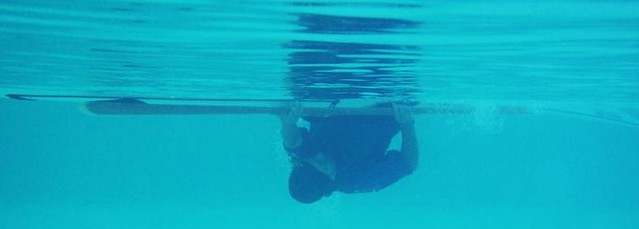
eskimo roll
Tatiana Cappucci rolling- (photo Duska Martina Minorello)
There are some who claim to have eliminated the tinnitus after an intensive period of several months, with a powerful neurotrophic with antioxidant action.
Others say to try acupuncture. Some have tried to use, as palliative care, hearing aids that emit a masking sound, which would be exact contrary to the perceived tinnitus sound, and therefore should cancel the original noise. Between those who adopted these devices, I do not know of anyone who has really solved definitely the problem. A doctor told me that in America you can perform surgery, but surgery is very expensive and risky as it can easily lead to total hearing loss.
Once I have verified that tinnitus was not a problem of earwax in the ear and after carring out many tests that would excluded external factors (ie diseases that do not depend on the ear), the doctors think that the cause of my tinnitus is due to a thickening, deformation or displacement of an ear bone, a problem most likely caused by the exposure to water and at the same time to cold.
The fact is that no doctor is able to guarantee me the healing, to the point that they are now of the idea that I will never rid myself from tinnitus and I think that soon I will be forced to seek a solution to improve my hearing, that over time has significantly reduced.


Che dire ancora?
Ecco qualche suggerimento, dettato dalla mia esperienza, nella speranza possa essere utile a prevenire
l'acufene negli appassionati di kayak e di eskimo (rolling).
Certezze non ne ho e non ho una cultura medica, ma, da kayaker, consiglierei di non eseguire l'eskimo senza dei buoni tappi nelle orecchie e una molletta stringi naso, per ottenere un sigillo totale. Orecchio e naso sono collegati e perciò l'acqua che entra dal naso raggiunge il timpano e l'orecchio medio, credo sia opportuno tappare entrambi.
Queste precauzioni sono tanto più importanti, quanto l’acqua e/o la temperatura esterna è fredda.
Le orecchie vanno protette anche in caso di forte vento e in particolare in caso di vento gelido.
Conoscere e confrontare le esperienze potrebbe essere molto utile.
E’ necessario sapere quali sono i rischi per le orecchie del kayaker, per prevenire l’acufene; e conoscere i rimedi efficaci, se esistono, per chi ne è affetto.
N.B. - quando pagaio, come quando sono molto concentrato a svolgere con passione qualche lavoro, pur essendo l'acufene sempre presente, non ci penso e lo percepisco meno, mentre ora che ne sto parlando, anzi scrivendo, raccontandolo, il tinnitus è fortissimo.

Un saluto con pagaia.
Marco
(Eko) http://ekokayak.wordpress.com
ekokayak@gmail.com 

What else can I say?
Here are some suggestions, derived from my experience in hope they will be useful to prevent
tinnitus in kayakers and rollers.
I don't have certainties or medical knowledge, however, as kayaker, I recommend not to roll without some good earplugs and a tight nose clip , to obtain a total seal. Ear and nose are connected and therefore the water that comes from the nose reaches the eardrum and middle ear, I believe both.must be stopped.
These precautions are even more important when water and /or the outisde temperature is cold.
The ears should be protected even in windy conditions, especially in freezing wind. To know and compare the experiences could be very useful. And 'need to know what are the risks to the ears of the kayaker to prevent tinnitus; and know the effective remedies, if any, for those affected.
NB - When I paddle, as when I am very passionately focused with a job, while the tinnitus being always present, and I do not think about it and I feel it less, but now that I'm talking about, even writing, describing it, tinnitus is very strong.


6727579069_97e0b7a3fe_b


photo by Marco Ferrario, publisher of Ekokayak on a trip in Sardegna


This article was translated with Google Translate with additional corrections.


24 February 2011

SHOP: retractable grab handle

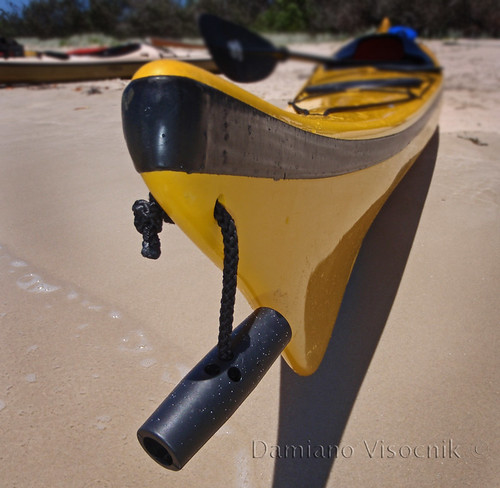
The latest addition to my fleet of kayaks needed a toggle handle to be repositioned since I deemed it to be attached in a dangerous location.
The kayak’s deck is designed to accommodate an optional rudder and the designer could not attach the grab handle at the stern of the kayak since it would interfere with the rudder.
I have previously detailed the reasons why I regard some grab handles and its position on some kayaks dangerous. After a few pinched fingers and a bruised knuckles I now like to have all of my handles attached at the ends of my boats.
I believe that the best handle on a kayak is the single cord (not a loop) one from SKUK (Nigel Dennis).
SKUK grabhandle (c)
handle on SKUK Exporer
While some argue that it is not as easy to use in an emergency towing situation (no loop for a carabiner to be attached to) I prefer that type of set up to prevent injuring my fingers.
One thing that I don't like is the banging that the handles produces when the kayak is paddled in textured waters. Some other set ups (like Valley kayaks) have a bungee cord tensioning the handle back onto the deck which stops the annoying banging.
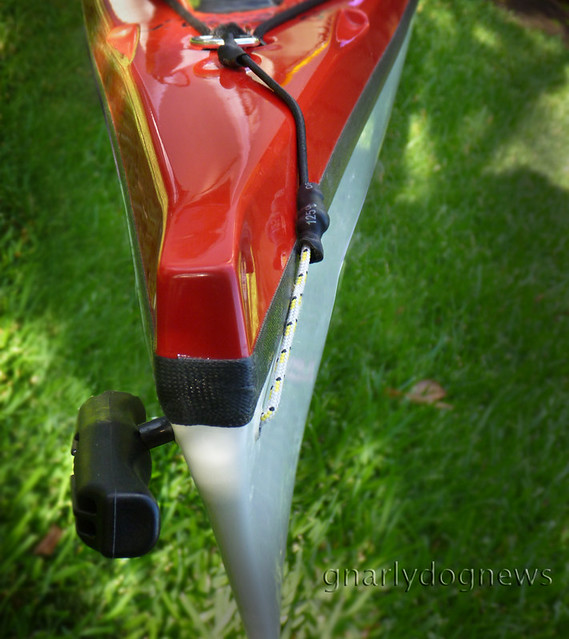
Then it dawned on me: why not combine the two? Why not tension the single line?
retractable handle_3
the handle was originally attached on top of the deck
While simple in concept the details of the execution and the quality of materials for this handle set up must be first rate.
I used a sheeted Dyneema core 4 mm line for the cord and quality bungee cord for the retracting/tension section.
retractable handle_4
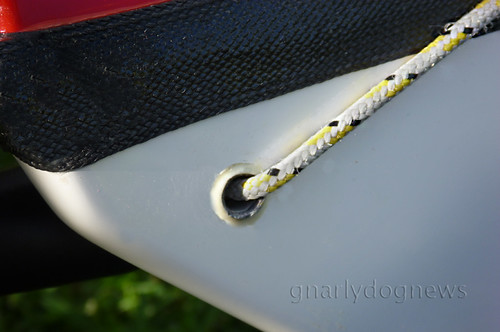
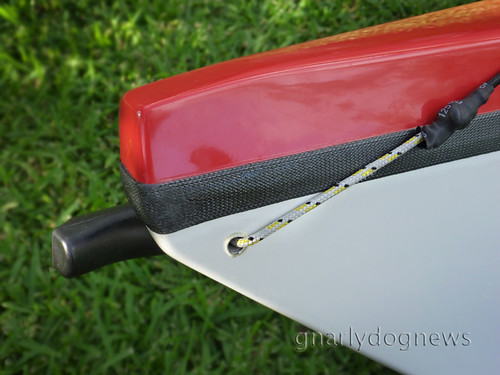
Dyneema line through a sleeve in the hull
A knot joins the two and a bit of heat shrink covers the ends to make it look neater. The knot stops the cord from being pulled through the sleeve in the hull. The bungee is attached to the toggle's original anchor point on deck.
retractable handle_2
Dyneema/bungee junction
The handle has a short stand-off from the hull so it can be grabbed easily when in a hurry (like in the surf).
retractable handle_1
handle with stand-off
The idea of having a retractable handle came to me after I had drilled and sleeved the end of the hull of my kayak.
If I had to do it again I would position the sleeve on a slant to alleviate the (right) angle of the hole and have it more in line with the toggle cord. That would achieve less friction when the handle is pulled out and possibly reduce the wear on the line.

PS You have seen this set up here first

08 February 2011

GEAR: carabiners for sea kayaking.

On my sea kayak I often use carabiners (snap shackles) to attach items to the deck.
The convenience of being able to release the item without tools or too much fumbling is the main reason that a biner is used. Other items, like stays for a sail, that don't require quick release are usually secured by D shackles with a screw on gate.
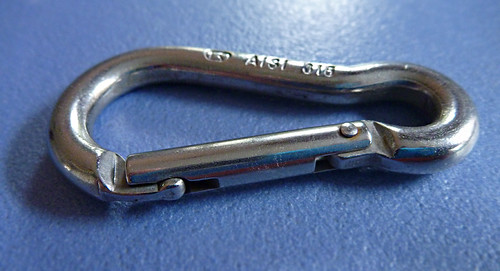
crab_4
I use this type of biner for the items that might need occasional use (hand bilge pump secured below deck).
This biner is compact, light and cheap.
crab_5
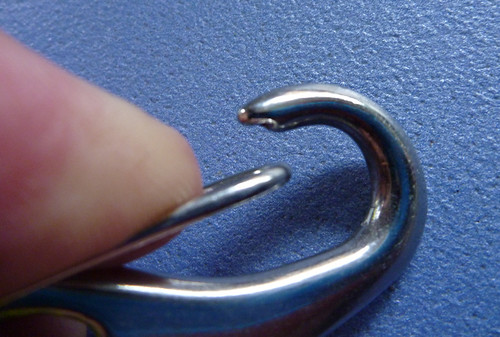
But I don't like using this type of gate on a towrope.
There was an incident where the sharp hook ripped somebody's hand open when grabbed by its end.
A larger snap shackle is desirable when trying to attach a towed kayak since some kayak handles will have a hard time accepting a small opening gate.
Towrope11c
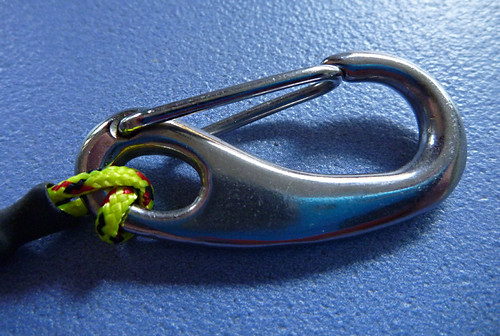
A larger stainless steel snap shackle from marine chandleries seem to do the job.
What I don't like on this option is the little hook that the biner has when the gate is open and often snags on ropes when least needed.
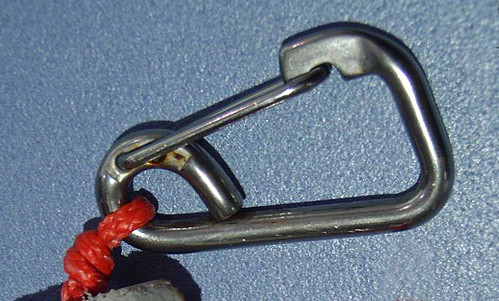
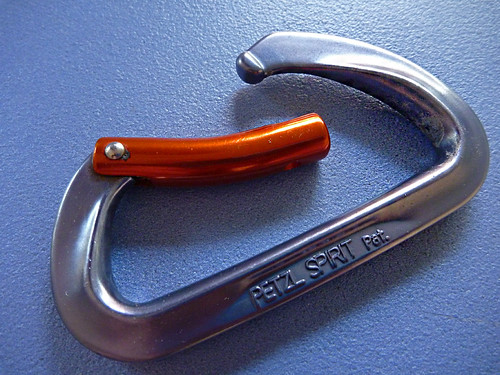
I thought that a high quality anodized aluminum climbing biner with a key-lock style gate would be the perfect tool.
crab_3
It was, for a while. The biner has a spring gate and the spring is housed inside the gate itself.
With time the spring corroded and failed leaving the gate wide open. While the rest of the biner still looked in great shape it was no longer usable/safe.
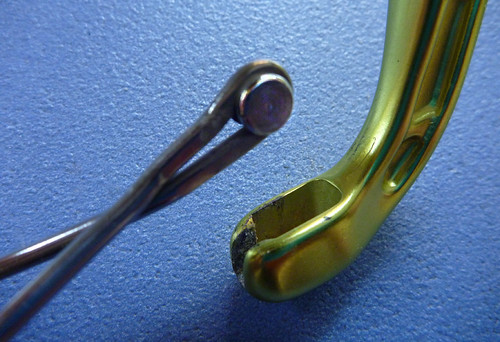
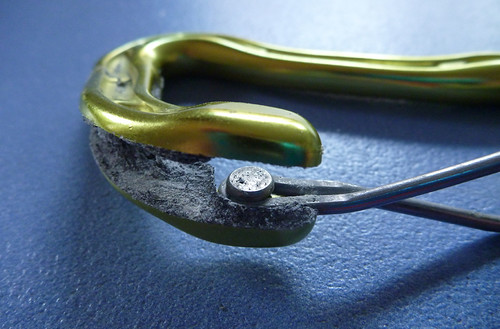
I then tried a carabiner that uses a wire gate as spring. The anodized climbing crab was perfect. The gate was free of hooks that could snag on a rope and would shut securely.
crab_2
Less then a year later the carabiner started to show signs of corrosion and eventually just exploded!
crab_1

Finally I sourced a biner that meets my needs.
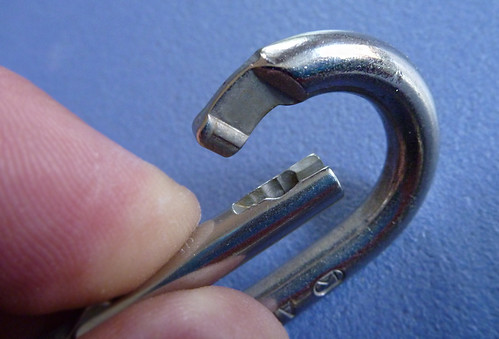
Stainless steel with a key-hole gate designed for salt water.
The carabiner is made by Kong in Italy (holders of the key-hole gate patent).
crab_6
There are no signs of corrosion after a year and the action of the gate is very positive.
I don't snag on ropes when releasing from a towline and there are no sharp edges to cut myself on.
crab_7
The biners come in different sizes but they are not easily sourced. Only high end marine chandleries seem to carry them.

20 October 2009

Kayak carry straps


After witnessing several injuries and sustained the odd one myself while carrying loaded kayaks up the beach I decided that there must be a better way of doing things.
While some kayaks are strong enough by construction and are fitted with very decent carry handles that could easily sustain the load others are not.
I have been taught to carry loaded kayaks by grabbing them with my arm wrapped around the bow or stern.
Wrapping my arm around the deck and hull of the kayak is relatively a good position to carry such kayak however picking it up from the ground and bringing it to waist level is not.
If the kayak is loaded with gear for an overnighter (or for a longer trip) it tends to be rather heavy.
I can hear you say: unload the kayak then carry it up the beach to camp.
While that sounds the smart thing to do often under peer pressure some kayakers carry a loaded kayak "just up the beach".
Other times kayaks have to be fully loaded on the beach far enough from the water's edge to accommodate for an incoming tide (or vice versa, tide ebbing and leaving the kayak on dry land).
It does not take much to injure your back while twisting your spine in a curve and applying the lifting load.
To aggravate things most kayaks are shaped so that if 4 people are helping to transfer the load chances are the persons helping at the cockpit are bending over (rockered kayaks) or bending their arms trying to elevate the load.

"cockpit helpers" having a hard time
Most times carrying a kayak on the beach might also involve going over sand dunes where uneven grounds is encountered.
The image below shows the problem I am describing


source* Seamongrels

I have seen people use carry straps to transfer the loaded kayak.
I liked that idea.
You slip the strap under the hull and two people at each end can lift the kayak without twisting their spine.
The traps however have to be wrapped around the wrist and often constrict the hand.
Carrying a loaded kayak for any distance results in a "blue" hand.
I have therefore modified the carry straps and added some handles.
Using a PVC conduit of suitable diameter (not too small or it does not distribute the load on your hand well) I have cut 4 sections of 11cm.

Using a nylon webbing strap I have sewn loops that thread through the PVC handle to come up with a strap with handles of approx 85 cm.
Now 4 people can carry a fully loaded kayak without risking a back injury.


my preferred way of carrying a loaded kayak

* published under Copyright Act 1968, section 41

15 June 2009

Sea kayak grab handles


source *: http://www.kayaking.com.au/brochurefiles/Ocean.pdf
A sea kayak to be safe must have grab handles.
Just like its perimeter lines, the grab handles are used to hold onto the kayak when out of the boat.
While perimeter lines are essential to perform an assisted rescue and vital for hanging onto your vessel in rough waters, the grab handles perform also other duties.
They are needed in towing situations but most often are used by the paddler in a wet exit in the surf zone.
When paddling in ocean conditions chances are you might need to land on a beach where surf is encountered. Most paddlers have been dumped at some stage out of their kayak (some more than others) and probably had to hang onto the boat to prevent their vessel being smashed onto shore by the following waves.
The best location to hold onto your kayak is the bow or stern where you can point the vessel into the incoming force of the wave and minimize the impact (less surface area).
Unfortunately not all kayaks have stern grab handles because of rudders.
The waves don't even have to be that big to surf your kayak away from you if not held tight.
Often the wave will twist your kayak when you hanging onto it by the grab handle.
Most likely you will have your full hand holding onto the grab handle trying to stay together with your kayak.
Let's analyze the different types of handle, their merit, shortcomings and potential dangerous features.

(Explanations to comments at the bottom)
Eco Bezhig:
-great carry handle
-no grab handle
not safe in the surf zone (1)

Mirage grab/carry handle:
-average carry handle (too small)
- dangerous as grab handle in the surf (2)

Guillemont Petrel custom made kayak and handles:
- good anchor for towing
- dangerous handle in the surf (3)
Raider grab and carry handle:
- OK carry handle
- dangerous grab handle in surf (4)
Impex grab handle:
-very good handle for surf (5)
-carry handle is separate (same as Eco Bezhig)

SeaBird carry handle and grab handle (retrofit)
- good carry handle
- excellent grab handle for surf (6)

Valley (VCP) grab/carry handle:
- average carry handle (too small)
- very good surf handle (7)
SKUK (Nigel Dennis)
-one word: brilliant
The simplest design seems to be the best.
There is no chance to get your fingers caught or your wrist injured in the surf.
The stern handle is offset (handle of left) to balance the kayak when carried.
While this handle might look like the obvious solution it took the genius of Nigel Dennis to perfect this simple design.
.
By dangerous I mean:
if the kayak is held by this handle chances are that your wrist or fingers will be injured if the kayak twists/rolls.
Analysis by numbers:

(1) this kayak has no grab handle, only a carry handle. Holding the kayak in the surf by the grab handle there is a good chance of injuring/braking your wrist when the kayak gets rolled by the wave

(2) this grab handle allows for fingers to be slipped between the two ropes of the handle. Documented cases of severed fingers are the result of this type of handle. If the kayak is rolled by the wave possible wrist injury.

(3) this handle is excellent for towing (low centre of gravity that lifts the bow under tow) but is even more dangerous than handle (2). Not be used in surf at all as grab handle.

(4) this handle is soft on the hand for carrying an unloaded kayak but has similar potential of injury as handle (2). Just slightly better because the ropes join at the handle and less of chance of having fingers caught between the lines. Still potential wrist injury when boat rolls.

(5) this handle uses bungee cord as shock absorption when the waves yanks on your holding hand. The cords might still allow finger insertion however the bungee would be softer and less damaging. Not perfect but better than others.

(6) the SeaBird Desisg kayak came only with carry handle (bad); I retrofitted a decent grab handle by drilling the bow and threaded some heavy duty bungee cord. The bungees also have a sleeve that prevents the fingers being inserted between the two lines. Very safe grab handle.

(7) Valley has addressed the risk of severed fingers by sleeving the grab handle lines however the handles are a bit undersized for carrying an empty kayak.

After a few near misses with some of the types of handle described above I now will not hang onto a kayak in the surf that potentially will injure me.
There are some other handles that I have not reviewed yet but I might add them as I will have more photographs to post.
* used under COPYRIGHT ACT 1968 - SECT 41
PS 17JUN. It appears that my observations on the above grab handles have stirred some emotions from loyal kayak owners and manufacturers.
It seems that maybe one kayak manufacturer is prepared to redesign the grab handle on his kayaks.
However, today I had a strange call from a kayak instructor.
He sternly warned me against possible lawsuits from the "offended" kayak manufacturers. I am grateful to him for his concerns for my wellbeing however before posting the above I consulted with my legal advisor and cleared some points.
What I don't share with my concerned instructor is the fear that some individuals have towards manufacturers.
While I can't see any slandering in my review, just observations, I do understand that individuals might have been challenged with their design rationale.
My question is: how would a consumer truly find a non bias review?
I have tried a few times myself but the ones available on forums are often "doctored" or deleted. It seems that is not uncommon to have forum administrators not display an unfavourable review with the fear that an advertiser/sponsor might cancel their support.
I have also noticed that true unbiased reviews are only possible from users that have no ulterior motives.
Come on, how often have you read a review on a website that was just reeking of commission?
Unfortunately there are very few sources out there that are fully independent from any commercial agenda that will give you an honest opinion.
While some might advocate for "if you ain't got nothing nice to say, say nothing at all", I rather believe in an informed consumer.