Showing posts with label waterproof camera. Show all posts

23 December 2014

VIDEO: beyond the action cam

A few years ago I fell in love with action cams.
I started using the newly "invented" waterproof compact camera to capture images first and then I discovered that some scenes were best captures with motion pictures.
I brought the little Olympus 720SW into the surf zone and devised mounts to go onto my kayaks.
It was fun for a while  but the metal bodied cameras don't last in salt water. After killing a few waterproof cameras I decided to revisit the GoPro, housed in a plastic case.
My early experience with the first generation was very disappointing: the resolution was so low that I really could not see clearly what was happening, things were fuzzy. I discarded that camera and labelled it as a "toy".
Then one day GoPro Hero 1 came to the market and that changed everything, totally.

It was a very decent tool with an excellent case that was seriously waterproof and sturdy enough for the footage that I wanted to capture.
I embraced the wide angle distorted view that was giving me a lived-in point of view, not a spectator one, more one of an actor, really being there.
While GoPro can deliver outstanding footage in the right hands and shooting technique, it comes up short when I want to isolate the subject from the busy background.
Action cams (and a lot of compact cameras have) lenses create images where everything is sharp: from the close-up foreground to the distant subjects in a scene.


There is little chance (most often impossible) to isolate the subject.
While most on-water action situation from a sea kayak don't offer me the time and environment where I can compose an image to create shallow depth of field and have selective focusing, on land, away from the bobbing of the waves, I have the time and stability to see the world more selectively.

I find that if I want to emphasize my subject and make it stand out from the visual noise of the background (or occasionally foreground) I need to limit the area that will be in focus in my images.
Van Dec14_1_c

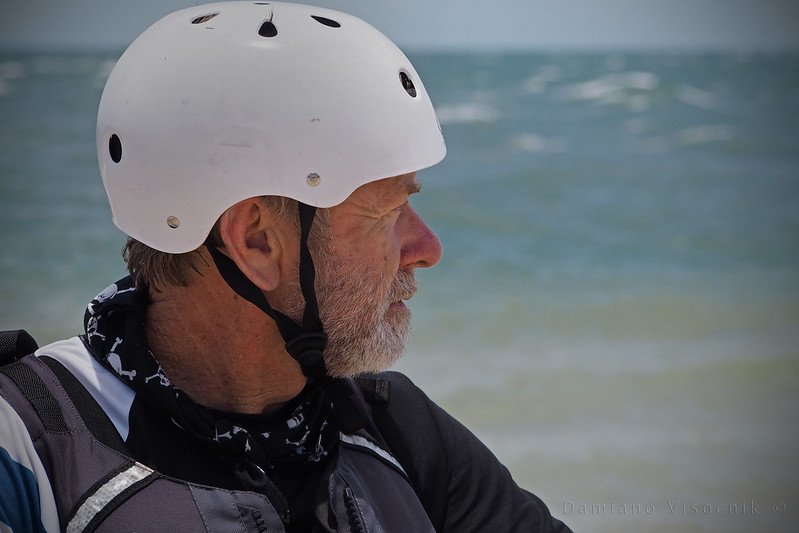
A blurry background makes a person stand out from a busy scene, a softly focused foreground brings attention to the the kayaks on the beach instead of having the viewer visually wonder around and miss the focal point. A less busy image can sometimes convey a different message.
I predominately use actions cams for video capture and I mix the use of my land camera between still images and video.
Lately I have been experimenting with selective focus on my Micro 4/3 cameras and found out their limitations. Shooting video is particularly challenging with a wide open long lens.


While my cameras excel in image stabilization I struggle to create even transitions of focal points and smooth focus pull. I don't zoom much as I find that most consumer cameras (of reasonable cost) lack real slow smooth zooming. I prefer to concentrate on the camera movement to create a dynamic point of view. As I have never used tripods for video, since I think it creates static scene that are too stiff, giving me a sense of "spectator" instead of a person that is present and involved. Therefore the in-camera image stabilization is very important to me to allow me to move around my scenes without producing jerky footage.
The one thing that I lack with my larger cameras is waterproofness; I have to be very careful around moving water.
30 August 2011

TEST: waterproof camera drop

.
I have convinced myself that there is no durable waterproof compact camera on the market yet. These so called waterpoof cameras don't last if used regularly for sea kayaking. Corrosion creeps past the pretty external metal shell and kills the internal electonic components.
I have however never tested if they are as tough as they claim to be.
Only one way to find out...
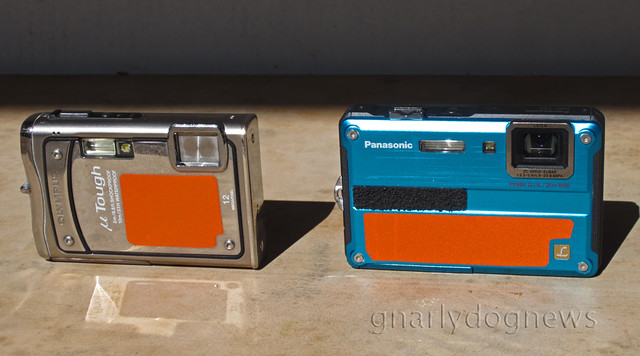
Tough and FT2_c

While the test was more for "effect" than a scientific experiment it appears that the two candidates can survive normal drops even on concrete.
A typical accident would be slipping the camera out of my hand and onto the ground. Most times the hight would be around 3 feet. But what happens when the camera hits the ground from 6 feet? or even higher like 10 feet and 20 feet?
Watch and be amazed :-)


Surprisingly these so called "waterproof" cameras did not explode like most other compact cameras would. Only the tiny sticker on the selector dial of the Olympus Tough came flying off (at 1:13); no other bits broke off the two cameras.
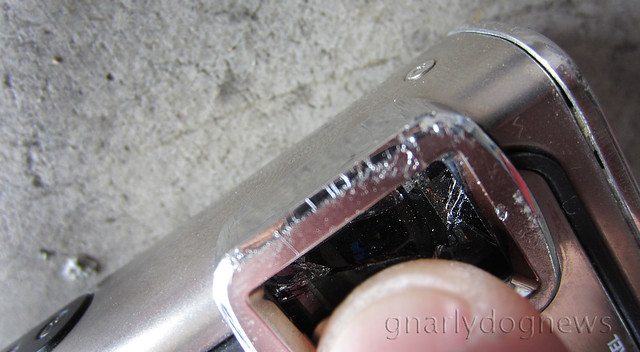
At 10 feet I managed to crack the lens cover on the Tough, after 3 drops.
Tough 8000_2_c
glass lens cover cracked at 10 feet drop
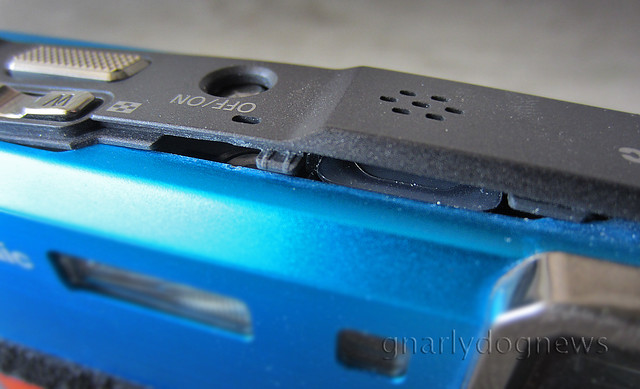
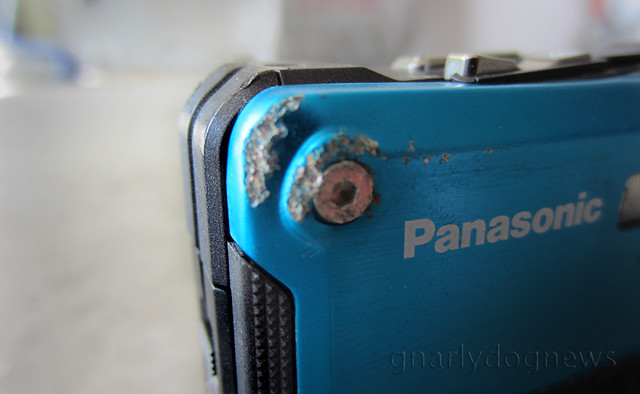
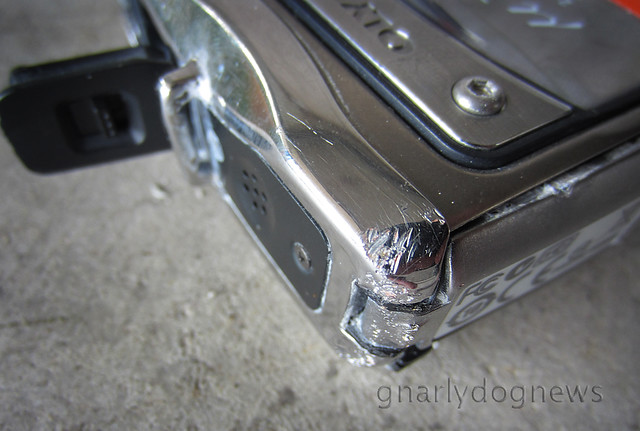
At 20 feet things got out of shape, I mean the poor camera bodies compressed so badly that permanently deformed the case.
FT2_dead_3_c
camera body defomed and no longer aligned with front plate
FT2_dead_c
ouch...
Tough 8000_1_c
metal corner compressed and deformed from repeated 20 feet drops
Unfortunately I was unable to veryfy if the cameras were still working after each drop: corrosion claimed their respective "ghosts" long time ago :-)

.

09 November 2009

Compact waterproof cameras: long term testing

A few years back when I started kayaking I wanted to transfer my passion for photography on the water.
It was not long since I had embraced digital imaging and finally said goodbye to the film cameras.
While I noticed some drop in sharpness with my first 4.0 Megapixel digital camera compared to the Nikon FM (with quality lenses) digital images were obviously the future for me.
If nothing else the extended dynamic range alone was worth the initial drop in sharpness.
When shooting professionally (architecture) one very important aspect of my work was that the final photograph had to be very sharp.
Hasselblad gave me those desired results.
However the bulky camera was not suited for action photography or remote locations.
Schlepping a heavy and very expensive tool that I had to be very careful with ,when confronted by the elements, was fast becoming a chore that was taking a lot of enjoyment from my trips.
It was bad enough to shelter the “blad” from rain when bushwalking but I could not see myself toting around that thing on the sea, in a kayak.
The Nikon would have needed a bulky and expensive water housing to be able to use it on-water.
I was very excited when finally Olympus brought out the first waterproof camera.


MEI's current set of cameras, left to right: newest to oldest

My early attempts of housing a compact digital camera in a soft waterproof pouch proved useless; the results were worse then ghetto.
Water droplets and out of focus images were the norm, no the exception.
Olympus was offering a real waterproof camera that was compact and robust.
Finally I had the tool with me that would allow my style of images to be transferred on the water.
I don’t often photograph “sitting around the camp” or serene landscapes in dry conditions.
My preferred images are taken in rough conditions where a conventional camera does not stand a chance.

The little Olympus proved to be a winner (collection of images here)
Compact enough to be sitting in my PFD pocket I could reach for it at any time and getting it wet was not a problem.
Olympus even took care of water droplets on the lens problem.
They have a special coating that repels most water droplets. A quick dunking of the camera in the sea would clear the most stubborn ones.

The camera served me well for about 3 years when eventually some minimal water intrusion killed one memory card.
While not dead, the camera could not trusted on water anymore.


signs of light corrosion on the 720SW
In 3 years I did not bother to service the seals (recommended). At $150 a pop I figured I was ahead of the game.
I would have spent as much as a new camera. By then Olympus finally brought out a waterproof camera with wide angle lens that I purchased as replacement to the 720SW.
With improved features (better movies, better menu) the wide angle lens (comparable to 28mm) was getting close to my style of wide angle photography.

Unfortunately the quality of the 1030SW was appalling.
So far every user of the same model camera (specifically the 1030SW) that I know, that shoots in salt water, has had trouble with the camera.
Salt water corrosion being the common problem.
After only a few months the camera showed signs of corrosion (not just surface like on the 720SW) and compartment doors to battery and ports became hard to operate.

The black paint on the front panel flaked off and the lens frame with it.
Olympus "repaired" one 1030SW of mine under warranty that flooded the first time I used it in water. Eventually they replaced it with a new Though8000.
A second 1030SW had the same problems and that one got serviced under warranty too.
Without expressly saying it, Olympus admits that that particular model was a dud.


signs of heavy corrosion on the 1030SW (and that's after servicing)
However some waterproof cameras "die" way before they reach "maturity"
How often do I see kayakers using waterproof cameras while paddling without any security for accidentally dropping them.
Water makes things slippery and often tired hands become “fumbly”.
Some at least use a tether but even then a few accidents have occurred while passing the camera to an other paddler.
All of my cameras, while on water, are tethered and have a floating device to prevent them to be donated to Neptune.
A piece of minicell (closed cell foam) large enough to float the camera is essential.


fishing clip used for attaching floatie detail of reinforcement on minicell

Recently I have added a budget waterproof camera to my set: a camera from Aldi!
Yes, that’s right: a camera from the discount chain store.
Manufactured by Olympus it offers enough features to satisfy most amateur photographers.

single door on Traveler camera: battery, card and port all in one location
The quality of the images is slightly inferior to my other Olympus cameras but at 1/3 of the price of the others is not a bad one as spare for “high risk” shots (read surf photography).
Sure there are many self professed expert photographers that will laugh at the Aldi "toy".
To them I reply: it ain't what you have, it's how you use it :-)
Thousaunds of dollars worth of high end equipment and very little results to show for it... that's what I am laughing at.
What really sold me is the 3 year warranty. I strongly doubt it will last 3 years in salt water but I will make sure I keep that purchase receipt handy :-)