Showing posts with label environmental responsability. Show all posts

17 November 2014

Vandal or innocent fun?

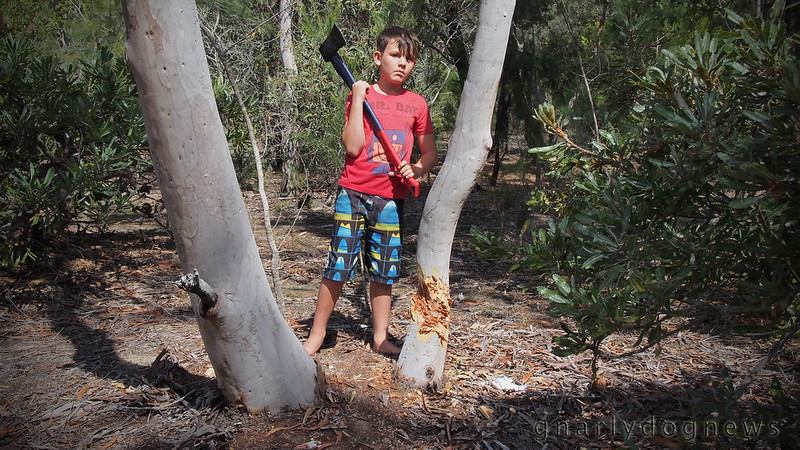
At my favorite camping spot I was confronted with this scene.
To paint the picture a bit I should mention that it is a National Park heavily frequented by motor boats; a popular destination for day trips or overnight camping; in other words a busy place, not remote at all.
Axe yealding_c

I did not know how to react and experience has taught me not to engage too much with somebody possibly not doing the right thing. My initial reaction was disbelief soon followed by anger: somebody was cutting down trees that offered shelter from the sun and wind, in a natural place pleasant enough that I often call home for a night or two.
But the best I could do was to keep my distance somehow and just take photographs.
Even though the youngster did not look too menacing, my camera is no match for an axe; if not used by the youth, certainly by the parent not too far away.
Cut tree_c

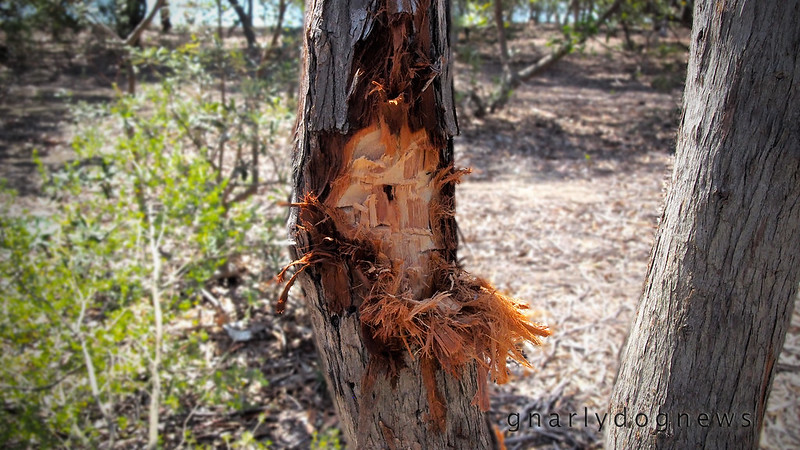
There were a dozen trees that have been freshly cut, some a bit too large that seem to have deterred the short attention span of the kid that found attacking smaller ones more rewarding.
The child was still hacking away when I got near him but then he stopped and watched me for a while.
I am not sure what went through his head and if he felt that a camera on the scene might have prompted to review his actions.
It was not long before the adults arrived to see why the chopping stopped.
Cubby house_c

I was asked what I was doing and I explained that I was photographing.
Again the older man wanted to know what for and I revealed that it was for documentation.
Hammer in hand he stepped closer to me and asked: What for?
I explained that somebody might be interested in my images, suggesting the ranger.
At this point the vibe changed and I could sense a shift in emotions.
The hammer holding man tried to convince me in a loud voice that his kid was just having fun and that I was not allowed to take pictures.
Soon a little group gathered (friends of the man) and started to shout rather insulting remarks.
It was clear to me that it would not be wise to try to explain my view, after all I was quickly labelled pedophile and pervert and police was going to be called in.
I thanked them for their decision to actually call the police as maybe a few things could be cleared but I never saw the arrival of any law enforcement.
I also knew that it was time to retreat, clearly outnumbered by menacing little crowd.
I walked away happy that despite my rage I was able to remain calm and not engage: it was not my place to prevent trees getting cut down.
Somehow maybe my presence and the fact of me taking images deterred the kid from continuing and the ax was put away: damage was done but at least not continued.
I feel sad that the child lives in ignorance and cuts trees down in a National Park, right where so many others try to enjoy the place. It makes me wonder what messages has he learned at school, or is the influence of his father stronger than what I hope the educational system has given him?
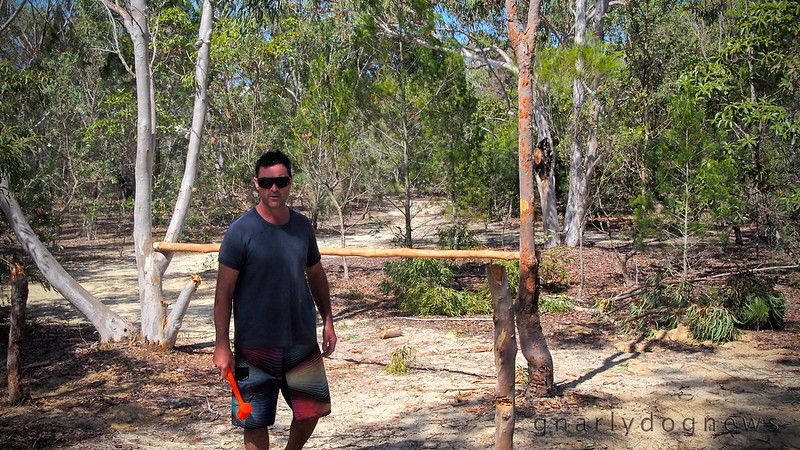
The other part in me also acknowledges that it could have been intended as innocent fun to build a cubby house (his father's words), just maybe in the wrong environment?

Later in the afternoon I suddenly heard a chain saw fired up and the shrieking sound of trees getting cut down at the other side of the camp.
This time, I was not going trying to document the event.
A kid with and axe is one thing, somebody waving a chainsaw at me is a bit different, especially if alcohol is involved...

.

24 November 2009

Too busy?

Is it more selfish to have offspring or not to have them?
That's the question I asked myself the other day.

I used to believe that it was more selfish not to have them.
Let's rewind a few years back.
I migrated to Australia to a relatively low density urban environment.
I grew up in a low density community (village of 600 people) and was partially schooled in a small city of 150.000 people.
To most world standard largely populated areas I grew up in an environment that was not oppressive and offered a lot of outdoor recreational opportunities.
Although even in my teens I started to sense that the world was getting rather busy.
I was lucky enough to travel to some of the most populated areas in the world and witness population explosion in its worse manifestation: India's large cities.
It was a shock to see all those masses having no room to live.


India's overpopulation problem (*1)
The population problem started to become evident to me when I kept on hearing that at the current rate the world was going to get busy, very busy.
Very reputable sources were predicting a population explosion that, unless something catastrophic would happen, would effect the way we live tremendously.
That knowledge lingered in the back of my head and just would not go away.
When I married I decided that I would not follow the common peer pressure of starting a family.
Despite coming from a family of 4 siblings I decide that I was not cut out to be a dad.
I am sure that most viewed my decision as selfish probably not knowing my reasoning.
At the time, there was not real talk of climate change, overpopulation and current other social problems that we are facing today when I decided that having offspring was not the best idea.
However I was somehow feeling guilty that I did not follow what society was expecting from me: perpetuate what was “natural”.

After hearing a comment that having children is selfish the other day, I asked myself the question.
The commentator said that having offspring is a selfish expression of yourself: you wanting to perpetuate yourself with your children.
While some might view the comment totally out of line and actually absurd, I am lead to believe that there is some truth in it.
Why is it that well educated people with knowledge of the evidence that the world is overpopulated continue on the old adage: populate or die* (Australian Government slogan in the 50').
Could be arguable that the opposite is true: populate and die?


We are depleting our resources faster than we can replenish them and while all the efforts toward sustainability are focused on reduction of the use of those resources, there is very little talk on how to tackle the root of the problem: overpopulation.
The Public Health Association of Australia however seems to recommend this.

And what has this got to do with kayaking?
Simple: the population explosion is impacting my paddling environment.
No longer can I just decide on where I want to paddle and just head off.
These days a trip has to be planned carefully around holidays (avoiding them) and climate.
If I want to have a half assed experience of remoteness I have to pick the time of the year that other people don't favor: winter.
That certainly was not the case just a decade ago.
My neck of the woods, or shall I say surface of the pond, has experienced an unprecedented population growth.


India's crowded beach; not my scene (*2)
While the growth it’s dismal compared to some real big cities in the world, I don’t ever wish that my place would become so busy that an actual wilderness experience will no longer be possible unless I am prepared to travel so far away from home that I will have to use my annual vacation to reach those places.

Indonesians play in the water at Ancol beach during the Eid al-Fitr holiday in Jakarta, Indonesia on September 21, 2009. (REUTERS/Crack Palinggi) (*3)
Have I answered myself the original question: am I selfish?
Not totally, however I sense a certain rewarding feeling that I have not contributed to the problem.


"....
There have been many mass extinctions of species in the history of our world. The planet seems to have taken no notice whatever. There will no doubt be more in the future. If we are foolish enough to precipitate our own mass extinction, I am pretty certain this will have not the slightest effect on the ultimate fate of our planet.Saving the planet may be a nice catch-phrase, but the real challenge is saving ourselves."
(from the Ad Contrarian 12JAN2010)

published under the Creative Commons licence from this author
*1 here
*2 and here
*3 source http://www.boston.com/bigpicture/2009/11/on_the_shoreline.html

28 April 2009

DIY: Candlefire ™

Camping often evokes thoughts of campfires.
It just seems that an evening at camp must have one. It’s like the moon and the tides; you can’t change that...
So when the administrators of National Parks around the world started to realize that too many of us having campfires in the wilderness were causing great degradation to the environment they decided to ban campfires.
Initially I took the news with disdain, followed by refusal and eventually I had a good look at the issue.
Fires cause tremendous impact in pristine wilderness. They scar the land.
Even if not escaping out of control with irreversible consequences (bush fires that kill lives and destroy property) even the mere little camp fires cause damage.
I love to travel in areas where there is little or no sign of human impact.
Unfortunately fires leave a scar that takes years to heal.
But I still want my fire; it just adds so much atmosphere.

Years ago, while in USA, somebody (Edgar Peralta) showed me the solution to this dilemma: make a fire in a can.
He produced this can that once lit looked like a small fire.
I couldn’t believe that simple thing would be a great surrogate to a real fire.
He explained to me the basic principles of fabricating one and I have since made hundreds of these.

You will need:
-candle wax (recycle your old unburned candles)
-medium sized empty can (tuna cans seems to work best)
- some cardboard
- pliers


Method:
Your can should be clean and dry.
You can place the can directly on the stove or have a much larger can to melt wax for the fabrication of multiple candlefires ™.
A word of caution: if you are generally a klutz and tend to spill and tip things probably you should not be handling hot wax, however if you can handle a bit of heat (so to speak), be careful and all will be good.

Wax is like oil. Do not spill any water into the liquid wax or an explosion of hot wax will spray everywhere.

Do not overheat wax: if it’s smoking there is great risk of imminent fire. Therefore stay at the stove while melting wax… don’t wonder off to the TV and watch the riveting Australian Idiot reruns…

Once the wax has melted, remove it from the stove with pliers.

Alternatively, if you have a large container of hot wax, carefully pour some into the empty cans, just below the brim.
You will need to insert a spiral of corrugated cardboard into the hot wax.
Add some “spikes” of cardboard that will act as starting wicks.


Let the can cool down before handling it with bare hands.

Candlefires ™ will give you a decent flame (small fire effect) for a couple of hours depending on the quality of the wax.
The great advantage of the candlefire ™ over the fire: people can sit all around without getting smoked out.


candlefires ™ at the table (timber has been protected)
Above pic is a time exposure. The flame is obviously much smaller...
The candlefire ™ is not more than a stove powered by wax therefore totally legal in all National Parks where open fires are not allowed but stoves are.
Light your candlefire ™ on a durable non flammable surface since once the candlefire ™ is lit the wax melts and can’t be repositioned.