
Let's name her Dugong!
Short, stubby and just a bit "a face only a mother could love" look... the Whisky16 (designed by Nigel Foster) is not a pretty kayak in a traditional sense.
Dugong seemed an appropriate name for Petra's new kayak.
While looks are often deceiving, this kayak fits Petra very well and being very maneuverable spurs confidence in rough water.
The inspiration for the name came from the previous day's event where Petra and I were kayak-sailing back from my favorite play spot. A dugong suddenly surfaced too close to my kayak and looked at me with spooked eyes: I don't know who got the bigger fright, me or the dugong.
Then he quickly dived, his tail flew inches away from my face wetting me completely while I ducked my head avoiding the slap as he desperately tried to miss my kayak.
That evening a sail was hastily mounted to the Whisky16's deck as next day's forecast was promising conditions for a pseudo tidal race: wind against ebbing tide.
With the new SeaDog sail mounted up front Dugong really brings smiles
click on image above to play video
Edging and rolling the Whisky16 seemed easier than the borrowed kayaks: a good fit where one can brace without having to splay the legs too far could be the reason.
The keyhole cockpit where the legs can be kept relatively close together, allowing some wiggle room but still offering a solid wide area of contact, is probably a better solution than the diminutive thigh braces wings I see in most kayak cockpits.
So far the two kayaks that I own with such keyhole cockpits are way more comfortable than the other system I have tried.
The rear deck is not particularly low in the Whisky16 however layback rolls are still reasonably easy since the seat is not jammed right against the rear of the cockpit rim.
For once the seat is not shaped as a racing short-pan paddler crunched-over design: a lower front lip allows for more relaxed seating.
My experience with short seat that have a higher front has not been positive as I often end up with "dead legs". A flatter pan and longer seating area is key for longer paddles where my thighs don't suffer from blood circulation cut off.
Petra, while being the exact opposite of my bio-metrics, seems to agree: she dislikes short peaked seats and loves the flatter pan. The seat of the Whisky16 is here to stay.
The front deck however has already been modified to accept a sail and place it at closer reach. Details here.
Showing posts with label Nigel Foster. Show all posts
Showing posts with label Nigel Foster. Show all posts
24 February 2015
04 April 2013
Nigel Foster's finesse
Nigel Foster's presentation of his Arctic trip by sea kayak was awe inspiring.
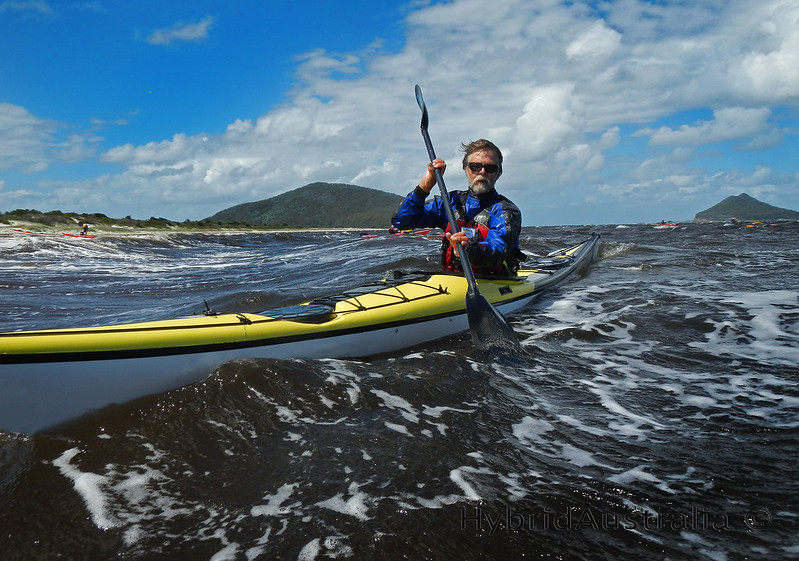
There was a breeze stiff enough to deter some paddlers from launching and wind driven waves were lashing the sandy shore.
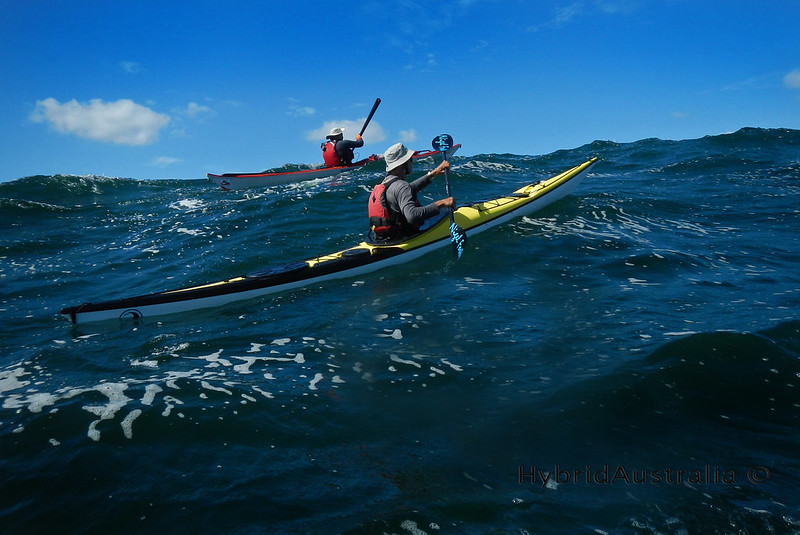
The seas were calmer than the previous day but the swell outside the bay was still a considerable 10 feet with a healthy rebound from the big waves crashing into the cliffs.
All images under license from Andre Janecki/Hybrid Australia
.
I gained new respect for the man that took on almost uncharted waters (by kayak standards) in very inhospitable conditions; cold and windy and patrolled by polar bears.
My first knowledge of this exceptional kayaker was years ago watching his instructional DVDs.
I was mesmerized by the incredible finesse he was using to make that kayak spin around like it was on a bearing.
I was however a bit incredulous on how easily his kayak could dance with so little effort. No paddle sweeps, no excessive edging, just confident paddle placement that to my ignorant eye seemed fit only for calm conditions.
I was now watching him from my kayak, on the water.
There was a breeze stiff enough to deter some paddlers from launching and wind driven waves were lashing the sandy shore.
I was back-paddling constantly just to keep position to watch him.
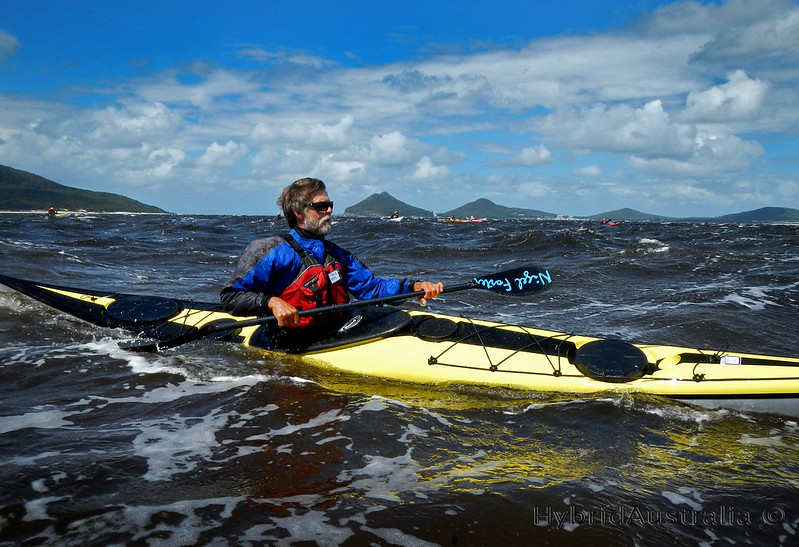
And with just as much finesse as in his DVD he was spinning that kayak around in circles like the water was flat and nary a whiff of wind.
No huffing and no puffing, with paddle strokes slowly paced and precisely placed his kayak was dancing on the water regardless of the adverse conditions.
The man is a Master like I have not seen before.
Despite his status of true authority on the water, a paddler with no equal, Nigel is extremely approachable and willing to share his knowledge without the air of superiority that I have encountered elsewhere. Softly spoken, thoughtful and considered, my conversation with Nigel was easy and inspiring.
As the 3 day sea kayak event (Rock and Roll) was drawing to an end Nigel had the morning free to go for fun paddle, not scheduled to any instructions.
I was lucky to join him with Andre Janecki of Hybrid Australia.
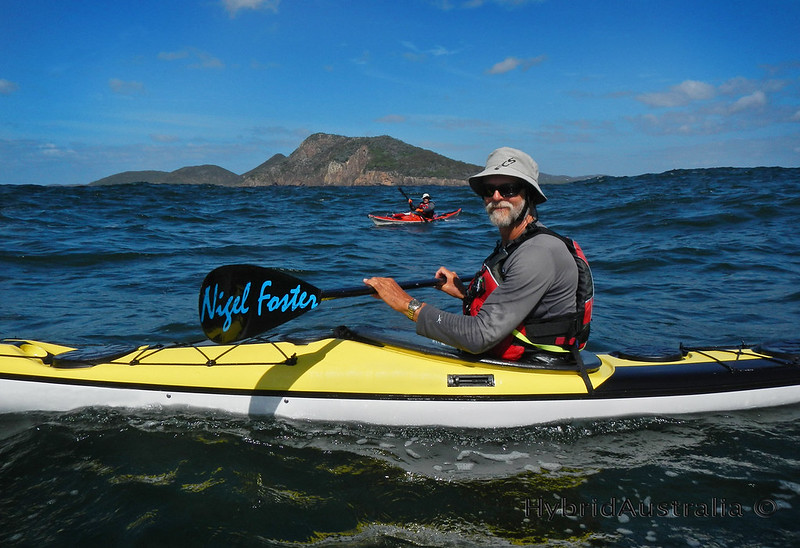
I paddled beside Nigel and if I didn’t see him launch his kayak I would have sworn that there was a little motor under his hull. He was paddling with a cadence that seemed like lily dipping while I was giving it my best shot to keep up. I watched him closely and his timing was crucial to his paddle stokes. I later asking how he could move with such grace and so little apparent effort; he replied that he was using the little waves to propel his kayak.
His stroke appeared to be lower than the current local trend of a high angle and aggressive body rotation. I saw gentle twist of his upper torso and his hand rather low, gently inserting his paddle to then exit a bit further than “Olympic form” would suggest.
I regard Nigel Foster without a doubt a "Legend" and a "Master of boat control without equal". All images under license from Andre Janecki/Hybrid Australia
.
17 February 2010
SAFETY: surviving a summer storm.
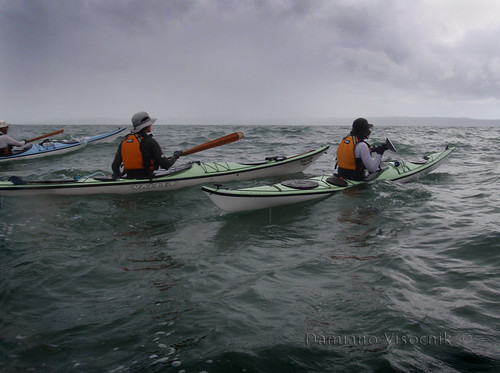
As a leader (among peers) of sea kayak trips I have often pondered at scenarios that I might be involved in while paddling in a group.
I usually paddle with sea kayakers that have a minimum standard of proficiency (self rescue in mild conditions) and rarely with novices.
Some stretches of water involve crossings of semi protected waters (no ocean swell) of 15-20 Km.
Living in a subtropical locale the possibility of sudden storms, occasionally violent, unexpected and usually brief is feasible.
While the weather forecast is religiously checked and observed before leaving shore, on multi day trips sometimes the only forecast available is via VHF radio bulletins on the morning schedule.
I have been caught out before on sudden changes of weather but luckily close enough to shore to make a hasty easy retreat.
.jpg)
hand towing kayaks to camp in 30+ knots wind
To better my skills and be able to handle unexpected though scenarios I sometimes seek conditions where I never see any other user on the water, let alone a kayaker.
Obviously in those conditions I chose an on-shore wind location where in case of trouble I can be blown back to safety in a short time.

training with Greg Schwarz in 30 knots wind
In the unlikely but possible event that I should be caught out on the water in a group of 6-8 paddlers (too far from shore to be reached in time) what would be my best way to ride out a short storm (1 hour duration, for example) ?
I have asked this question on a couple of Forums and I got replies of limited value and some abusive ones too ("you should have checked the forecast", "paddle close to shore", "don't go out in bad weather" or "if you are that stupid to be out there in a storm is serves you right").
A local instructor replied to me:

click on image to enlarge
While stating the obvious, I really did not learn much from his comment.
Relying purely on the weather bureau's forecast is very shortsighted.
I believe that knowledge, skills and being prepared for the situation is my best defense.

windy conditions (1)
So I asked the question directly to highly regarded sea kayakers Nigel Dennis (of SKUK) Eric Soares (from the Tsunami Rangers) and Nigel Foster (of Nigel Foster kayaks):
"Since I believe that you have had a fair share of bad weather experience on the water, what is, in your opinion, the best way to ride out such event when paddling in a group of medium skilled paddlers?
Winds would not exceed 40 knots and waves would be of max 1.5 meter with probably braking tops.
I believe that rafting up would be hard and holding together dangerous? clipping the perimeter lines of the kayaks together to raft and leave the hands off the edge of the kayak?
I am open to suggestions"
Thankfully their replies were outstanding first hand knowledge of possible solutions for my sticky scenario.
Nigel Dennis replied:
-----
Hi Damiano,
Thanks for the e-mail. I am not sure there is a one answer. If it was me and I was caught out in strong winds with a group the best thing would be to run down wind. As the wind gets stronger this will become more and more your only option. The problem is that people will be at different levels. It will be very hard to keep the group together. Someone will need to lead from the front so they have a little control over the direction and speed of the group. Another will have to stay at the rear and be in charge of rescues. As the wind picks up you will have problem with people falling in. You can't afford for this to happen. Your only option left is to raft up. I would advise two small rafts rather than one big one but only if you have sufficient competent leaders to go in each group. Finally it would help if you used a small drogue on each raft or clipped helmets on tow lines to each raft. This will be difficult but it’s the only thing you can do. I have had to do this in the past.
Nigel
-----
.jpg)
sea kayaks in wind waves (2)
Eric, more specific to different levels of storm gravity and participants skill level, said:
-----
Greetings Damiano,
Here is my reply to your scenario.
1. Of course, all your friends are right who say "You shouldn't be there." Right. But as you said, you can't always forecast sudden squalls that only last an hour or so.
2. I do not recommend rafting up unless someone is very ill. The reason is as you said. Even in somewhat brisk conditions such as you describe, boats that are rafted bang together, which can hurt boaters and damage boats. It's especially risky to tie boats together, as they may get entangled, which can cause all sorts of problems, as you can imagine.
3. Form a diamond formation of four boats. If there are more than four boats, form more diamonds or parts of diamonds. A diamond formation has one boat in front, leading, another boat in the back, sweeping, and one boat on each side. Each keeps a safe distance from each other, about ten meters or so, so they don't bang into each other, but the paddlers can communicate and watch out for each other. Also, for your weaker paddlers, the formation provides a psychological structure so they feel safer and protected in a "pod". If there are say, two diamond formations, have one follow the other with the lead of the second diamond maintaining a distance of about ten meters or so behind the sweep of the first diamond.
4. From the diamond formation, (assuming the wind is 30-40 knots, w/seas below 2 meters in a semi-protected environment), FACE the wind directly and have everyone put their heads as low and forward (to reduce windage) as possible, so they are looking up to see forward. Arms (elbows especially) should be close into the body to reduce windage. This will give you a low physical profile so you are less effected by gusts and the strong prevailing wind. The leader should paddle just hard enough to make nominal forward movement, so slower paddlers can keep up. Do this for an hour until the squall passes, then resume your course. Facing the wind like this provides the most stable feel for inexperienced paddlers.
5. A formation variant: Should you have one or two truly weak paddlers, make a column formation, either by itself, or within the diamond. A column formation is a straight line. The weak paddlers draft on the strong lead paddler, so their workload is reduced.
7. Another solution: Should you have all strong paddlers, just continue on course with the wind at your flank in a diamond formation and ignore the beam seas, while doing correction strokes as needed. Or, turn with the wind, fan out (row formation), so you don't run into each other, and run with the wind for the storm's duration, then turn back toward your destination, assuming it's to the side and not behind you! These two solutions are preferred, if your paddlers are strong and bold. This is what we do!
8. If someone is unable to stay up for any reason, have a diamond of four or five paddlers raft up, all facing the same direction (ideally, into the wind and swells). Put the weakest paddlers in the middle and the two best on the outside. Hold the boats together tightly by placing paddles on your laps, with the blades extended to the boater next to you, so he can grab your paddle. Everyone holds onto the paddles, and that keeps the boats (roughly) in place, with everyone pressing toward the center.
9. These solutions to this scenario should be rehearsed, first in mild conditions, then in rough conditions--but near shore!
Happy paddling!
Eric
-----
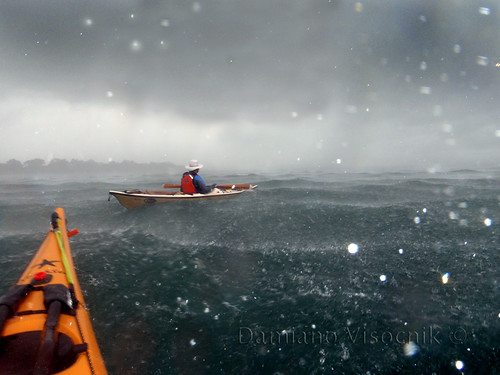
Vanilla practising in 30 knots wind (according to BOM records)
Nigel Foster addresses the training for the unexpected.
Only by being prepared and having trained in harsher conditions will give me the chance to survive a possible storm.
>>
Hi Damiano,Thanks for your patience. Recovered thanks and back on the water... and last weekend running kayak incident management courses.
Re your questions; If I could start with the concept; "fail to prepare; prepare to fail" and suggest that for the individual paddler who faces a real possibility of encountering certain conditions on open water, then the best advice is preparation. If you want to know what it's like to control your kayak in strong winds, then practice in strong winds in a safe place (such as just a short distance from shore when the wind will quickly blow you to shore if you get out of control)
If you can paddle circles or figure-of-eights in the wind, can edge and brace for balance against a side wind and make forward progress in all directions... then you are in a better position to meet similar conditions unexpectedly while on a trip or on a crossing. It's neither safe nor as much fun for the individual or the leader to play Russian Roulette on open water, knowing that there's a good chance of meeting conditions that group members have never experienced even closer to shore. But... it's really fun to learn techniques in a safe place in wild conditions that get close to or exceed your experience and current ability, especially if you're doing it with paddlers who know what to do and can offer help and advice. It makes you a better paddler.
Ideally each paddler should be confident and able to rescue others, and to perform self-rescues in conditions they might expect on any trip they choose to go on. Ideally that means practicing in similar conditions in a safer place before signing on for an open water trip where those conditions are a possibility.
What do paddlers generally find easiest? Heading straight into the wind until it reaches a certain strength... ( beyond that wind strength the kayak will prefer to be sideways to the wind.) So in the first instance, paddling against the wind through a squall will offer more ease of control for individuals, and therefore more safety so long as they can keep together as a group.
So a good practice session might include heading out from a safe shore against the wind to a nearby anchored float and paddling steadily to remain as close as possible to the float for the duration of a violent squall. Try it with a small group and try it with a larger group. If anyone gets tired, they'll be blown onto the safe beach behind.
Another useful practice session in similar conditions is to paddle a figure-of-eight path around two anchored floats. (Anchored floats can be as simple as a plastic bottle on a line anchored with a brick.) It gives practice in turning in every direction to the wind and shows how effectively you can control the kayak in that strength of wind. The more practice, usually the quicker and more effectively you can do it without getting blown onto the beach.
Other skills that are useful? Techniques for balancing while looking behind at fixed objects or other paddlers, the ability to slow down your paddling pace to match someone else's pace, the ability to turn your kayak around and position yourself to rescue someone in the conditions... and practicing anchored rescues in those conditions, which require positioning skill, tow-line skills and rescue skills... and awareness of what happens if you let go of your kayak... again practice in a safe place first.
Finally, in wind, communication gets more difficult. Practice using eye contact and head gestures rather than shouting, and keeping close as a group. Then... the squalls on open water become a treat rather than a potential hazard, and if someone capsizes, your role becomes one of making use of the situation as a useful practice session for everyone, rather than it falling on you to perform the rescue. Hope these comments help! Get back to me if you need to, and have fun out there!
nigel
There you have it.
I very much value their advice that will help me to become a more prepared leader with wiser knowledge.
Please feel free to comment on their advice and if you have anything to add, my readers would love to hear from you.
PS AUG10: a very informative discussion thread on QajaqUSA forum here.
1,2 published under Creative Commons license
Subscribe to:
Posts (Atom)


.jpg)