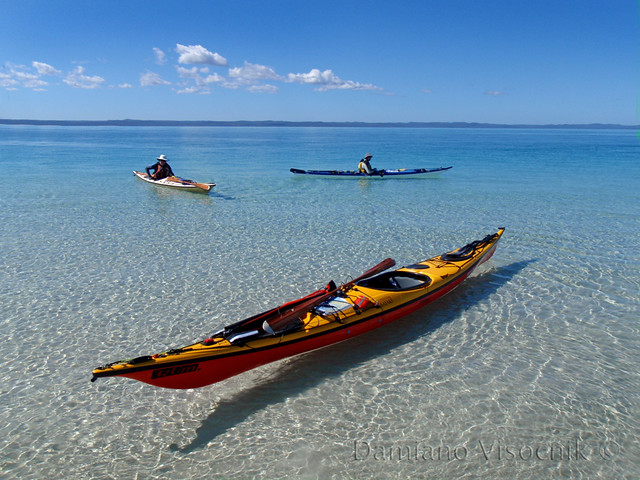
21 March 2013

VIDEO: Sailing with Flat Earth 0.8

.
A few months ago I received a new sail.
For years I have been using a Flat Earth Sails of 1.0 m² in all conditions and I wanted a new one to use specifically in higher winds. Paddling in stiffer breezes and sailing with the FEKS 1.0 has proven to be a bit tricky for me. I also have come to the conclusion that a larger sail does not equate to higher speed on my kayaks.

The large Flat Earth Code ZERO 1.0 mt sail seems to shine in lighter breezes up to 15 knots; my kayaks are propelled along at a reasonable speed where I still need to paddle along if I want to reach hull speed (the maximum sustainable speed achieved by paddling alone). At around 15 knots of beam wind I find that I no longer add to the kayak’s speed if I add my paddle strokes; maybe with a short furious burst I have a sudden sprint, but not a continuous increased speed.
At higher winds (like 20 knots) the kayak does not travel any faster, despite the sail offering more resistance and heeling over my boat.
As I have to lean over with the weight of my body to prevent the kayak from tipping and I don’t feel too comfortable in winds higher than 20 knots; I get tired from twisting my body.
In reality, the only time I can really make my kayak’s skeg hum is when I have following seas and my kayak is propelled by the wave hitting it from behind.
A few short fast strokes bring the kayak to the speed of the wave and suddenly I am surfing.
 

Sailing with Green-Piece: the lime-green Impex Cutticuk

I was intrigued to try the new sail: would it still give me the fun rides that I was used to with the big sail but make it easier in higher winds?
After a few months of using the new Flat Earth 0.8 sails (two different ones) I realize that less is more.
The smaller sail propels my kayaks (skeg, fish-form, British style 5 meter-ish) just as fast as the larger FEKS 1.0, when the breeze sends most small motorized watercraft back to the boat ramp.
The smaller sail gives me enough resistance to bring my kayaks to hull speed but not too much heeling over. I can handle the sail better in wind gusts.
 
While rigging the 0.8 sail I made a taller mast to allow me to reach the boom when stowing the sail on deck. In a lowered position the mast (pocket) is longer than the boom and to keep the two together, when folded, I now have the mast slightly protruding over the cockpit.
As sea kayak sails are generally useless for tacking (head wind) I lower mine and stow it on-deck. The mast, boom and sail cloth are bundled and tied together to prevent wind and waves catching the sail and balloon. A sail hastily stored on deck has filled up with water and made boat handling very precarious; I like my sails secure with a low profile to make head wind paddling easier too.
An unplanned advantage of having a higher mounted is to gain a clearer view between deck and boom without much need for a window.

.

26 February 2013

Buying a dream


I am a sucker for toys. Just like a bowerbird collects blue objects I love gear.
Some might say however that stuff means nothing if it doesn't get used.
But is that true? 
Sports Room "After"  
gear closet?
A collection of toys for the sake of just pure possession is often viewed as a pointless consumeristic decadence and I tend to agree. But I also see the other hidden side of the reason why often individuals find pleasure in just "owning stuff".
Let me tell you about my experience of a few years in retail at the largest outdoor gear retail chain in the world.
I used to manage the bicycle department in a massive shop and occasionally I would mingle on the floor and help customers with their purchases.
There were some genuine outdoor type guys that needed gear and pretty much knew what they wanted and knew how good/bad the offerings in the store actually were.
The vast majority  of people tho that came through the door were clueless and wanted gear for what they thought would give them a lifetime experience.
 
Him: “I saw this program on TV about Mt. Whitney; I want to go there. What do I need?”
Me: “Sir, what experience do you have in the outdoors?”
Him: “I walk my dog to the park and I play baseball. I am a real outdoors lover”
Me: “Hmm, OK, let’s see…”

I love their enthusiasm, the candour with which they approach life and that they have a dream.
They would ask me what  gear I use when I go in them “out of doors” places and inevitably they would buy the exact same product from the store. I knew that there was also no point in telling them that some of the gear that I had was home made or that it was no longer available, so I kept quiet ; who was I to disappoint them?
I also knew that they were not buying equipment to go to the mountain, they were buying a dream. 

A few years later, returning to Australia, I started sea kayaking.
The first kayak that I bought was “expedition” capable. I knew very little about paddling and even less about seamanship. My new (to me) kayak was large, had a great big rudder and even came with a sail. I knew I was going to be paddling and exploring far away places in about a week or so.
Fortunately reality checked-in before I got in trouble and I learned that the sea is not a forgiving place where I should really prepare myself before dreaming too big.
I recently read on a sea kayaking forum about somebody that wants to paddle from Australia to Papua New Guinea soon. His experience so far: paddling a few hours on a calm lake :-)
My second kayak was also a large big-guy boat, for expedition use of course.

Impex Assateague at Fraser Island (c)
 
Eventually it hit me: who am I kidding?
I rarely go away for an overnight paddle and maybe once or twice a year on a camping trip for a week or so.
I soon realized that that mighty big boat is not the best suited vessel for my day paddles. 
 
Just like those big stompers that my customer was now buying in my store, with a cart full of top end gear worthy of a Himalayan assault. He would have been better off with a lighter and nimble boot that would not give him blister the size of dinner plates, but I knew I could and should not convince him. He was dreaming.
And that is how far his dream went.
I saw him a few months later, now winter, in my store again. I asked him and he told me that he never got to that mountain: “Things got in the way”. I will do it next year, for sure.
All he wanted now was some full suspension bike because he was going to compete in a 24 hour mountain bike race.
I should have known: Discovery Channel showed a piece on that a few nights before. 
 
I loved that guy: he was enthusiastic about his dreams (and keeping my biz healthy).
I knew that the bike, just like his “Everest” jacket, would have a special place in his home.
Every so often he would open the wardrobe and look at the jacket and sigh: one day... 
 
Dreams is something money can’t buy, for everything else there is MasterCard.
Oh wait a minute, people are buying “dreams”
Some say that traveling and buying gear are the only two sure ways of converting dollars into happiness.

19 February 2013

VIDEO: The Hybrid550 project


I am bored of always paddling in paradise.
The perfectly smooth waters of Moreton Bay and the endless sandy beaches of South East Queensland often leave me longing for more challenging seas.
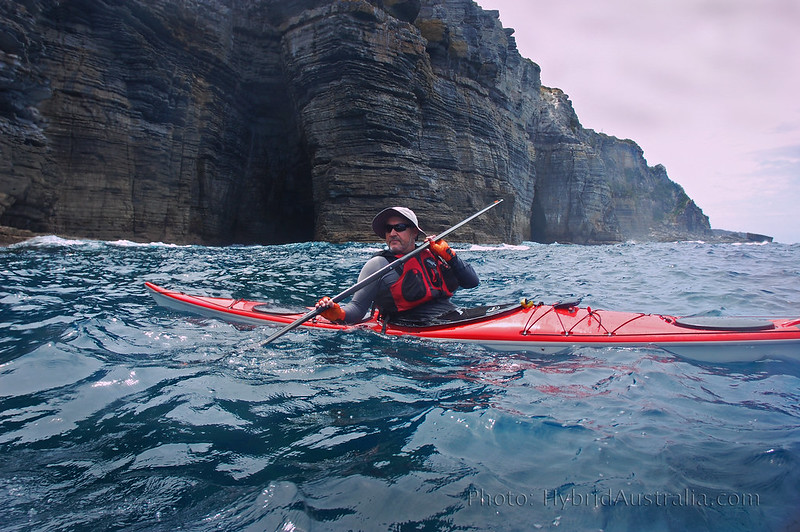
Lately I have been trying to go out paddling in rougher days when motorized boats stay put and only lonely sailors are about. I usually don’t have company as most local paddlers don’t like wind and waves.
However I am looking at the bigger picture: train for conditions that are more challenging than my back yard.

Andre Janecki has helped me before with the kayak sled and a while ago he invited me to come and paddle his part of the sea, the rugged coast of NSW, Sydney, Australia.
I was not sure how the two of us would go along: my limited skills overshadowed by my egocentric character against his extensive experience in large ocean swell and a much more humble personality…
 
Andre_r
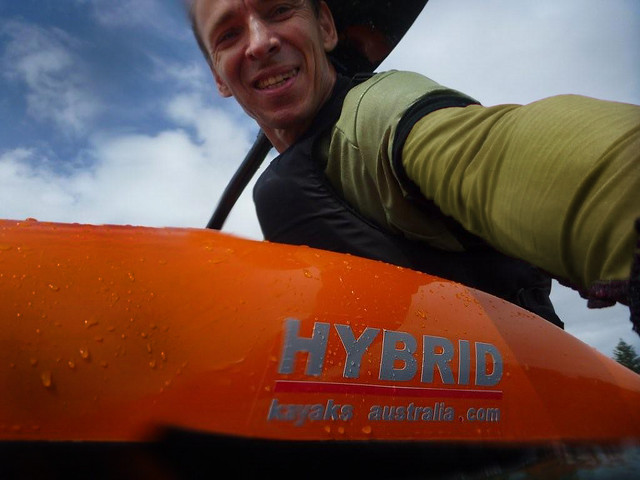
Andre Janecki-Hybrid Kayaks Australia


Andre is also a philanthropist with his sights firmly set on the UNLIMITED project, and that is what attracted me to spend time with him.
I don’t think he is in for the money, actually quite the opposite, and the Hybrid550 kayak of his design is just a fundraiser for the bigger project: a kayak for double leg amputee and paraplegic paddlers.
The least I could offer him was to make a promotional video because for every Hybrid550 sold, $500 goes to the UNLIMITED 

Armed with high spirit I loaded my car with a few cameras and minimal camping gear for a few nights. The goal was to travel light since I was not sure of my surf landings on rocky shores would be as precise as I was hoping for: a light boat makes easy work when dragged over shore rocks.
And finally I was paddling along the cliff line that I have seen so many pictures of before.
I concentrated on capturing this new world for me, trying to hold the camera while steadying my kayak in the healthy rebound; I am just not used to this.
I was hoping to film for all 3 days, but I failed to captured the stuff that kept me white knuckled fearing of flooding the day hatch and capsizing next to cliffs while retrieving my camera.
 

for a better viewing experience select HD if you have fast Internet connection, and use headphones
While I paddled along Andre I noticed that he was having a much easier time than myself keeping that kayak humming along: I was sweeping regularly in my British kayak with skeg, he was just enjoying himself in his ruddered kayak.
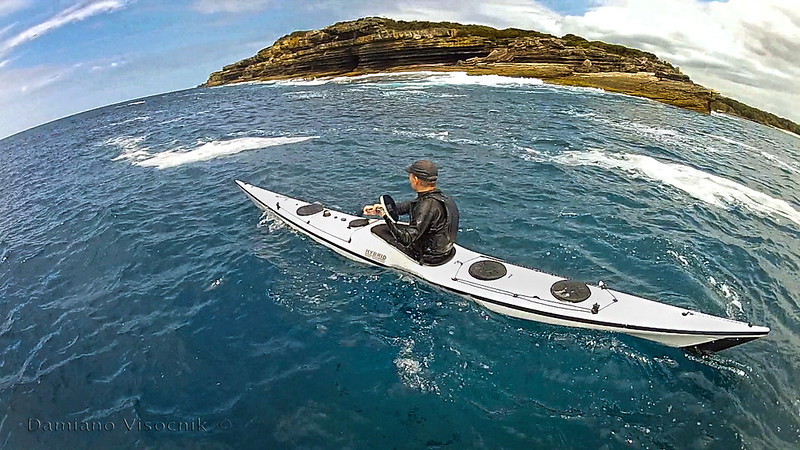
The Hybrid550 looks so slick and low profile (reminds me of a Greenland form kayak) to then surprise me with the amount of volume that really has inside those hatches; maybe is the 'symmetrical' hull shape that can carry that much gear compared to my 'fish form' boat.  

The trip was a real success. The conditions were an eye opener for me as my local bay is too easy to be able to develop decent seamanship in ocean conditions.
I am planning to spend more time on the South Coast.


12 February 2013

GEAR: rustproof knife

There is no other subject that generates more interest than talking about knifes (Justin Bieber excluded). Websites and forums seem to spark seriously opinionated debates when it comes to the perfect blade.
Myself, I have been looking for a knife that would work well for sea kayaking.
I don't need no Bear Grills knife, no Crocodile Dundee blade or a knight's Excalibur; all I want is a knife that does not rust, and stays sharp.
No many knifes will not rust, in a marine environment.
While I can get plenty of sharp knifes that will do so well for general outdoor pursuits (like backpacking) finding a blade that will really stay rustproof in salt water is not easy.
I hear good reviews of some knifes that use some really high-end steel alloys; unfortunately those knifes are also ridiculously expensive.

I have a knife on my PFD, that despite being inexpensive, after years of regular exposure to salt water is still looking perfectly shiny. One problem: it ain't sharp, and no matter how much I sharpen it, it just does not hold an edge. The blade is also very soft and bendy (yes bendy... trying to pry open some oysters, the blade just bent!).

I was pleased that in the search of the perfect knife, that would cost me less then a small kayak, an importer of outdoor goods suggested I should look at ceramic knives.

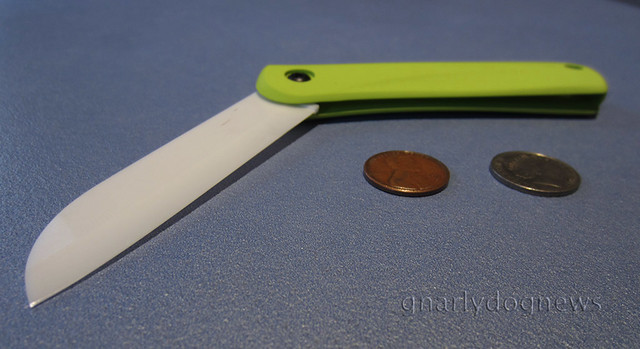
open knife_c

I have seen and handled a few ceramic kitchen knifes but never have I seen a small pocket knife or one suitable for paddling. My search for one in a holder/sheet (diving style) was unsuccessful but I did find this great offering instead.

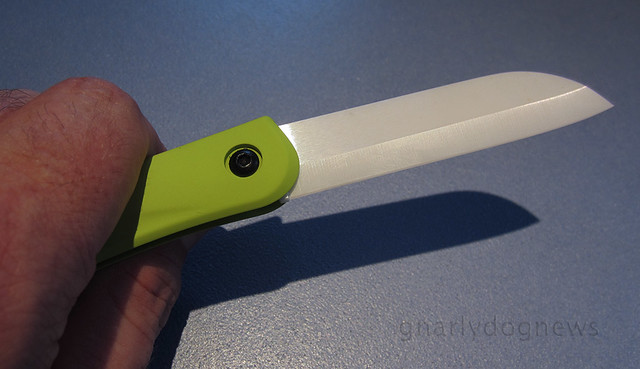
in hand_c

I sourced the knife on eBay for a silly price compared to sharp rustproof steel knives.
The size is perfect and fits my hand well, and my PFD pocket.
There are no spring to snap it open and it does lack a blade latching mechanism (there are other offerings that might have that) but I know that the knife will not rust.
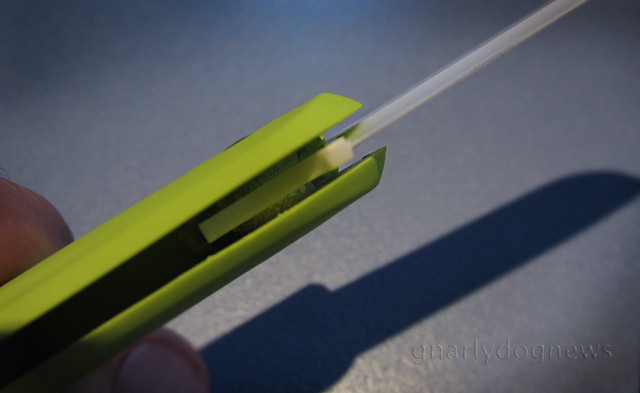
The blade is very sharp (I could shave with it) and it folds neatly into the plastic handle. The retention of the blade is just simple friction between blade and handle.

detail_c

I am not sure if this knife is the perfect choice for a rescue situation (non locking folding blade) but suitable for other common tasks. And as somebody once asked: does it cut the cheese?
I will report: yes it does :-)

cutting cheese_c

.

05 February 2013

DIY: repair a cracked paddle

It had to happen: I cracked the carbon fibre paddle.
Since I have been appointed ambassador for Northern Light paddles I have trying hard to see what that paddle can take.
From gingerly taking off in textured waters in a sprint first to becoming more aggressive with my rolling, I eventually took the NLP Greenland in the surf. To me it feels the most comfortable blade when paddling in waves but I had my reservations that it could take the surf and my ungraceful tumbles when tossed in a kayak.
But no matter what I subjected my paddle to it always delivered with no sign of problems.
Paul from Northern Light Paddles said that there was no reason I should hold back with the 3-piece Greenland and he really wanted to see what his paddles could do when treated rough.

NLGP_2

I obliged.
Pushing off from the shore when beach launching I would dig deep into the sand to propel myself before I hit the water. On rocky shores my timing would be out occasionally and I found myself pushing off rocks to prevent ending against them.
My previous wooden paddles were reinforced with epoxy to minimize tip damage but there was no way I could abused them like that.
Not to mention my high-end carbon foam-core Euro paddles where inserting them in the sand and then pry off would simply result in snapping the blade.

I was enjoying myself in shallow waters getting tossed around by the waves washing over a bank of sand. I was bracing to keep myself upright occasionally touching the bottom when suddenly a larger waves tossed me sideways and I instinctively braced and pushed down hard to keep myself upright.
My full body weight plus the force of the kayak sideways was leveraged on the Northern Light paddle.
I heard a creak and looked down. Nothing seemed to be wrong; paddle looked fine but I didn't want to push my luck and called it a day.
Later on at home I wanted to inspect the paddle and see what that noise was.
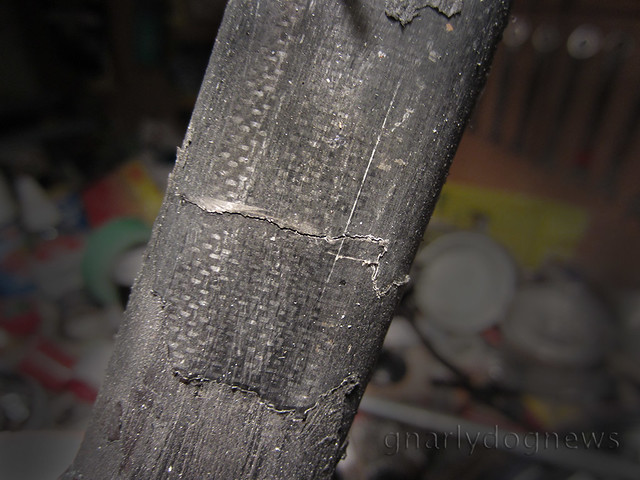
That's where I found the hairline crack.

NLP insert crack1_c

The insert on the loom of the 3 piece paddle had almost failed.
I was not too upset since a loom is fairly easy and inexpensive to replace but then I remembered the short insert that comes with every Northern Light paddle that transform it into a "storm" paddle.
It was the exact dimensions of the cracked insert bonded to the loom.
I knew that epoxy's melting point is not that high and a heat gun can soften the resin enough to make it loose its grip.
I would lie if I say that it was an easy job but 15 minutes later with the aid of the heat gun I managed to separate the insert from the loom tube.
I cleaned up the residual resin and used a bit of epoxy glue (epoxy resin and microfibre) to bond the new insert into the loom. I bolted the blades together making sure things were aligned.
The next morning the paddle looked solid and after testing everything looked kosher.
I was paddling with the same paddle the next day not showing any signs of damage or mismatching.
One thing is sure: no Euro paddle of mine can be repaired at home with such incredible ease.
As for the Northern Light Greenland paddle, I now play in deeper waters.

29 January 2013

GEAR: a rudder like no other

.
I found myself constantly sweeping on my right hand side with my Greenland paddle to keep away from the crushing waves against the tall cliffs.
The mild swell of 1.5 mt and the stern wind of 15 knots were affecting my British kayak like I have not experienced before.

Beecroft Pen_cliffs_JAN13
in a bay away from the heavy seas
I often paddle in environments where wind is the only reason for a bumpy sea.
Even on my extended trips I have dealt with following seas and breezes with ease where a bit of skeg control would balance the weather cocking of my rudderless kayaks.
I used to paddle kayaks with over-stern rudders and while I found the cruising much easier than in a skegged boat I eventually abandoned the pesky blade sticking from the end of my boat.

The deciding point of getting rid of those kayaks with “crutches” came when for the 3rd time my rudder was damaged when paddling in waves.
I was not happy with the unreliability of rudders.
As I transitioned to skegged kayaks I learned how to maneuver a boat with my body (by edging) and sweeping paddle strokes while directional stability was taken care by the adjustable skeg.
I now have 6 sea kayaks, all without rudders.
There is no denying that a skegged kayak is slower for me and that I don’t keep a perfectly true course in following seas. That does not bother me: I am in no rush and I usually don’t like to paddle too close to my buddies to be then bumping into them if my kayak sways a bit.

But all that I wanted right now was keeping myself off the big spraying smashing waves against the rocky coast. I looked over to my paddling buddy and I noticed that he was paddling with greater ease and I didn’t see any corrective strokes.
He was paddling a Hybrid550.

Hybrid550_1_c

The Hybrid550, designed by Andre Janecki, is a kayak like no other. It has features that I have not seen on any other boat. The thought process that went into designing and redefining that kayak is astonishing.
Unlike so many kayaks that capture my attention and look so similar to each other, the Hybrid550 is unique. Its cockpit concept is inspired by white water boats with outstanding ergonomics for this chunky body of mine while still perfectly accommodating a more nimble paddler. One thing that concerns me is the width of the cockpit rim since my, how can I put it, “love handles” might rub after a while.  I hope one day Andre will produce the Hybrid 550 L (larger cockpit) but I understand his priorities are with the “UNLIMITED”  www.hybridfoundation.org.au
 
What intrigues me however is the unique design of the rudder.

Hybrid rudder_1

As I was dissatisfied with my own rudder boats many years ago I looked at the alternative integrated rudder of Mirage kayaks. I liked the look and I like the idea of not having anything above deck, nothing to swing and insert in to the water with so many less parts moving resulting in a simpler design. What concerned me though is the fact that the Mirage rudder is always there, even when I want to seal launch or beach land and drag the kayak.
After repairing a few split rudder blades from friends' Mirages I decided that if I wanted a rudder boat it had to be stronger than that.

I did the initial mistake of confusing the rudder design of the Hybrid550 as a copy of the Mirage but I never had a real close look at the details.
I now know that the pivot points are totally different, the action of the swinging blade is different and the construction is nothing like the Mirage...
 
Hybrid rudder_2

I had a GOOD look at the rudder on the Hybrid550 and I have one thing to say: brilliant.
It can take a reverse surf landing, right on the blade. What other ruddered kayak can do that?
None that I have seen so far.

Hybrid rudder_3
rudder folding away and bending when being hit
I am a skeg man, I don’t paddle with ruddered kayaks. I came to the realization that rudders are not suitable for my style of paddling.
With the Hybrid550 however I now have to rethink my philosophy. 

Psychologists have found that familiarity breeds fondness: Repeated exposure to a new idea leads to progressively lower fear and avoidance and even, eventually, sometimes, to acceptance. (Megan Kimble)


24 January 2013

VIDEO: Bumping around in waves


I found myself getting tossed around more than usual in those short dumpy waves.
It has been a while since I paddled Green-Piece, the quirky little lime green Currituck from Impex.
Yes, it felt little compared to my other kayaks and with my hefty weight it does not suit me as multi-day tripping boat (I think I am at the load capacity limit). I find that boat quite nimble and I seem to be able to turn it faster than other hard tracking kayaks.
I wanted to take it surfing and find out what it can do for me.


select HD for a superior viewing experience

I noticed the bow getting pushed under the surface faster than my other larger kayaks and occasionally it would pitch and broach; I think a lighter person will find it more forgiving.
Reverse surfing made me spin quicker than in my Zegul and I had find again the balance point before it would tip over.
It was refreshing to be paddling a kayak that I have neglected for a while thinking that it just was not suited for me.
It gets to show what a difference a few years make and with new skills what fun I can have in a kayak that I find boring otherwise when flat water paddling.
.

15 January 2013

DIY: paddle retention on kayak deck

.
A few years ago I came up with a great on-deck retention system for split paddles.
It was also just about then that I stopped using Euro style paddles and transitioned to Greenland paddles. The new style became my regular paddle and soon I totally abandoned the fat blades.
My spare paddle became a shorter version of the full length GP (also known as "storm") or a slip sectional full size one.
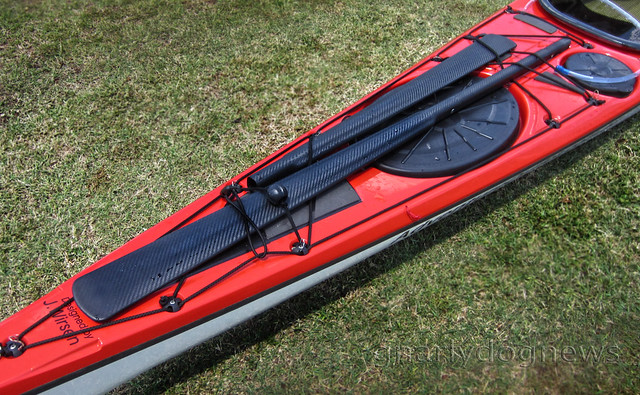
While the split Euro paddles fitted well on the front deck, I did not like carrying the Greenland storm on the front deck.
Some argue that a spare paddle should be readily available in case the main one (the one in the hand) is lost; in ten years it has not happened to me once. I also use a paddle leash most of the times so I minimize the risk of parting company with my paddle. It is a risk that I am now willing to take that if one day I will loose a paddle I will have to reach for the spare paddle behind me. Then again I often wondered if I would have the presence of mind to grab that half paddle in front of me anyway, in the heat of the battle.... probably not.
I am happy to carry my spare on the rear deck, to create an uncluttered front deck.

NLP on rear deck_2

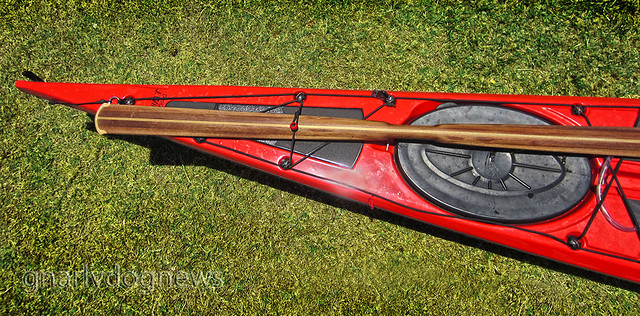
The kayaks in my fleet all have bungee cord on deck for the retention of miscellaneous gear that one wants to access while on the water. Some kayaks have strategically arranged these bungee in view of carrying a spare paddle. The idea is to slide the paddle under the bungee and hope to retain the paddle.
My experience however shows that if the bungee is not highly tensioned those paddles tend to creep out in heavy seas and occasionally dislodge in surf.
Sliding the full length of the paddle under tensioned bungee is often tricky while I scratch the shiny gel coat (considering resale value).
I wanted a system that retains my paddle but would not require a slide.
On my expedition kayaks I devised a flat strap with a Fastex buckle.

paddle retention_4

It worked well; I could attach my split Euro paddle there with little fuss.
With the storm GP there is only one shaft (loom) and the buckle of the Fastex clip was not working well there: it would slide and become loose.
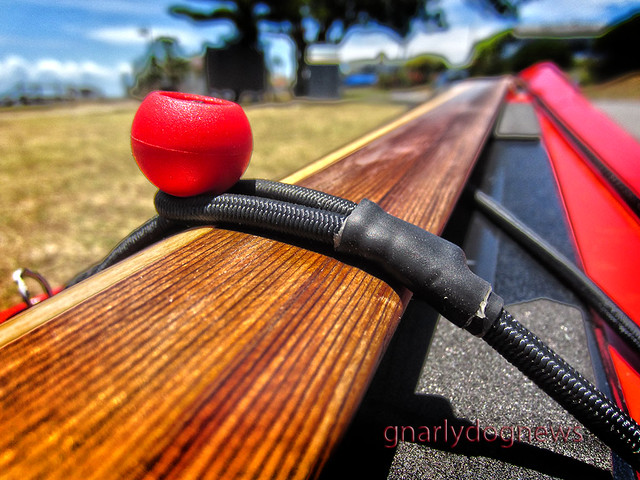
Borrowing the idea from my simple paddle leash I now use this system for my spare paddle retention.

paddle retention_2
laminated Western red cedar storm Greenland paddle by Greg Schwarz

paddle retention_1
heat-shrink over the bungee joint

Removing/attaching the paddle is very simple: I just pop the bungee loop off the little plastic ball.

paddle retention_3
retention system released

While the bungee retention system works very well for paddles I recently found out that it works also in anger when I need to attach something on the rear deck quickly.
One of my camera mounts failed in heavy seas and I had to stow it away as it was dangling in the water with my camera still attached (I did NOT loose that one this time!).
I had to jump in the water, take down the remaining mount and attach it to the deck, while bobbing up an down in waves (I was also happy to be wearing a PFD). The bungee and ball system worked very well allowing a swift attachment of the hardware that I would not be able to carry any other way.
Reentered and rolled, pumped the water out of the cockpit and I was sailing again on my way in minutes.

04 January 2013

REVIEW: Buff water gloves

The brutal Queensland sun is a killer; it causes an incredible number of cases of skin cancers.
Protecting my body from the harsh sun is imperative for me. When kayaking I cover my body with a long sleeve rash guard, my head with a wide brim hat and the rest of the exposed skin with SFP 50 sunscreen lotion.
My hands tend to get very wet when paddling since there are no drips rings on my Greenland paddle; sunscreen would wash off too soon and gloves are my best defence against the sun.
In the search for the best gloves for paddling for years I used several brands of sailing gloves.
Some half fingers styles did not work for me where the fabric would bunch under my thumb and cause blisters. I also find sailing gloves too bulky with all that padding in the palm of the hand; they are designed to handle ropes (sheets) where padding is desirable to prevent rope burn.
As most of my sailing gloves started to fall apart after a year of regular paddling, I really wanted thin gloves, with no padding, that were durable.
Then I stumbled upon a different offering from a company famous for their head/face scarfs: Buff.

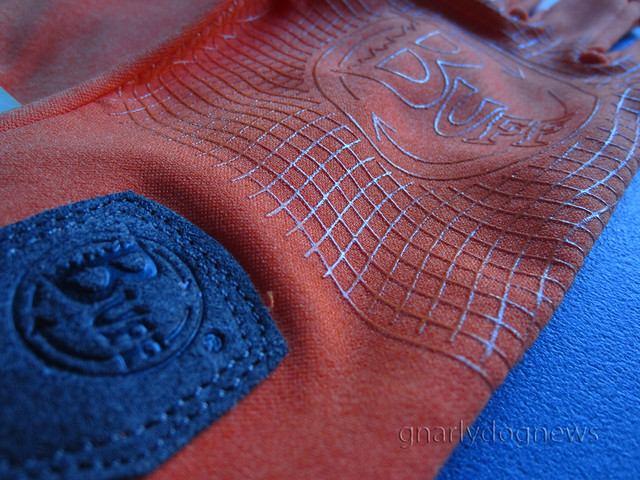
Buff water glove silicon detail_c
silicon texture detail on the palm
In their line they have a glove mainly designed for fishing where protection from the sun is the key.
I ordered a pair a year ago and initially I was dubious about the durability of the product; the thick Lycra style fabric was not convincing me as I thought that they would not last long, similarly to my cycling gloves.
Surprisingly however the gloves are outstanding.
The lack of bulk allows me to grip my paddle easier with no bunching-up in the palm of the hand.

Buff water glove palm_c

Furthermore the palm has a grid of textured silicon that gently grips the paddle. Without gloves some of my carbon Greenland paddles would occasionally slip forcing me to have a dead grip to keep them in my hand. With the Buff gloves the paddle feels more secure and after a year the silicon is still in place and doing its job.
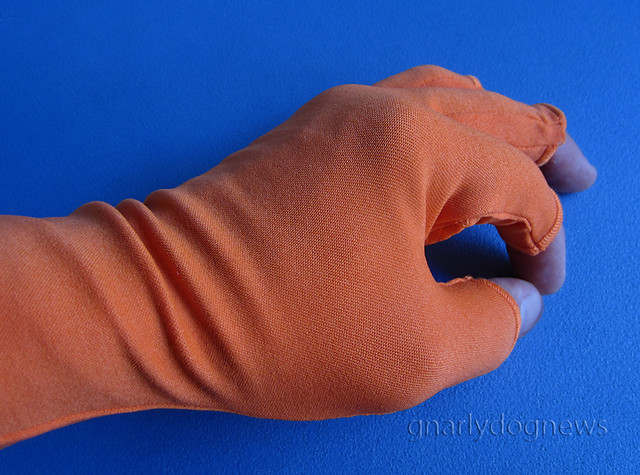
The very long cuff allows me to create a decent overlap at my wrist between glove and rashie, something that the sailing glove did not. I no longer have funny looking sun-burned strips around my wrists that I am sure some folk thought were caused by some "kinky" bedroom games :-)

Buff water glove_c

The stitching is superb and nothing has failed after a year of paddling.
Where occasionally I used to stitch-up my other gloves on the sewing machine, the Buff gloves have not failed.
Originally I ordered a size L-XL for my hands but I always felt that the gloves were just a bit too loose, so I got myself a Xmas present and ordered some "safety" orange new ones in M-L that fit me like a, ... doh, glove.

Buff glove_c

This product review is independent, unsolicited and unrenumerated. No swag, no perks, no glory.
Bought the gloves on eBay from Utah, USA.

01 January 2013

PHOTO: Start of the Year

Somehow the conventional NYE celebrations left me wanting for something a bit more real this year.
On the 1st of January, not having to nurse a headache, I headed to the beach instead.
The surf was promising and I was in an unfamiliar kayak.
Not wanting to hold back I decided I was starting 2013 head on.

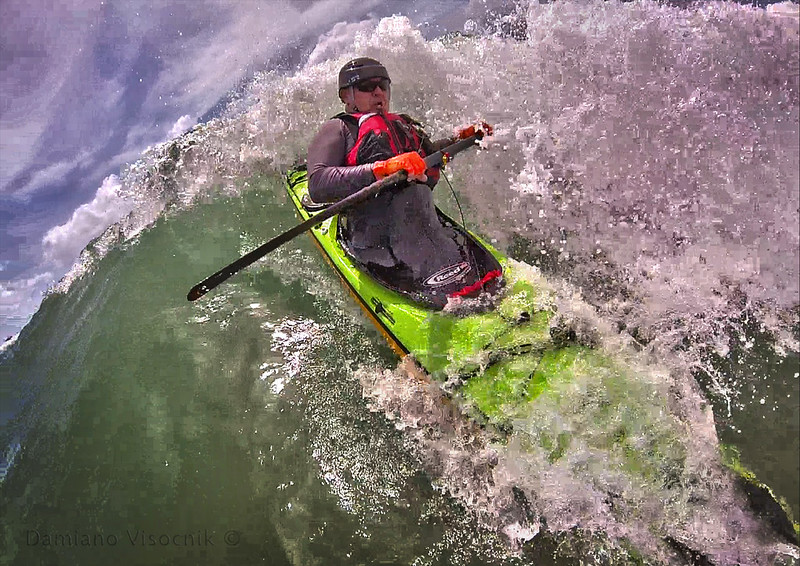
Start of Year_c
New Year's resolution: more of this :-)

.