17 November 2014

Vandal or innocent fun?

At my favorite camping spot I was confronted with this scene.
To paint the picture a bit I should mention that it is a National Park heavily frequented by motor boats; a popular destination for day trips or overnight camping; in other words a busy place, not remote at all.
Axe yealding_c

I did not know how to react and experience has taught me not to engage too much with somebody possibly not doing the right thing. My initial reaction was disbelief soon followed by anger: somebody was cutting down trees that offered shelter from the sun and wind, in a natural place pleasant enough that I often call home for a night or two.
But the best I could do was to keep my distance somehow and just take photographs.
Even though the youngster did not look too menacing, my camera is no match for an axe; if not used by the youth, certainly by the parent not too far away.
Cut tree_c

There were a dozen trees that have been freshly cut, some a bit too large that seem to have deterred the short attention span of the kid that found attacking smaller ones more rewarding.
The child was still hacking away when I got near him but then he stopped and watched me for a while.
I am not sure what went through his head and if he felt that a camera on the scene might have prompted to review his actions.
It was not long before the adults arrived to see why the chopping stopped.
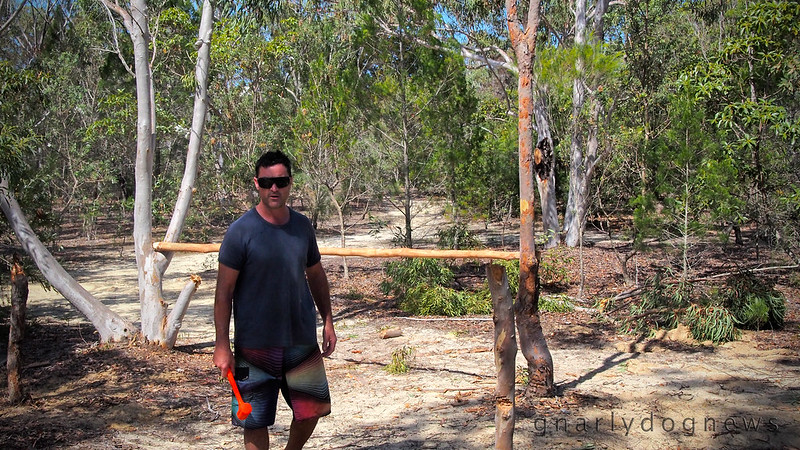
Cubby house_c

I was asked what I was doing and I explained that I was photographing.
Again the older man wanted to know what for and I revealed that it was for documentation.
Hammer in hand he stepped closer to me and asked: What for?
I explained that somebody might be interested in my images, suggesting the ranger.
At this point the vibe changed and I could sense a shift in emotions.
The hammer holding man tried to convince me in a loud voice that his kid was just having fun and that I was not allowed to take pictures.
Soon a little group gathered (friends of the man) and started to shout rather insulting remarks.
It was clear to me that it would not be wise to try to explain my view, after all I was quickly labelled pedophile and pervert and police was going to be called in.
I thanked them for their decision to actually call the police as maybe a few things could be cleared but I never saw the arrival of any law enforcement.
I also knew that it was time to retreat, clearly outnumbered by menacing little crowd.
I walked away happy that despite my rage I was able to remain calm and not engage: it was not my place to prevent trees getting cut down.
Somehow maybe my presence and the fact of me taking images deterred the kid from continuing and the ax was put away: damage was done but at least not continued.
I feel sad that the child lives in ignorance and cuts trees down in a National Park, right where so many others try to enjoy the place. It makes me wonder what messages has he learned at school, or is the influence of his father stronger than what I hope the educational system has given him?
The other part in me also acknowledges that it could have been intended as innocent fun to build a cubby house (his father's words), just maybe in the wrong environment?

Later in the afternoon I suddenly heard a chain saw fired up and the shrieking sound of trees getting cut down at the other side of the camp.
This time, I was not going trying to document the event.
A kid with and axe is one thing, somebody waving a chainsaw at me is a bit different, especially if alcohol is involved...

.

11 November 2014

Video: Radikal Kayak Surfing

I love this video.
Beside the incredibly smooth kayak surfing demonstrating outstanding skills using an unconventional paddle, the footage capture and the editing is really captivating.


It inspires me to get out more in the rough stuff and play.
My aspirations: to be one day half as good as Marc.

.

07 November 2014

Photo: candle lit tent

.
Candelight tent_c

First outing with the new "summer tent".
I need a roomy tent for tropical conditions, for when the nights are humid and hot, or for when it's raining. Small tents are a sauna in the Queensland heat and ventilation is critical.
While not super light (2.7Kg) and not very compact it still allows me enough elbow room for maybe a game of cards with a few buddies?
I got this one for a steal at REI...

03 November 2014

GEAR: cheap light stoves

.
There are a few things easier than cooking on a gas stove when camping, eating cold food is one.
I love the simplicity of canister gas stoves: turn the control knob, light the flame and we are "cooking with gas"

stove comparison_c

I have made a previous post about the virtues of compact gas stove here.
I have since updated my stoves and opted for something that is stable but still light.
I prefer to cook with non-dedicated pots that are not part of a system (with flux ring, like JetBoil and MSR Reactor).
I like the flexibility of being able to use a small frying pan (that I picked up at K-Mart for under $10) when a fancy dinner or breakfast is in order.
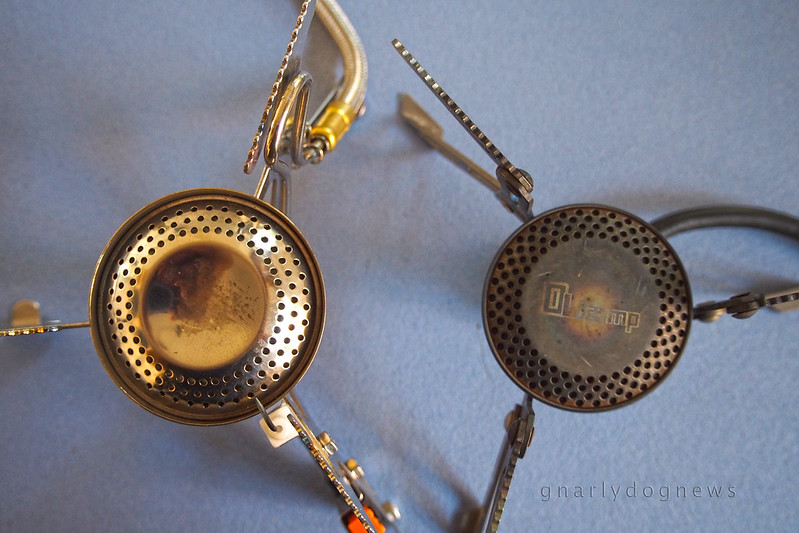
Therefore I looked at stoves that are close to the ground, have a decent footprint for stability and have a large burner (Pocket Rocket's small burner head scorches light pots).
Above are two stoves: left is a very cheap one in stainless steel from eBay, right a bit more expensive one in titanium.

weight comparison

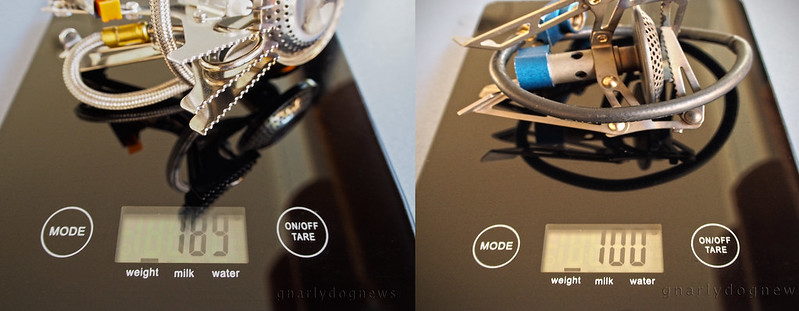
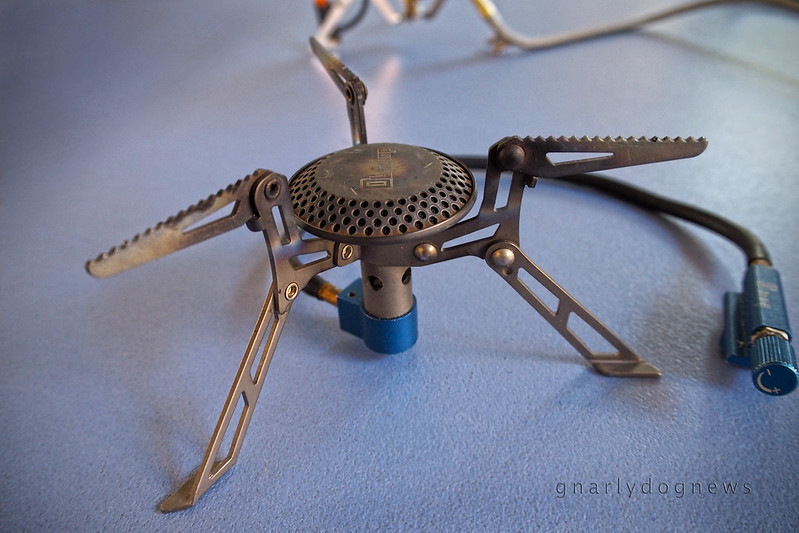
For the last 18 months I have been using a light titanium stove that sits low to the ground. At 100gr. is very light, packs away small and shows no signs of rust.
The stove is so light that a small movement of the flexible hose tips it over if no pot is on the stove

Olycamp Ti stove_c

I have used this stove for approximately 100 days, cooking extensively meals for two, occasionally for 4.
Coupled with a light windshield (very thin aluminium sheet) it has worked well in above freezing temps, even in very windy locations. The windshield is critical when there is a breeze as it retains heat and saves fuel.
When cranked to the max the stove roars and emits too much heat; I usually have it regulated at about half power.

Olicamp fitting_c

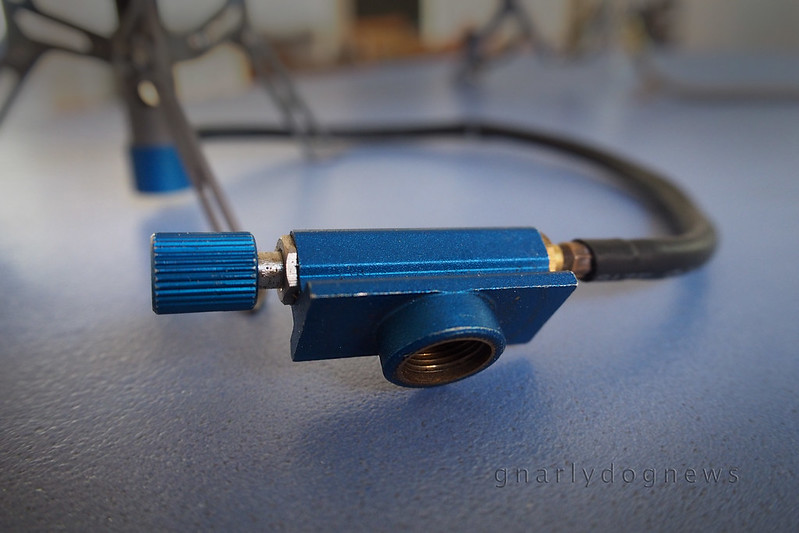
The flame control knob is at the canister spigot, away from the heat of the burner and easy to adjust when the stove is going. I like that: no burned fingers trying to reduce the flame when I feel my risotto is about to get scorched.

Olicamp hose_c

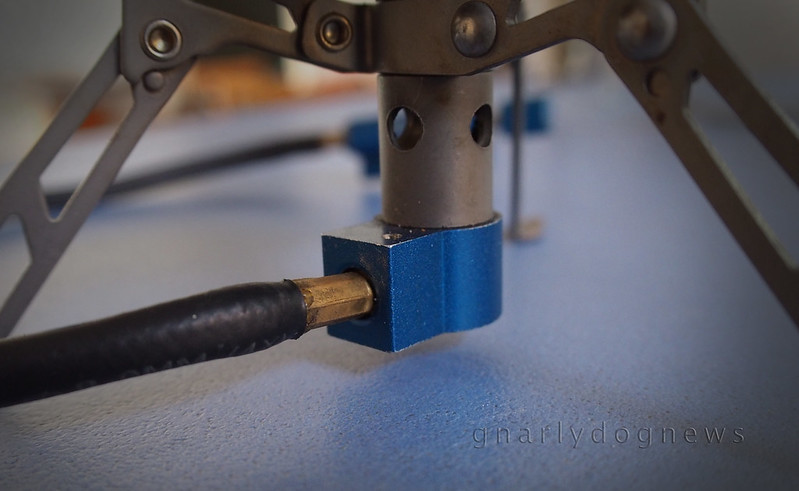
But there is little fault: the hose junction into the base of the burner's jet.
While the hose does have an O ring on the shaft of the hose intersecting the (blue) aluminum base, the hose can not freely rotate. A slight redesign would make this stove even better.

Trolling on eBay I came across this stove: a compact stainless steel design with large burner (did I mention I don't care for burned food?).
Labelled as "Lingyun portable gas butane stove..."  I was impressed by the price: $17.99
I ordered one as I thought it would be great as a back-up stove.

Lynun stove_1_c

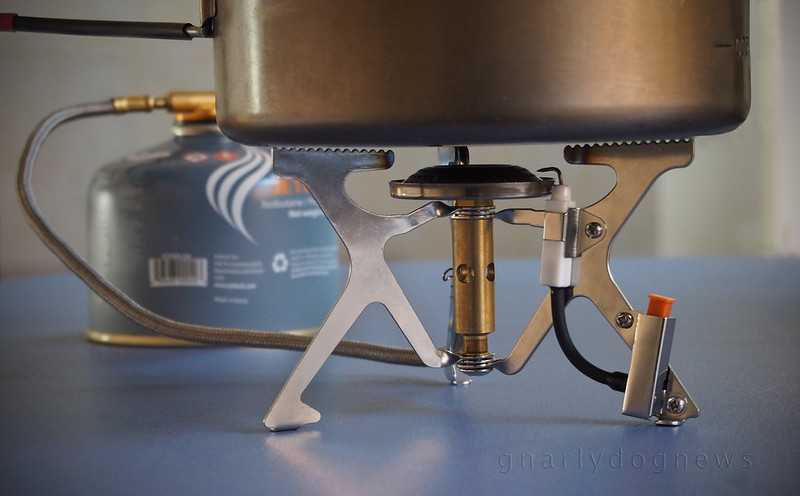
The difference on this one are the legs, the fuel supply and the ignition.
I don't care about the piezo ignition where the stove can be started by just pressing a button: my experience is that they don't last. Luckily I can unbolt the unit when it will stopped working and use my trusty BIC lighter.
The legs of the stove are however made of one-piece sheet metal; they can not be accidentally folded and collapsed while operating the stove making this unit a bit more sturdy, requiring less care.
The downside is that this stove is not as compact as the titanium one, when stowed.

Lynun stove_2_c

Last but not least the fuel supply.
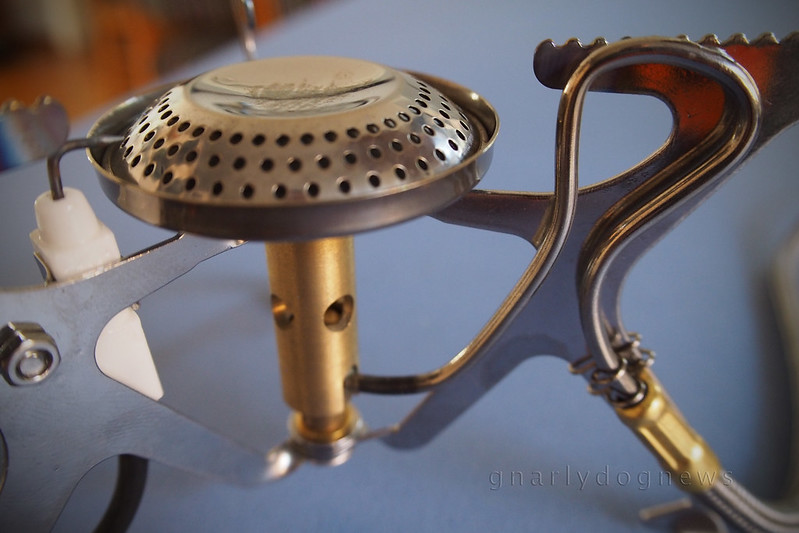
The gas travels from the canister to the stove via a flexible hose and then, just before reaching the jet is makes a loop of solid pipe passing close to the flame area.
It is intended to vaporize the butane/propane gas before it reaches the jet when ambient temperatures are low, close and below freezing.
While not really a concern to most sea kayakers in tropical locations, outdoor users in colder environments lament poor performance of gas canister stoves when temps are chilly.
The preheating loop takes care of that and delivers hot gas to the burner (once the stove has been operating for a minute or so).

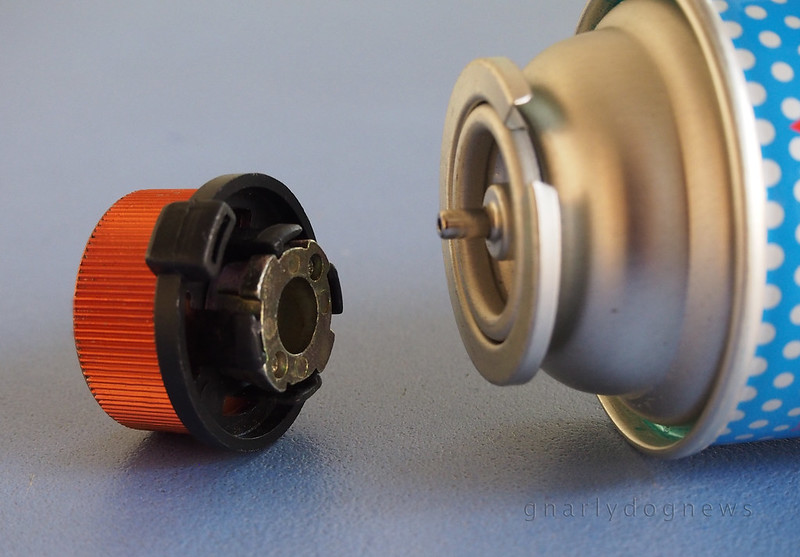
And while I write about gas stoves I should mention this little adapter.

adaptor1_c
*If you run the canister sideways with the notch up, your canister will deliver fuel vapors.  If you run the canister with the notch pointed down, your canister will deliver liquid fuel.

The gas canister stoves use a Lindal valve, where the stove or regulator are screwed-on to create a leak-proof seal. Gas canisters are usually a mix of butane/propane for better performance in low temperatures. They are readily available at good outdoor stores but not so easy to find elsewhere.
I had a bit of trouble locating the Lindal valve canisters in Sweden but I saw plenty of push-on style butane cans.
Again, on eBay I was able to source an adapter that allows screw-on stoves to be used with the much cheaper ($5 for 4 cans)  option of push-on cans.
The push-on cans are often just basic butane, more suited for warm climates; however I have also seen the butane/propane mix ones.

adaptor2_c

And to get that gas stove working well in windy places (cooking inside the tent is a bad idea) I sourced a matching windshield.

windshield2_c

This shield is a bit heavier than my super thin one that I have used for decades, the advantage is that it has little spikes that can be driven into the ground to keep the stove and shield well connected.

in the field_c

.

22 October 2014

GEAR: SeaDog sail Code Zero

I nearly tipped in and went for a swim when a small set picked up my kayak and I started surfing.
I was in my "tippy" kayak and half an hour into testing a new sail: the SeaDog 0.7 mt² in Code Zero .

SeaDog Code Zero 0.7mt_1

I was having fun trying to catch the short wind waves that the tidal flow against a healthy breeze was producing.
I am familiar with this location and often I wait for the conditions to be just right to be able to surf with my kayaks.
I am not sure if the long waterline Swede form narrow beam low rocker kayak was ideal for the small steep short waves but I wanted to see if a smaller sail would be easier to use in a stiffer breeze.
I have several sails from Flat Earth of 1.0 mt² and 0.8 mt². They work great and are very efficient sails for sea kayaking. Their design is a derivative from the decade old, or more, proven system that the Tasmanian sea kayakers have been using in strong winds.
That lead to the development of a sail mounted further forward, away from the paddler's cockpit as explained here.
The SeaDog sail is an unapologetic close resemblance of  Norm Sander's rigs and Flat Earth sail.
Actually the design is strikingly similar.

SeaDog sail_3

I have been kayak sailing with other paddlers that have been using SeaDog sails for the last couple of months.
Richard, an avid SE Queensland Sea Kayakers paddler, is the man behind the brand and his passion for sailing is evident.
He can be seen paddling every weekend (and often during the week) sporting sails of his own creation on his kayak.
It all started innocently when Richard decided to add some color to his sail.
A special one was made just before Xmas and of course, inspired by the festive season, it was green and red. It was different and unique; people noticed.

Xmas sails_SeaDog
photo: SeaDog sails
I was impressed by his early work even tho I didn't share his passion for the color choice :-)
A few weeks later a new colorful sail appeared in the paddling group. Again the work was impeccable.
I watched those sail taking the wind very well and I noticed them filling with air at even very acute angles into the wind. One thing that I was very surprised is that Richard's sails did not flutter.

Eventually Richard made me a sail that I was missing in my quiver: I wanted a small sail that will allow me to be used in winds of 15 knots and above.

SeaDog sail_1

I have used my Flat Earth of 0.8 mt² in winds where I no longer was comfortable with the heeling force of the strong wind. Unless surfing, the hull speed of my kayak will really determine how fast I can go, no matter how big my sail is

As the small waves started to pick up my kayak the SeaDog sail was hit by a gust from the side. Any other time I would have to quickly react with a solid brace with the risk of tipping over.
This time the jolt was softer and the shock cord on the main sheet (the rope that pulls-in the boom) released some of the pressure from the wind. This sail being smaller helped reduce the heeling force that wanted to tip the kayak into the water. I was able to stay upright and continued to surf.

The downside of a smaller sail is that I have to work harder and paddle more when the wind is from behind (running with the wind). As the waves catch up with me I have to put an extra effort to then accelerate down the wave.
Side-by-side with a buddy using a 1.0 mt² sail I had to really crank to catch the marginal waves, while I could see that he was getting more push from the wind.
However, I am sure if the wind was 20 knots +  he would be a bit worried with his larger sail...

SeaDog sail_2

In essence the SeaDog sail of 0.7 mt² is best suited for stronger winds or paddlers that have just starting out sailing, possibly with less bracing skills. Lighter paddlers will also appreciate this sail as their lack of counterbalance body weight is noticeable in strong winds.
SeaDog sails also makes 0.8 mt² sails, in traditional colorful Dacron® or the fancy laminated Code Zero (unfortunately white only).
On closer inspection I notice very clean seams and stitching on the SeaDog; every stitch is continuous from one end to the other with absolute precision. Every end is reverse stitched to prevent unravelling and the tension on the bottom and lower cotton is perfect to create a very clean stitch.
Attention to details is superb and the finish is outstanding: every rivet and every reinforcement is very well executed.

SeaDog sail_4

Is SeaDog a better sail for me?
I can't say that as Flat Earth has served me well and I had no trouble for years now.
What I notice is no flutter in the leech, something that mildly annoys me in the Flat Earth sails.
I mounted the SeaDog sail with two back/side stays, as I have done on all my other sails.
Richard recognizes that kayakers have preferences in mounting styles and hardware used for doing so. He supplies the sail with the mast, Spectra stays and the flexible polymer base only, leaving the rest up to the sailor.
I much prefer that since some of the (Flat Earth) sail kits that I have used had parts that failed on me.


08 October 2014

Photo: Back to Magic Island

.
We found it again despite not having it clearly marked on our map last summer.
The weather was warm this time with less wind; the clouds benign and not threatening a thunderstorm.

Magic Island_2_c
photo: Petra Ries
The sun was baking the polished granite shores and soon we would be laying on them drying our bodies after a refreshing swim.
We were back to our Magic Island

.

03 October 2014

Video: Aquarius Sea Lion LV

On a sea trip of 5 weeks in Sweden and Åland (Finland) Petra paddled a Sea Lion LV.


Aquarius of Poland sponsored her with a very light carbon/Kevlar kayak and we installed her Flat Earth sail to make our expedition more fun.
Petra picked the color scheme of her kayak and I thought the graphics were particularly attractive making the kayak very visible against the water and granite islands.
The kayak behaved very predictably in varied conditions and weather-cocked just enough to make it safe when windy, even in a storm.
The only real modification was removing the padding that was factory fitted on the seat; lowering the center of gravity made the kayak a bit more stable. Given that she has never paddled a Sea Lion LV before, Petra liked how she felt in that kayak right from the beginning.
Despite the cockpit maybe being a bit too roomy for her the key hole style thigh braces allowed her to brace efficiently when the waves picked up and tossed her around a bit.
Cargo space was sufficient for our extended trip and the main hatch covers (Kajak Sport) never leaked (the "glove box" needed a bit of sealing around the rim).
The skeg performed flawlessly and was butter smooth to operate. Adjusting the foot rests was possible even while paddling (without needing to exit the cockpit to reach the adjusting tab behind the foot rest!).
The shorter waterline and the rockered hull seems to be well suited to shallow waters with shorter waves (no ocean swell in the Baltic sea). Clapotis was not upsetting Petra and I noticed increased confidence in following seas where she was catching and surfing waves way faster than me, leaving me behind.
I think that the Sea Lion LV combined with a sail is a great fun kayak.
It performed well with just light loads in strong winds (slight leek cocking when sailing) and very steady when filled with camping gear, food and water.


10 September 2014

The power of disconnecting

.
I call it "expedition style".
Petra was starting to understand what I meant by that; it was not the fact that we were now on our third week of 5 paddling and camping in the Swedish archipelago, it is more the state of mind that comes from being away from everyday life.

My highlights of any given year are usually my trips.
I love being away from the confinement of 4 walls and a roof, plugged and connected to the increasingly demanding "social media".
For 5 weeks I wanted to not think about others far away from the place I was in.
At the risk of offending and being called selfish I cherish the being away from others.
The islands we were travelling through had slightly more traffic then last year and on occasion my first choice of campsite was already occupied: we could not have the whole island for ourselves.
It was however prime holiday season for Sweden and realistically we were not that far off shore to think we could be really alone.

Evening shore walk_c

I prefer to travel with as few tools as possible that keep me connected to my usual world. I had to have a mobile phone with me so my friend Johan could text me the weather forecast. Honestly I would have preferred not to have it. I chose not to bring a GPS even tho Sweden would be one place where I could really use it as "geographical confusion" had its moments.
In a spur of the moment decision we started our trip too far South along the coast where we had no map for it. Interestingly enough the initial concern quickly drifted away since I knew I just had to keep to the right of the big islands but not too far out to be in totally open sea.
The fellow paddlers that we met and chatted to shook their head when we told them that we didn't have a map for the first days' journey and ultimately planned to reach Finland.
I now laugh at myself thinking that we might have come across a bit bizarre: we had the right gear and our kayaks were of the latest style but not having a GPS or even a map? now that is odd...

Vögeln camp_c
On my last local paddle in Australia before my Scandinavian trip I was in company of other paddlers that elected to use way-points to reach an island in my bay that clearly needs little navigation aid to be reached, in my opinion. I prefer the "navigation by sight" style where things become clearer as I get closer to my destination. And if I paddle a few minutes longer, I regard that as bonus time on the water.
There are times and places where electronic navigation does come in handy, but in reality often common sense still helps me out where I paddle.
Somehow there is a primeval sense of connection to the land or sea when I don't rely on too many external aids to travel in a remote place, a sense of achievement and discovery that I deem electronic devices can take away from me. I could have mapped my journey way more efficiently and searched online for "the best spots" to then have my GPS guide me along, but that is not how I like to travel.
I could have many websites tell me what the weather was going to do (rarely accurate tho) but I would have not engaged in conversation with the occasional sailor asking him for the wind predictions. I often ended up spending some times with them and had additional local knowledge shared with me, something that many websites can't offer.
Petra even scored the odd cookie or piece of cake from strangers once they discovered that we were travelling far.

And in the evening I was glad that I had no social chore of updating my site (I never did buy into the Facebook thing) and keep my fans fed. I spent my time running around the granite shores, sometimes taking pictures or just laying on my back on the warm rock, concentrated on the clouds passing by above me. I had time to talk to Petra; talk like there was no rush to say things as there was plenty of time. We did not bore each other with mundane trivial facts of who is doing what in the world.
We cared about our world: right there and right then.

Dinner at Lost Island camp_c
Did I miss out on something?
Yes, I did.
I did not hear the news for over a month; I did not hear of air disasters or wars, Royal babies or rock stars deaths, no scores of games and no updates on championships. And it felt so good.
The simplicity of being able to focus on what really matters can only be achieved when I disconnect, anything else just muddles my head.

Tara Jacoby:
You know that naked feeling you get when you realise you’ve forgotten your phone somewhere and have to go an hour or (gasp) a day without it? Rather than rushing to cover up that nakedness with a nearby tablet or the iPhone of a passerby, embrace the freedom a little. Enjoy the fleeting moment of not being tethered to a device that can tell you anything about anything at any given time. ...
Just be present and live in blissful ignorance, if only for a moment.
,

04 September 2014

Photo: The German camp

As we were paddling close to the cliff line when we rounded the corner their camp came suddenly into view. We found the Germans again.
We met on the water the day before and briefly chatted, then saying goodbye and hoping to meet again.
Myself and Petra have been on our paddling trip for 3 weeks already and wanted some company: time to talk to some new paddlers. It was late in the afternoon and despite having only paddled a short distance that day we saw no reason to paddle past this great little bay along the cliff faced Northern shores of the Åland islands.


The rocky granite ground was a bit bumpy in places but enough flat glacial-polished spots could be found for our tent too. A few showery looking clouds made sure that we searched for a location that would not pool under out tent in the middle of the night.
We spent the evening talking with our new friends, me in English, Petra in German (while I do understand "school" German the fast-talking locals leave a bit behind at times...).

Sunset finally approached and the light went "magic".

Reflection of Ǻland_c

The higher ground above the bay was graced with little ponds making the landscape a delight for an evening walk.
The glacial sculpting of the last ice age was particularly interesting here: the layers of the rock were tilted allowing the top edges to be of a baby's-butt smooth finish.
It felt great to run the hand over the shiny rock, reminding me of soft leather.
We laid down, our backs onto the warm granite and looked at the passing clouds in the sky, now no longer threatening rain. We knew real darkness would not come here as the sun was rising again way before we would.

.

23 June 2014

Call of the Baltic

I retire to the tent late, tired; it has been a long day.
I lost track of time because I did not need to know, my watch stowed somewhere deep in my kayak.
The sun has been shining since very early morning and now has almost made a full circle around the sky. I watched it eagerly skirting the horizon but it just doesn't want to set.

Sea kayaking in the Baltic sea is extraordinary.
The labyrinth of islands where I choose not to navigate electronically (no GPS for me) are truly endless.
I don't have to rush to find my campsite as I don't have a set destinations; there is an incredible abundance of good spots to stop for the night.
The wind has been pushing us North and made our journey easy.
The sailors we meet along the way are intrigued by our kayak sails and often question us.


I have  a great sense of freedom here.
The vast choice of routes and destination, places to stay for the night and easy waters create an environment suited for my style of travel. I am not pressured by tidal flows and timing needed to reach my camp, I get up when I feel like and paddle as long as I want; night comes too late to have to fret and usually I tire out way before I run out of daylight.
And there is no sand at camp: always a bonus for me. While sandy beaches are gentle on the kayak's hull they are my nemesis when camping. I rather have hard granite under me anytime over messy sand that seems to stick to all things it shouldn't.
The sea water is so much less salty here; I use it to cook pasta and potatoes but just a bit too briny for drinking. I don't have to carry much fresh water with me anyway since there are enough houses around with a hand pump in the back where I can refill every couple of days.
The Baltic sea offers me the perfect blend of civilization when I need it and remoteness when I want it. The islands closer to the mainland have more vegetation, more houses, shops. Further away are the outer islands: often desolate low elevation polished granite shores exposed to the wind and waves.A great place to camp in fine weather where I rarely seen any other sailing boats and hear no noise but the one of wind, waves and birds.

For the next couple of months is where I will be.