Showing posts with label sea kayak. Show all posts

29 September 2016

West Coast Dream

The wind was blowing that afternoon as we crested the coastal hill to view what lays ahead for tomorrow's paddle.


select 1080p to view video in full HD glory

Johan Wirsen offered us to test two new kayak he recently designed: the Rebel Husky and Big Dog.
We were now paddling the West Coast of Sweden, North of Gothenburg towards the Norwegian border.
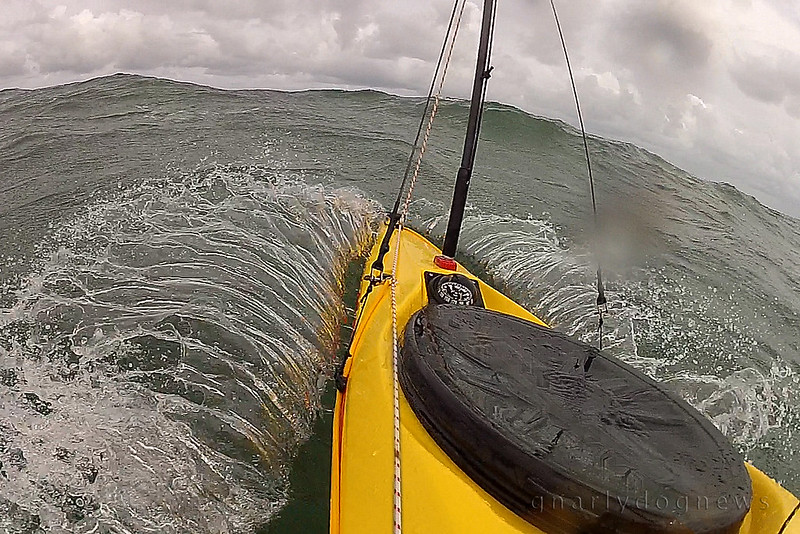
We mounted sails onto the decks for added fun hoping that the wind will push us along.

*This video is a follow up on the theme: I have a Dream


03 September 2015

Photo: camp at Japanese Gardens

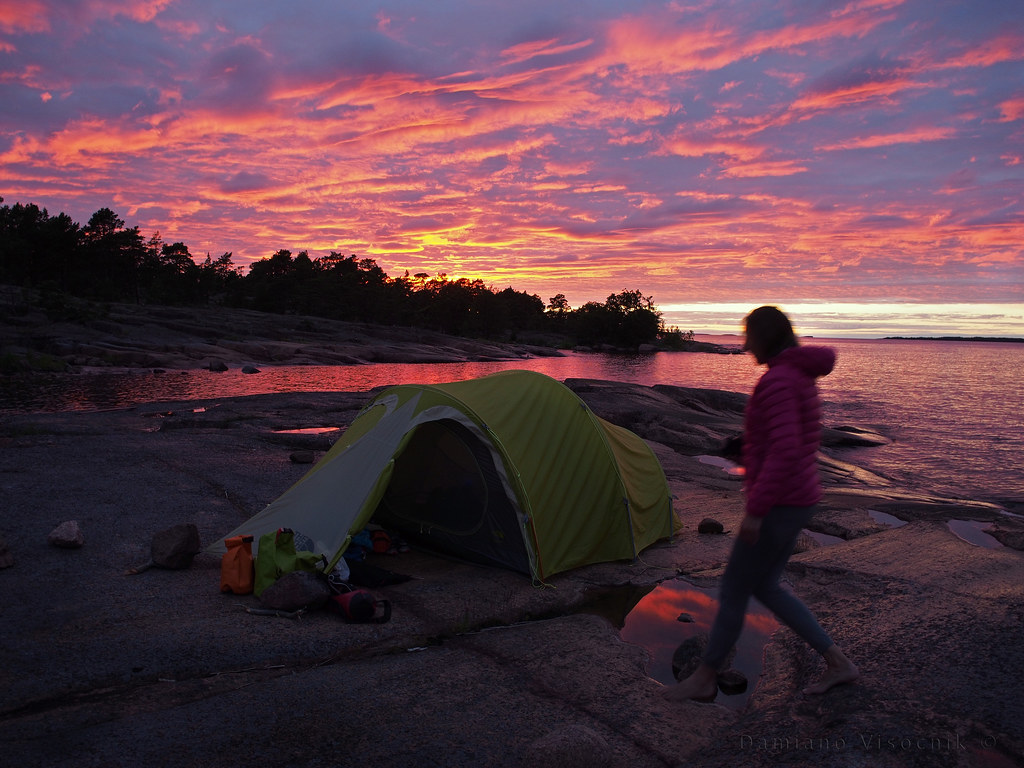
After one of the most intense days of paddling and sailing in swell against rebound against high cliffs the sheltered camp location we found was stunning.
The carefully arranged although natural setting of little ponds and low vegetation reminded me the look of Japanese gardens.

Aland sunset_4_c
more images appear on my photo blog

Polished granite slabs make camping easy as nothing gets dirty while sitting down and dinner can be had without sand in it.
Sunset only came very late and was not fully dark when we finally retired for the night.
Sea kayaking at very high latitudes has its advantages even if sea temperatures are not as balmy as back in Queensland.

.

15 June 2015

Hail hell

by Tess Dodd_Adveturetess

 I am almost halfway across, enjoying leaving the demands of a busy morning further behind me with every paddle stroke. My thoughts are filled with plans to paddle in Alaska.

Reading Audrey Sutherland’s books (87 days solo kayaking in Alaska, swimming and kayaking remote sections of the Hawaii coast); I recognized her spirit and felt inspired by her adventures. I spend many hours vicariously sharing her inflatable canoe. A deep rumble draws my attention to my right. I was no longer sharing Audrey’s inflatable canoe in Alaska, but alone in my Nordkapp in Moreton Bay.
Looking south, I can see darkness on the horizon. It’s distant and appears to be moving across the lower bay, out to sea, away from me. I can see the strip of white sand where my friends are camped. I know it’s not far for me to paddle now. I stop day dreaming and increase my cadence, keen to reach the beach before any rain falls. I don't fancy setting up my tent in the rain.

 Loud rumble. The storm is moving closer to me but still appears to be tracking out to sea. I stop paddling to hydrate and consider my options: I am closer to my destination than any other land.
If the storm moves towards me and not out to sea, no matter which direction I take now, I am going to get wet. I decide to continue my original course.
Before I move on, a sea turtles large head breaks the surface nearby, taking a huge gasp of air before sinking below. I notice a large shadow to the right, too big for a turtle, maybe a dugong? The shadow moves closer, rising from below to bump my boat, moving it with its body. Far out, a shark! It brushes my kayak as it moves away; I drop my drink hose, pick up my paddle and get moving.

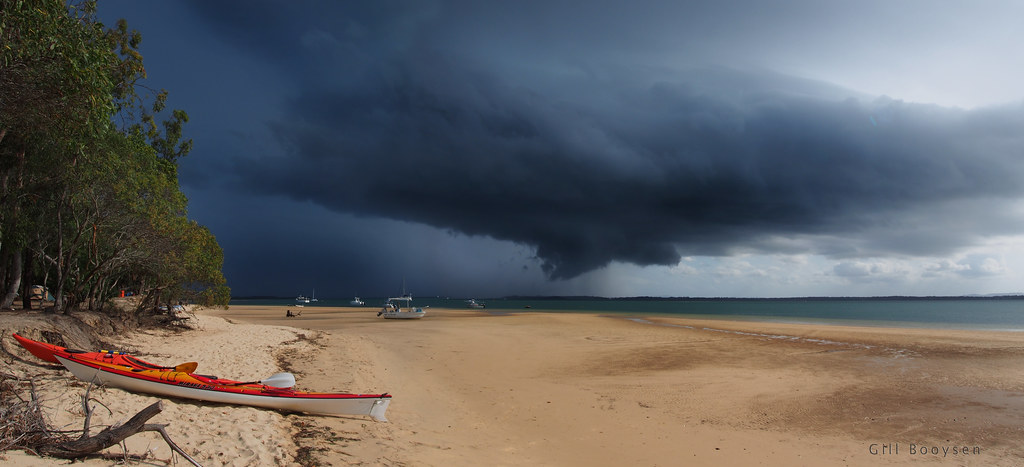
Hail storm at Bakesleys_Gill
Storm approaching, viewed from Blakelseys Landing _photo Gill Booysen

 I can see 2 motor launches near the island heading for anchor. Other watercraft have disappeared. At least I won’t have to worry about being hit by a boat out here.
BOOM… a BIG thunder clap. Louder. Closer.
The cell is moving as fast as my heart is beating – fast! I know I will soon be engulfed by this heaving beast. OK Tessie, don’t panic. Relax, think clearly, and make a plan. Stow the sail securely on deck. Point the kayak into it. Prepare to brace. (Larry Gray ‘storm brace’ technique – it works).

I glance behind me and see sunshine and blue sky. Bizarre. Ahead, I see people moving about on the beach, the storm cell has not quite reached them. I think about my friends and wonder if they can see me out here, knowing they can’t. I don’t want them to be worried about me. I wish I was with them right now. Looking into a sky that is now a deeper green than the water, I realize it’s going to hail.

I think of Australian Ironman Grant Kenny who was out training on his ski when a sudden hailstorm hit. The hail stones cut his head open. He flipped his ski over and used it for protection until the storm passed.
After the earlier shark bump, I was really hoping I would NOT end up in the water today, but knew I may not have a choice. I also hoped for small hail stones and a fast storm. The transforming beast of green and black was almost upon me. I could feel my body trembling, adrenaline I guess.

BOOM. …BOOM…crackle…The vibrations travel through me. I can no longer see the beach. The wind increases slightly as large drops of rain begin hitting the water around the kayak. It is a strangely beautiful moment. A bird sitting in the water just ahead dives below and does not reappear. Darkness wraps around me. Shit! A wave of anxiety washes through me. My senses tingle as I wait. Suddenly, a raspy sound becomes an almighty roar, heralding it’s arrival. I try to point the bow into it, bracing. The ferocious blast is more than I have ever experienced in the kayak before, EVER.


meanwhile on shore...
I struggle to stay upright, my ears fill with the roar of the wind, waves wash over my deck, my body is physically forced backwards over the deck. I bend forward trying to lessen the effects of the wind on my body. The drops of rain become bigger and the waves smaller. My saturated hat brim is down around my face. I can’t see or hear over the roar and have no idea what’s coming next. I focus on staying upright. A new sound joins the melee. Crack. Crack. Crack. Then, I feel it. HAIL! Hailstones begin hitting my head, my arms, my hands. Hail ricochets off the kayak painfully hitting my face and teeth! The hailstones increase in size. Taking one hand off the paddle, I cover the top of my head until my fingers hurt from the stinging ice. There is no relief. The noise is deafening. The hailstones bruise and sting where they hit my body. If this continues, I will have to get in the water for shelter. I don’t know how long the storm lasts, but neither of my hopes comes true. The hailstones are large and the storm is not over quickly. I endure an icy beating from Mother Nature until the storm cell eventually moves over me, the hail and wind easing to leave only gentle rain hitting my bruised face and body.

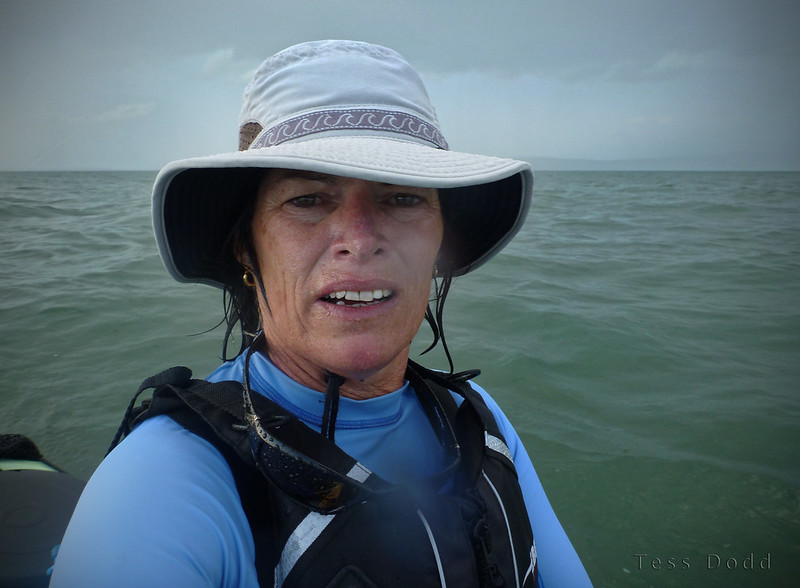
After storm selfie
After storm selfie
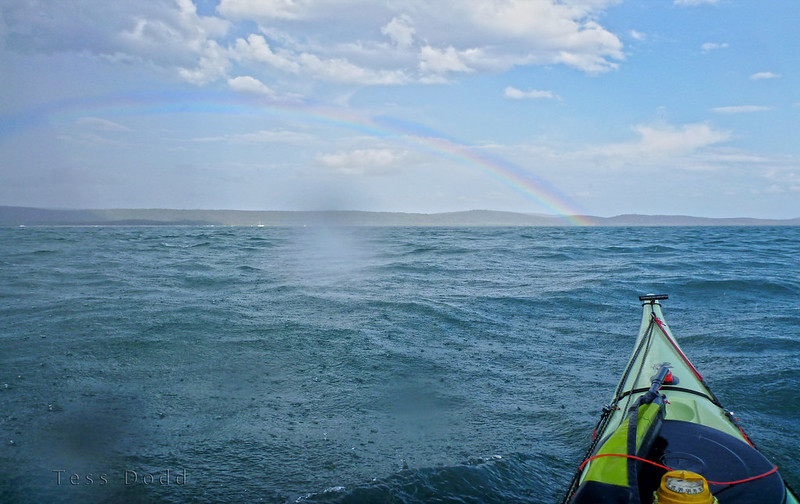
 Once again able to see, I look towards the island. It is further away but, in front of me is the bizarre sight of half the beach covered in grey sky, half blue sky with a rainbow…half storm, half rainbow! I self-assess. My kayak is still upright. I am beaten up but OK. I am close to tears, instead of crying, I begin laughing. Strange, stress relief laughter. I feel spent, alone and ready to resign the ‘Adventure’ from AdventureTess.

AFter the storm_Tess

But, I am in the middle of the bay and need to get moving again. The storm is north of me now, cutting a swathe over the water and Dunwich on the west coast of the island. I have a clear view of blue sky either side of this intense black and green field of energy. Eager to see my friends, I pick up my paddle and begin the work to reach them. I have been blown away from the island, so have additional distance to make up. While paddling, I reflect on the experience and my choices that day. I believe I made good choices and would have felt some comfort with company, but would company have created an additional concern? Using the last of my energy, I reach the beach. People are moving about, fixing campsites, and checking boats. I see my friends and call out. Relief floods through me as they make their way to the water’s edge to meet me.

Tess' arrival_Gill

Note: I launched just after lunch to paddle 10km to meet my friends, who were waiting at camp. Conditions were mild. The water was bumpy with a 10 to 15kn headwind. A possible late thunderstorm was forecast. It was early and there were no signs of a storm when I launched. I often paddle alone and am familiar with this stretch of water. I have been asked about the wisdom and safety of my paddling alone. Even for these short distances in familiar water. I enjoy social paddling with a few close friends but feel confident in my skills and decision making ability to kayak alone.

Recounting the story_Gill
great campsite story...                                                                                                                                       photo: Gill Booysen

.

11 June 2015

Photo: Pot of Gold

Legend goes that there is a pot of gold at the end of the rainbow.
Maybe it's true.

Commander at Straddie_1_c
SeaDog Commander in the sun shower

.

03 June 2015

VIDEO: Restocking supplies on expedition in the Baltic

Paddling a sea kayak along the archipelago of the Swedish Baltic coast required occasional restocking when on a 5 week trip.
Drinking water was available on most inhabited islands where a hand pump was most times operational. Only on the outer skerries we had to carry water for several days.
Food could be had on some larger islands but Rödlöga topped them all.
The little village had a green-grass square with a children's swing hanging from its large tree.
The shop owner is a very happy passionate man that loves his work.


you can view this video at 1080p

The attached bakery and coffee house was incredibly busy with customers, considering the island is tiny with a small population. Sitting outside under the shade of the large "main square" trees and watching the relaxed atmosphere of the unpretentious locals was like stepping back in time.
Children would play and run freely without overbearing parents fearing that they might get dirty.
The local dress code seemed to be short fashionable gum boots and the occasional life jacket, worn at all times, even at the cafe. Then I realized that just about all of them were sailors that came in the morning to get a java fix. The little harbor was abuzz with beautiful small sailing boats; motor boats were rare and jet-skis not existent :-)

Unfortunately this year my expedition route will not be in Sweden but in Finland. I would love to stop again at Rödlöga.

.

25 May 2015

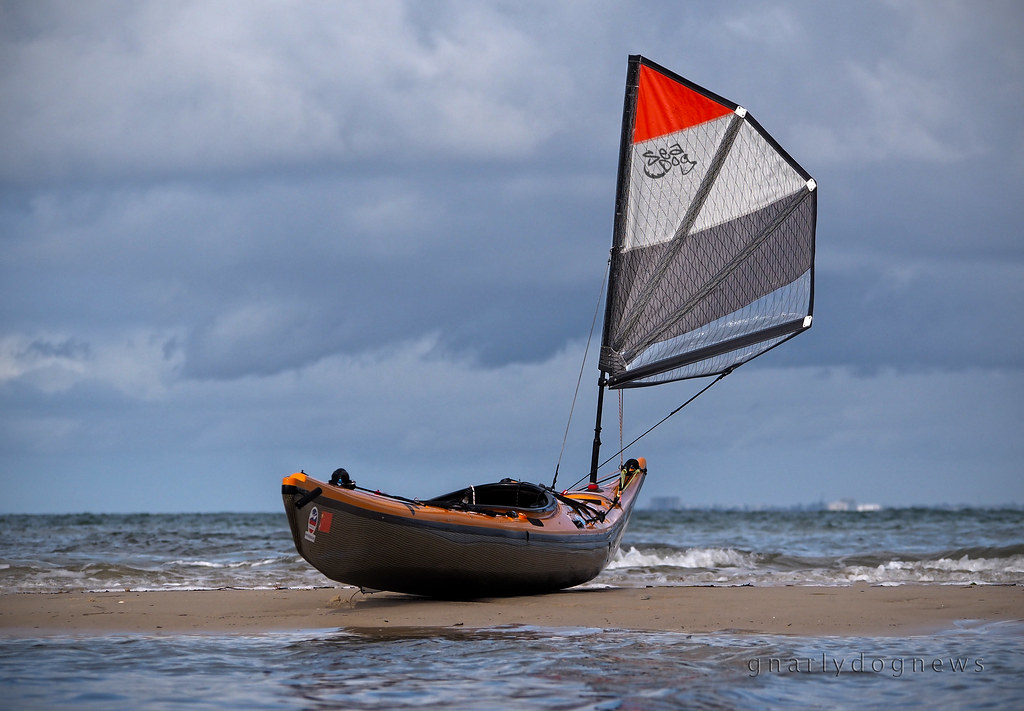
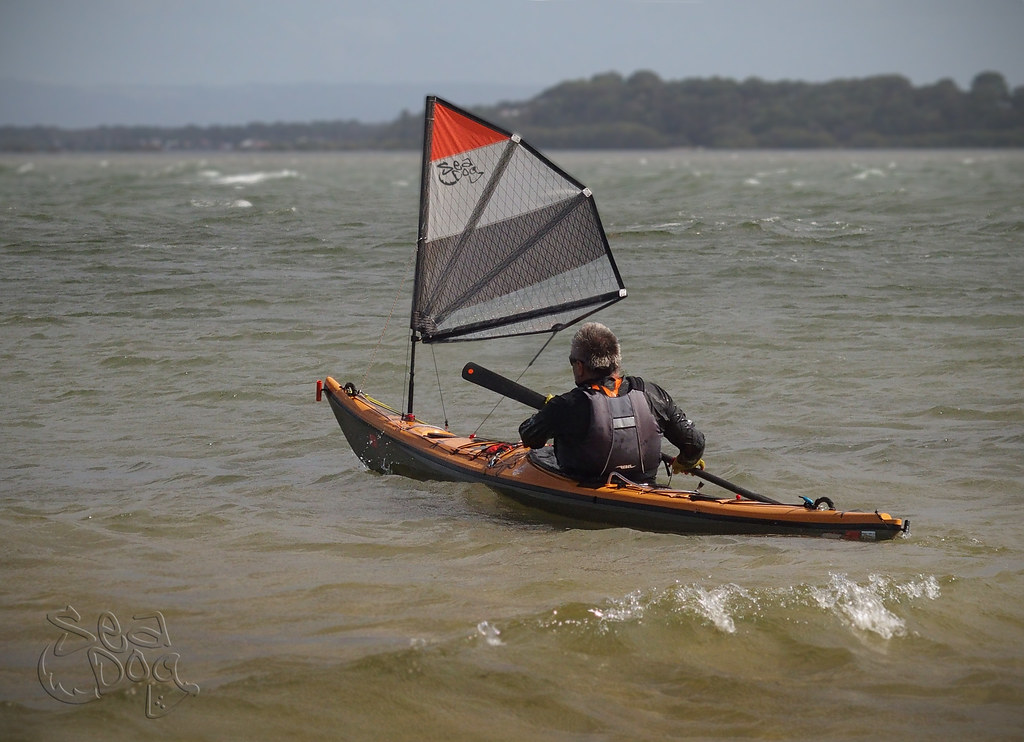
GEAR: SeaDog Commander.

I fell in, again.
I have been surfing for an hour and now I was heading home.
I sailed for a while but then I turned directly into the wind and I wanted to stow my sail away.
Stretching myself forward trying to reach the shock cord to secure the folded bundle of my sail made my loose my balance and I kept on falling in.
I realized that I needed a sail that would fold easily on my kayak deck.

Commander testing_1

My high aspect SeaDog sail (0.7 Code Zero) catches the wind beautifully and allows me to cut into the wind at a higher angle than before, but I had a problem with it.
Since I like to have my spray deck area clear my sail is mounted differently than a typical set up.

Commander1 at Peel_r
image courtesy of SeaDog
A typical mount for the sprit style sail (SeaDog, Flat Earth etc.) calls for a tall mast with stays mounted below the boom.
I prefer to have my sail mounted lower to allow the mast not to protrude in my "paddling area" when stowed on deck.
I don't like a folded sail that encroaches the deck where my hands swing when paddling.
It's simple: I want that area clear so my hands don't catch the sail.

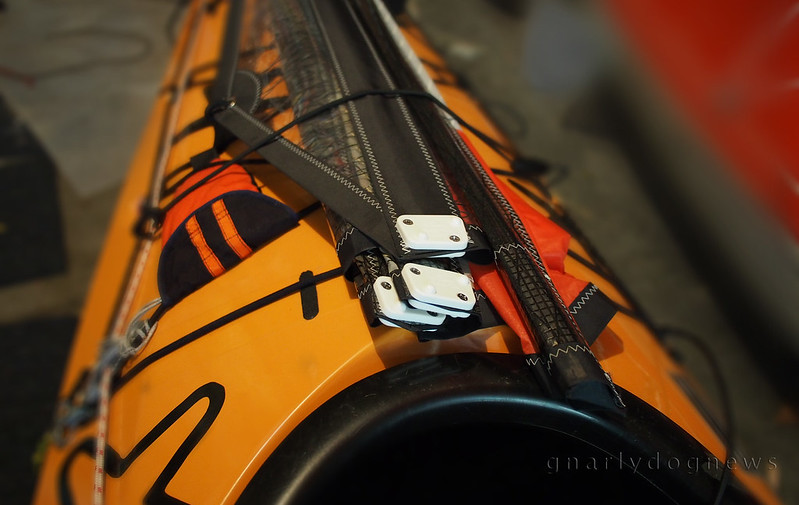
On my high aspect sail the boom is substantially shorter than the luff (mast section) resulting in an uneven bundle when the sail is lowered down: the boom is much further away from me when I lower my sail onto the deck.
In need to secure the sail firmly onto the deck I use a section of sock-cord to wrap around the mast, battens and boom to create one solid bundle that I know will not fill up with water when waves wash over the deck or I roll the kayak.
In the bumpy waters, I was now having trouble reaching that boom and I was loosing my balance.

SD_CodeZero 07_c_gd
SeaDog CodeZero 0.7, folded. In order to reach the boom this sail intrudes the cockpit area.

It has been in the back of my mind for some time now: I wanted a sail with a slightly lower aspect and a longer boom.
I consulted with SeaDog sails and after I proposed my design to Richard a technical compromise was hatched: the design I had in mind might end up less efficient and might cause some loss of upwind reach.
One other trait that I really desired in my new sail was that it would be quiet.
Douglas Wilcox aptly calls it "motoring"; the sound that the leech makes when sailing cross-wind.
I don't like that at all and a highly value a quiet sail.
I proposed a double batten to Richard and after some measuring we decided on an optimal length, given my initial request of "neat bundle" when folded.

SD_commander_5_c_gd
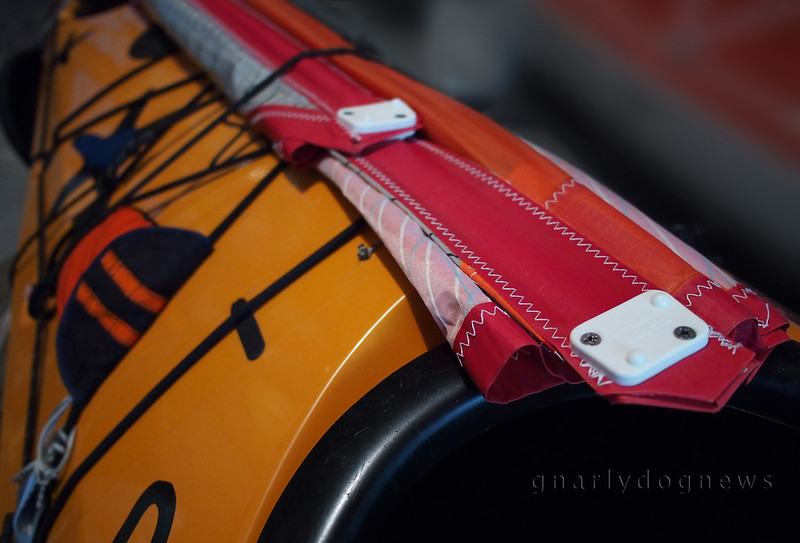
SeaDog Commander Mk1, folded on deck

SeaDog sails distinguish themselves for utilizing the very best high tech materials and superb cut and manufacture.
I love the pattern that the carbon fibre makes in the sail cloth used for the batten pockets; it looks really high-tech matching the finish of my Greenland paddles :-)
The twin battens shape the sail perfectly and there are no areas where the sail puckers; the sail stays aerodynamically shaped to catch light breezes allowing a high angle of head wind sailing.
My concerns for decreased upwind performance did not materialize: the SeaDog Commander stays inflated at really high angles too.

SD_commander_3_c_gd
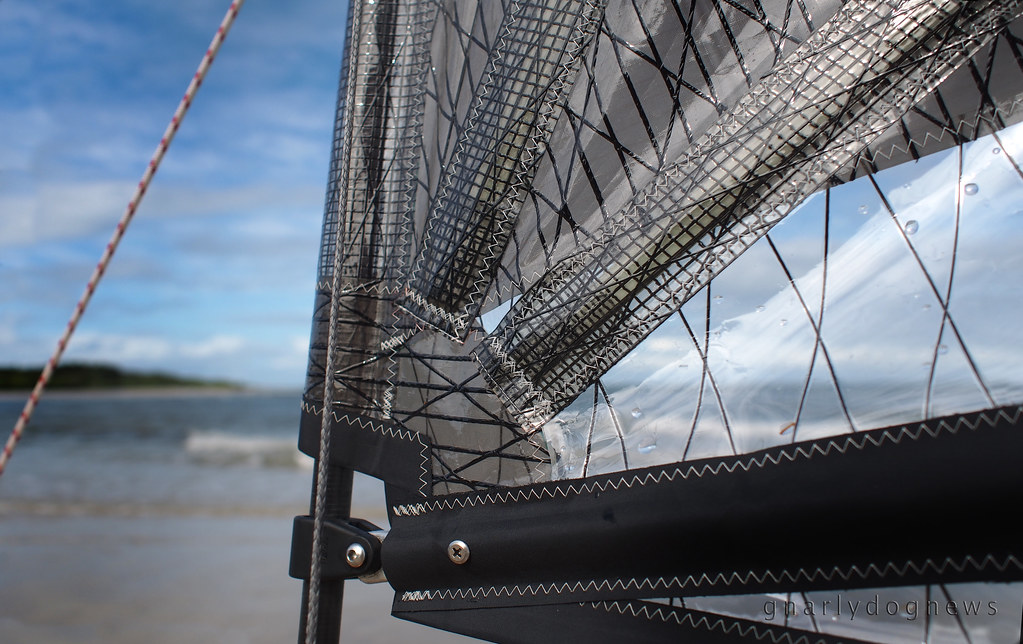
SeaDog utilizes a special thin thread that is incredibly tenacious and UV resistant: the results is beautiful stitching.

I asked for a combination of sail cloth that would be stretch resistant, dry fast and remain stable. I also wanted to add the Clear-View feature into the bottom panel so I could easily see where I was going. Somehow vinyl windows cut into my previous sails never really helped with forward vision; they were just too milky and were ruining a smooth surface with a puckered section of sail (different stretch).

The new Clear-View panel really offers a better vision of on-water obstacles and boat traffic while the sail surface remains perfectly tensioned and smooth.
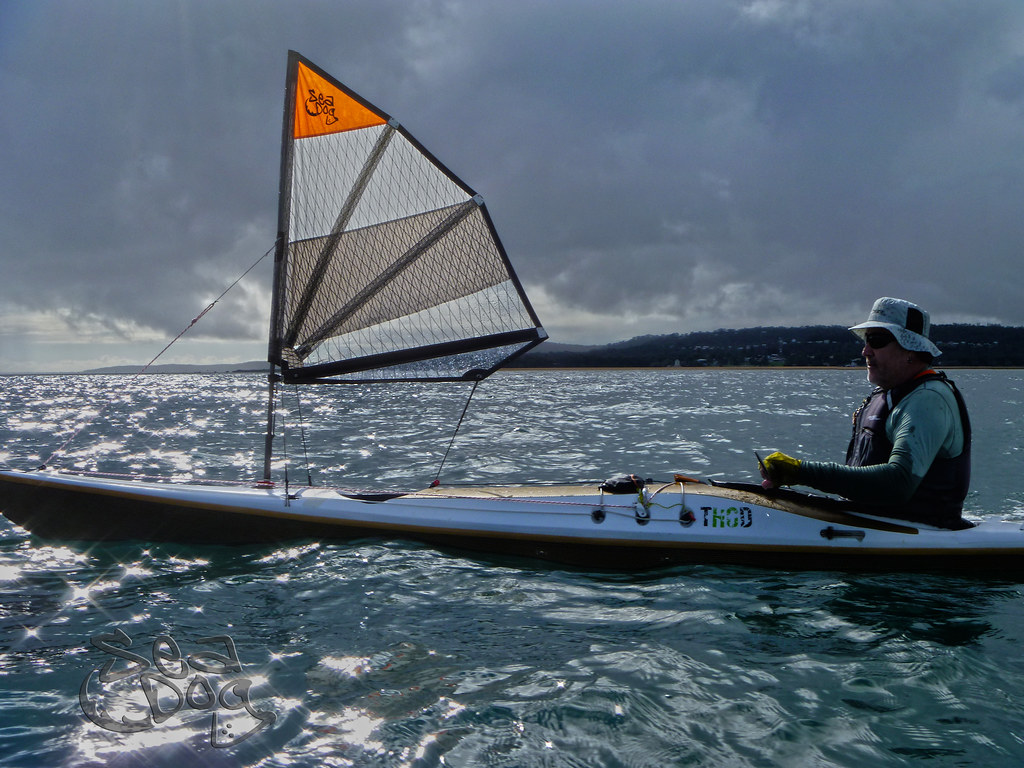
The orange tip adds incredible high visibility on the water while the pattern in the other panels makes for a stunning sail. The SeaDog Black Diamond series (with the Clear-View TM lower panel) are the highest technology sails that I have see so far: a true masterpiece.

SD_commander_2_c_gd

The new SeaDog Commander has a surface area of about 0.8m² to match the sail I most use in winds up to 20 knots.
Above 20 knots, in a beam wind, there is more heeling (pushing over) that I am comfortable with while my kayak does not really go any faster (max. hull speed).
If I know that there will be high winds forecasted I rather use my SeaDog CodeZero 0.7m²
I mounted this SeaDog Commander sail high enough on my carbon mast so I can reach it when folded onto the deck but not too high to intrude into my paddling area.

SD_commander_1_c

Disclaimer: my association with SeaDog has grown where we now collaborate on new projects. After purchasing my first sail from SeaDog I started to offer feedback and stimulated Richard with new ideas. Richard recognized that there was room for improvement with the original sprit sail design. Being able to quickly accommodate to special needs or requests with custom sails, SeaDog is able to blend high-tech sailing cloth to create sails that I wanted to realize for a while. I paid for the materials and he offers his workmanship: we both benefit from it.
 

02 April 2015

Video: I Have A Dream

Some dream of power, some dream of money.
Some dream of a slimmer waist and a bigger chest, some dream to have more hair on their head.
Some dream of a fast red car or those pretty shoes they saw in the window...
My dream is different.


reward yourself with full screen viewing in high definition on a larger screen, this one was not meant for mobile devices...

My dream is to be lost in a sea of islands, midnight sun and good friends.
A place where I don't need to keep time or answer my phone, no updates and no "likes".
And then the presence of mind to take it all in.

.

24 February 2015

Video: Petra surfing Dugong

Let's name her Dugong!
Short, stubby and just a bit "a face only a mother could love" look... the Whisky16 (designed by Nigel Foster) is not a pretty kayak in a traditional sense.
Dugong seemed an appropriate name for Petra's new kayak.
While looks are often deceiving, this kayak fits Petra very well and being very maneuverable spurs confidence in rough water.
The inspiration for the name came from the previous day's event where Petra and I were kayak-sailing back from my favorite play spot. A dugong suddenly surfaced too close to my kayak and looked at me with spooked eyes: I don't know who got the bigger fright, me or the dugong.
Then he quickly dived, his tail flew inches away from my face wetting me completely while I ducked my head avoiding the slap as he desperately tried to miss my kayak.

That evening a sail was hastily mounted to the Whisky16's deck as next day's forecast was promising conditions for a pseudo tidal race: wind against ebbing tide.
With the new SeaDog sail mounted up front Dugong really brings smiles


click on image above to play video

Edging and rolling the Whisky16 seemed easier than the borrowed kayaks: a good fit where one can brace without having to splay the legs too far could be the reason.
The keyhole cockpit where the legs can be kept relatively close together, allowing some wiggle room but still offering a solid wide area of contact, is probably a better solution than the diminutive thigh braces wings I see in most kayak cockpits.
So far the two kayaks that I own with such keyhole cockpits are way more comfortable than the other system I have tried.
The rear deck is not particularly low in the Whisky16 however layback rolls are still reasonably easy since the seat is not jammed right against the rear of the cockpit rim.
For once the seat is not shaped as a racing short-pan paddler crunched-over design: a lower front lip allows for more relaxed seating.
My experience with short seat that have a higher front has not been positive as I often end up with "dead legs". A flatter pan and longer seating area is key for longer paddles where my thighs don't suffer from blood circulation cut off.
Petra, while being the exact opposite of my bio-metrics, seems to agree: she dislikes short peaked seats and loves the flatter pan. The seat of the Whisky16 is here to stay.

The front deck however has already been modified to accept a sail and place it at closer reach. Details here.

03 February 2015

SHOP: filling-in the compass recess

.
Mounting a sail on a sea kayak requires a few considerations: position and deck strength.
On the newly acquired Whisky16 the front hatch is positioned surprisingly way far forward.
In front of that there is a deck-mounted compass recess.
The previous owner of that kayak had a small sail mounted there and I used the existing holes to mount mine.

PT65N_Whisky16_bow
first run with the Whisky16
A test run revealed that the sail worked well on the Whisky16 but the reach was a bit too far for grabbing the sail and stow it on deck, securing it.
Most other sailing buddies use a 3 stay set up ending with a rather long mast.
I see their stowed sails going past the front of the cockpit ending with a sail mast half way across the spray deck. I prefer to have mine clear off my deck so I do not rub it with my hands when paddling.

The Whisky16 however has the sail mounting spot just a bit too far out or reach for the sail to fit nicely on deck. As I use my sails on several kayak I need to have them fit all decks well, with the same stay lengths.
I could increase the size of the mast and bring the sail higher (and make an ill-fit on other kayaks),  but I prefer to keep the sail as low as possible and minimize the heeling force of a beam wind exerted on the sail.
The compass was not really needed on that kayak so I removed it and decided to utilize that space to mount the sail closer.
I wanted to fill the void left (recess on the deck) and create a solid base for the mast fitting.
I could have used a simple block of wood somehow attached to the deck but I knew I could do better.
I shaped a block of foam (polystyrene) to fit a bit loose within the cavity of the recess. Shaping the foam was easy: a bit of coarse sandpaper on a cork block.

Once the foam was shaped I placed kitchen cling wrap (Glad® wrap) over the deck and wetted out some fiberglass with epoxy. I draped the block of foam (under side) and pressed it into the cavity.
Once cured (overnight) I removed the excess and trimmed the glass.
The finish was really rough; maybe I could have used wax and mold release to have a perfect fit but nobody was going to see that part.
The top was done similarly.
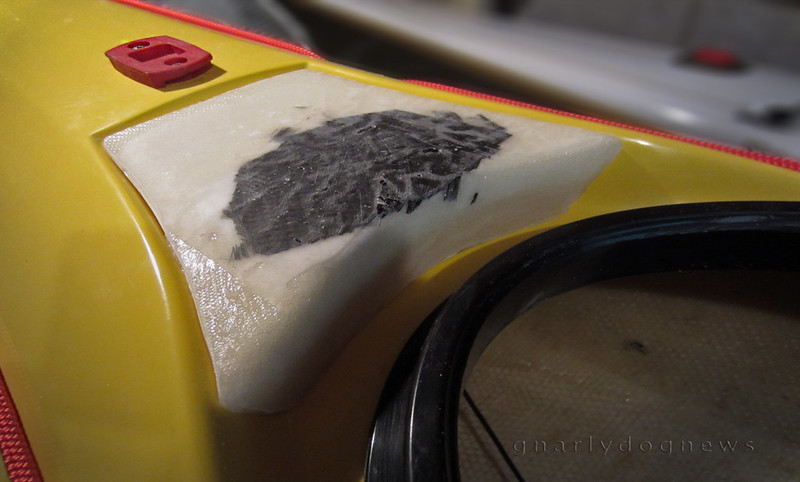
I carved out foam from the area where the screws for the fitting would go for my mast base and filled it with epoxy glue (mix of epoxy and microfiber). While wet I then used a few layers of glass for the top and a scrap of carbon fibre for where the main load would be.
Polystyrene foam compresses easily when spot loaded so I needed a sturdy surface.

compass fill-in1
the "black patch" is carbon fibre cloth over the carved-out foam filled with epoxy glue.

The next step was to clean and cut back the edges a bit leaving a bit of a gap between foam block and kayak deck. I filled that with epoxy glue again to create a hard edge and seal the two surface together creating a monocoque style item. Of course I waxed and prepped the kayak deck so epoxy would not stick to it...

compass fill-in2
the new mast-base fitting placed only for testing

The last step was to add a nice layer of carbon fibre weave: partly structural, partly looks.
A few coats of UV stabilized epoxy later and my block was ready for installation of the mast base.
I used wood screws that secured the mount very solidly: the epoxy glue is very dense.

compass fill-in3
the foam block now covered with carbon fibre cloth

Final step: securing the foam block to the deck.
This one was simple: a small bead of polyurethane all around the edge (only!) to then seal perfectly against the deck.
The original deck void was now sealed and the sail mounted closer to the cockpit.

compass fill-in4
notice the difference between old position and new closer location for the mast base. The old holes will get filled with matching gel coat

So, do 4" make a difference? *
Not in handling of the kayak but when reaching for the sail to be bundled on deck when stowed (reaching for the boom particularly) is now much better.

*Hell yes, she said :-)

28 January 2015

Video: Best Moments of 2014 in Moreton Bay

Once a year a new video is edited focusing specifically on local paddling's best moments.
This one was shot over 2014 in Moreton Bay alone.


Of course, only a very small portion of "the fun stuff" is recorded despite spending most weekends on the water.
I compiled mostly "orphan" clips that were not previously included in a other videos; the shots are short and highlight the best moments of a day's outing.

In order of appearance: Gnarlydog, Vanilla and Petra.

PS: work has already commenced on the 2015 edition...

.

12 January 2015

Photo: sail-surfing the New Year

Conditions were just right: a running out tide met by an opposing 15 knots of wind created waves steep enough to be caught by a small sail.

Surfing Dugong Jan15_1

Petra sail-surfing with Northern Light paddle and SeaDog sail.

.

17 December 2014

To club or not to club

.
"Keep on pumping, don't stop, you are doing fine!"
Those were the words of encouragement that I was saying to Tim*  hoping he could hear me; he was clearly shaken by the experience.
It was windy and the waves were large enough that he no longer could brace efficiently and eventually he fell in. I was holding his flooded kayak stabilizing him while he was furiously trying to empty it with the hand-held pump. It was working, but just so slowly...
The fear I saw early in Tim's eyes was now slowly subsiding, he knew that he will be alright.
I was on a Sunday outing with a group of kayakers, where the paddling arrangements were loose: we paddle together but without real rules and expectations.

I identified myself with Tim and recalled a few years back when I first joined a kayak club and had my first rescue.
I joined a club to learn the skills necessary to paddle safely in the ocean. I also enjoyed the company of other like-minded paddlers that genuinely loved the sport.


But I am kind of bitter about clubs now; my experience with them leads me to believe that, while they are good in principle, they also attract a fair share of power struggles.
My first exposure to a club was while bushwalking (backpacking).
I was new at the game, very keen but I knew little.
I joined the local club and went on walks and camps with my new-found buddies.


It was fun and I learned a lot. But the longer I was in the club the more I became exposed to the politics that seem inevitable in a structured environment: I observed a good number of people getting very animated about basic issues and some individuals clearly had their heart in the wrong place.
Eventually I no longer wanted to go on their outings as the red tape became too oppressive.
The club was large with several hundred members.

Years later I started sea kayaking.
I knew very little about the sea and I figured that I should really learn how to stay safe out on the water. I was lucky to get involved with a newly formed paddling club that was government sanctioned. For the first year it was really awesome: we all chipped-in with the organizing and there was a real good energy there.
Protocol was simple with not too many rules. Paddling was fun and we really went to great places; the calendar was full of activities.


QSKC trip to Lady Musgrave Island

As the Club grew it attracted individuals that wanted to make a profit from other paddlers while I was not sure if they really loved the sport without the monetary incentive; I call it conflict of interest.
The basic rules were not good enough anymore and a strong push to have mandatory skills to participate on any Club paddles was pushed onto the members. Incidentally those skills could only be "achieved" by being instructed by the few certified  commercial operators.
And then it finally dawned on me: this was no longer a bona-fide club, this was becoming a money motivated gig for a few eager individuals.
I was kicked out of the Club for wanting to expose a sexual harassment case and I was bitter about the events. I was also worried that my skills would not advance and I would loose my paddling buddies. I did loose some buddies that, if I look at them now, were rather lame.
Some no longer paddle and some just struggle in the same constrictive environment.

Luckily the Club is not the only way to paddle with others.
Several informal groups are actively involved in sea kayaking where I live.


easy paddle with the Claytons

There are also other Clubs that unfortunately, because of external pressure, seem to be too structured for a real free paddling experience.
I started to paddle more and more frequently with the very same people that shunned the Club that I joined in the first place.
As a novice I used to look at them as a dangerous crowd to paddle with. It seems that the Club culture brain-washed me enough to instill a fear in me to not paddle if not in a totally controlled and anal environment. Initially I felt that we should paddle all together, keeping a constant eye on each other.
Nobody should be no further than a few paddle strokes and if "anything happens" one could be "saved" within seconds. The tall stories of sharks (something that the Club was very good at selling) however had little impact on me as I rationalized the potential danger to a minimum.


the mandatory Club lengthy briefing before launch

So, here I was in the middle of a short passage between islands that had a few bumpy waves tossing us around. A bit of wind was pushing against the tidal flow and I could surf some of the lager waves.
I was having fun but in our group there was a person that probably found the conditions a bit intimidating.
I have kept a loose eye on Tim and while he was doing OK I noticed that he had stiffened up and his paddling stroke was reduced and the catch was a bit short.
At my last wave before the beach I looked back and I no longer could see him, his red kayak and white paddle not around. As the waves were obscuring my view from a low position in the water I spotted him a few minutes later: he was swimming.
I headed back and by the time I reached him he was already getting helped by a passing motor boat. We took it from there: myself and a buddy held Tim's kayak, now with flooded cockpit that was getting emptied by a hand pump. He was a bit shaken, a bit confused and a bit tired. Eventually he started paddling the remaining 1/2 Km back to the beach. I considered offering a tow but I held back: I wanted to offer him instead  the possibility to help himself, make him proud of what he achieved.
And then I thought: how would a similar situation be dealt in the Club.

Well, for starters the proposed outing would have been cancelled: too much wind (it was around 15 knots as we set off).
In the event that we would have gone out we would be on top of each other, like a flock of sheep, but not before a lengthy briefing on the beach of all the possible dangers that we could run into, including the shark stories ( I used to get a bit miffed with the scare mongering when I used to be in the Club). Falling in would involve a quick response and the swimmer would be placed back in his kayak within minutes. A good thing, right?
Well, I am not so sure about that...
Let me explain.

I believe in self reliance, in learning from mistakes and by "pulling the finger out".
When I used to fall into the water (and that was often) I was kind of expecting others to come and rescue me, I was relying on them. I had little incentive to actually become a better paddler.
Then I started to paddle by myself and much more aware of my surroundings and my actions: I did become a better paddler. I learned how to roll as swimming was proving to be rather tedious.
I am unsure if I would have advanced as much in the safety of the cocoon called Club.
Considering that today I see on the Club's calendar no real challenging paddles anyway,  I would have little opportunity to actually improve myself.

Now, don't get me wrong; clubs are a good thing.
They have introduced me to sports that alternatively would have taken me possibly longer to master.
In a decent club one can learn the basics without having to pay for private tuition, from other more senior members.


Clubs also cater for those that prefer others to make decisions for them. When I led trips in the Club I had my share of participants that really wanted to be guided for the whole paddling event totally foregoing any personal decisions; I understand that we are not all the same and some prefer it that way.
What I really like now instead is to have the freedom to actually paddle where I want. No sign-on sheets, no disclaimers, no herding, no listening to gurus for half an hour before launch in calm conditions. What I prefer is a self reliant group of paddlers that meets and paddles.
We look after each other in a loose way, no holding hands. We teach each other, no money changes hands. And if somebody in the group does not like where we are going he/she is free to do what they want: no sermon before "leaving the pod". A brief acknowledgment that that person will no longer be around for the day is sufficient. There are no formal leaders therefore no liability, we just enjoy each others company with no expectations.

* name has been changed to protect his identity

25 November 2014

VIDEO: sailing with SeaDog 0.7

This time the wind was really blowing and I was glad that I had my smaller sail installed on my kayak: the SeaDog 0.7m².
I could feel that there was less heeling as I didn't have to transfer all my weight to the windy side.
My large sail of 1.0m² would have been too much and harder to handle while my SeaDog 0.7m² was still giving me plenty of speed to surf the waves with ease.

Here is a short video of a few different outings with the SeaDog 0.7m²


I believe that the SeaDog 0.7m² is a great sail for when the wind starts to blow and white caps appear on the water; it offers me plenty of power while still allowing me to handle my more tippy kayaks without a white-knuckled grip on my paddle.
I figured out that a kayak can only go so fast and no matter how big of a sail I mount on the deck it just won't go any faster. A larger sail however just catches more wind and when loaded from the side wind it wants to push the kayak over. I have been at times hanging way over the side of my kayaks trying to keep them from tipping while not noticing any increase in speed over a smaller sail.

Of course, if the wind is from behind (stern wind) and the waves have built up to a size that they start to lift the stern of the kayak where I can surf; my kayak will indeed go faster than hull speed.
It is these times that I find the SeaDog 0.7m² exceptional and easier to handle. As I surf down the wave (on a wind right behind me) the kayak will come to a point where the sail no longer seems to be inflated. At the bottom of the wave I will have the boom flap loose over the deck and wanting to swap sides. Then the gust of wind catches up with me and with a shuddering noise the sail slaps to the other side taken in by the main sheet. It is in this moment that a smaller sail will save me from a sudden imbalance and possible precarious lean that might result in a dunk. I don't feel the raw slap that bigger sails give me in high winds: the 0.7m² is easier to handle.

Another benefit of a smaller sail is when things do go pear shaped and I fall in.
I have been practicing rolling with a sail; starting from dead calm conditions to increased breezes and more bumpy seas. I find that a sail with a smaller surface has much less drag underwater and in a roll I can scull up without too much effort. Recently I have been trying to forego releasing the main sheet and just leave the sail alone while falling in. While slightly more difficult than releasing the main sheet (or uphaul) I am more confident in recovering with the sail just left as it was before falling in.

As winds increase to 20 knots and above I wonder if a smaller sail would not be even better?
Maybe that is something I should look into...

.

11 November 2014

Video: Radikal Kayak Surfing

I love this video.
Beside the incredibly smooth kayak surfing demonstrating outstanding skills using an unconventional paddle, the footage capture and the editing is really captivating.


It inspires me to get out more in the rough stuff and play.
My aspirations: to be one day half as good as Marc.

.

22 October 2014

GEAR: SeaDog sail Code Zero

I nearly tipped in and went for a swim when a small set picked up my kayak and I started surfing.
I was in my "tippy" kayak and half an hour into testing a new sail: the SeaDog 0.7 mt² in Code Zero .

SeaDog Code Zero 0.7mt_1

I was having fun trying to catch the short wind waves that the tidal flow against a healthy breeze was producing.
I am familiar with this location and often I wait for the conditions to be just right to be able to surf with my kayaks.
I am not sure if the long waterline Swede form narrow beam low rocker kayak was ideal for the small steep short waves but I wanted to see if a smaller sail would be easier to use in a stiffer breeze.
I have several sails from Flat Earth of 1.0 mt² and 0.8 mt². They work great and are very efficient sails for sea kayaking. Their design is a derivative from the decade old, or more, proven system that the Tasmanian sea kayakers have been using in strong winds.
That lead to the development of a sail mounted further forward, away from the paddler's cockpit as explained here.
The SeaDog sail is an unapologetic close resemblance of  Norm Sander's rigs and Flat Earth sail.
Actually the design is strikingly similar.

SeaDog sail_3

I have been kayak sailing with other paddlers that have been using SeaDog sails for the last couple of months.
Richard, an avid SE Queensland Sea Kayakers paddler, is the man behind the brand and his passion for sailing is evident.
He can be seen paddling every weekend (and often during the week) sporting sails of his own creation on his kayak.
It all started innocently when Richard decided to add some color to his sail.
A special one was made just before Xmas and of course, inspired by the festive season, it was green and red. It was different and unique; people noticed.

Xmas sails_SeaDog
photo: SeaDog sails
I was impressed by his early work even tho I didn't share his passion for the color choice :-)
A few weeks later a new colorful sail appeared in the paddling group. Again the work was impeccable.
I watched those sail taking the wind very well and I noticed them filling with air at even very acute angles into the wind. One thing that I was very surprised is that Richard's sails did not flutter.

Eventually Richard made me a sail that I was missing in my quiver: I wanted a small sail that will allow me to be used in winds of 15 knots and above.

SeaDog sail_1

I have used my Flat Earth of 0.8 mt² in winds where I no longer was comfortable with the heeling force of the strong wind. Unless surfing, the hull speed of my kayak will really determine how fast I can go, no matter how big my sail is

As the small waves started to pick up my kayak the SeaDog sail was hit by a gust from the side. Any other time I would have to quickly react with a solid brace with the risk of tipping over.
This time the jolt was softer and the shock cord on the main sheet (the rope that pulls-in the boom) released some of the pressure from the wind. This sail being smaller helped reduce the heeling force that wanted to tip the kayak into the water. I was able to stay upright and continued to surf.

The downside of a smaller sail is that I have to work harder and paddle more when the wind is from behind (running with the wind). As the waves catch up with me I have to put an extra effort to then accelerate down the wave.
Side-by-side with a buddy using a 1.0 mt² sail I had to really crank to catch the marginal waves, while I could see that he was getting more push from the wind.
However, I am sure if the wind was 20 knots +  he would be a bit worried with his larger sail...

SeaDog sail_2

In essence the SeaDog sail of 0.7 mt² is best suited for stronger winds or paddlers that have just starting out sailing, possibly with less bracing skills. Lighter paddlers will also appreciate this sail as their lack of counterbalance body weight is noticeable in strong winds.
SeaDog sails also makes 0.8 mt² sails, in traditional colorful Dacron® or the fancy laminated Code Zero (unfortunately white only).
On closer inspection I notice very clean seams and stitching on the SeaDog; every stitch is continuous from one end to the other with absolute precision. Every end is reverse stitched to prevent unravelling and the tension on the bottom and lower cotton is perfect to create a very clean stitch.
Attention to details is superb and the finish is outstanding: every rivet and every reinforcement is very well executed.

SeaDog sail_4

Is SeaDog a better sail for me?
I can't say that as Flat Earth has served me well and I had no trouble for years now.
What I notice is no flutter in the leech, something that mildly annoys me in the Flat Earth sails.
I mounted the SeaDog sail with two back/side stays, as I have done on all my other sails.
Richard recognizes that kayakers have preferences in mounting styles and hardware used for doing so. He supplies the sail with the mast, Spectra stays and the flexible polymer base only, leaving the rest up to the sailor.
I much prefer that since some of the (Flat Earth) sail kits that I have used had parts that failed on me.


08 October 2014

Photo: Back to Magic Island

.
We found it again despite not having it clearly marked on our map last summer.
The weather was warm this time with less wind; the clouds benign and not threatening a thunderstorm.

Magic Island_2_c
photo: Petra Ries
The sun was baking the polished granite shores and soon we would be laying on them drying our bodies after a refreshing swim.
We were back to our Magic Island

.

03 October 2014

Video: Aquarius Sea Lion LV

On a sea trip of 5 weeks in Sweden and Åland (Finland) Petra paddled a Sea Lion LV.


Aquarius of Poland sponsored her with a very light carbon/Kevlar kayak and we installed her Flat Earth sail to make our expedition more fun.
Petra picked the color scheme of her kayak and I thought the graphics were particularly attractive making the kayak very visible against the water and granite islands.
The kayak behaved very predictably in varied conditions and weather-cocked just enough to make it safe when windy, even in a storm.
The only real modification was removing the padding that was factory fitted on the seat; lowering the center of gravity made the kayak a bit more stable. Given that she has never paddled a Sea Lion LV before, Petra liked how she felt in that kayak right from the beginning.
Despite the cockpit maybe being a bit too roomy for her the key hole style thigh braces allowed her to brace efficiently when the waves picked up and tossed her around a bit.
Cargo space was sufficient for our extended trip and the main hatch covers (Kajak Sport) never leaked (the "glove box" needed a bit of sealing around the rim).
The skeg performed flawlessly and was butter smooth to operate. Adjusting the foot rests was possible even while paddling (without needing to exit the cockpit to reach the adjusting tab behind the foot rest!).
The shorter waterline and the rockered hull seems to be well suited to shallow waters with shorter waves (no ocean swell in the Baltic sea). Clapotis was not upsetting Petra and I noticed increased confidence in following seas where she was catching and surfing waves way faster than me, leaving me behind.
I think that the Sea Lion LV combined with a sail is a great fun kayak.
It performed well with just light loads in strong winds (slight leek cocking when sailing) and very steady when filled with camping gear, food and water.


10 September 2014

The power of disconnecting

.
I call it "expedition style".
Petra was starting to understand what I meant by that; it was not the fact that we were now on our third week of 5 paddling and camping in the Swedish archipelago, it is more the state of mind that comes from being away from everyday life.

My highlights of any given year are usually my trips.
I love being away from the confinement of 4 walls and a roof, plugged and connected to the increasingly demanding "social media".
For 5 weeks I wanted to not think about others far away from the place I was in.
At the risk of offending and being called selfish I cherish the being away from others.
The islands we were travelling through had slightly more traffic then last year and on occasion my first choice of campsite was already occupied: we could not have the whole island for ourselves.
It was however prime holiday season for Sweden and realistically we were not that far off shore to think we could be really alone.

Evening shore walk_c

I prefer to travel with as few tools as possible that keep me connected to my usual world. I had to have a mobile phone with me so my friend Johan could text me the weather forecast. Honestly I would have preferred not to have it. I chose not to bring a GPS even tho Sweden would be one place where I could really use it as "geographical confusion" had its moments.
In a spur of the moment decision we started our trip too far South along the coast where we had no map for it. Interestingly enough the initial concern quickly drifted away since I knew I just had to keep to the right of the big islands but not too far out to be in totally open sea.
The fellow paddlers that we met and chatted to shook their head when we told them that we didn't have a map for the first days' journey and ultimately planned to reach Finland.
I now laugh at myself thinking that we might have come across a bit bizarre: we had the right gear and our kayaks were of the latest style but not having a GPS or even a map? now that is odd...

Vögeln camp_c
On my last local paddle in Australia before my Scandinavian trip I was in company of other paddlers that elected to use way-points to reach an island in my bay that clearly needs little navigation aid to be reached, in my opinion. I prefer the "navigation by sight" style where things become clearer as I get closer to my destination. And if I paddle a few minutes longer, I regard that as bonus time on the water.
There are times and places where electronic navigation does come in handy, but in reality often common sense still helps me out where I paddle.
Somehow there is a primeval sense of connection to the land or sea when I don't rely on too many external aids to travel in a remote place, a sense of achievement and discovery that I deem electronic devices can take away from me. I could have mapped my journey way more efficiently and searched online for "the best spots" to then have my GPS guide me along, but that is not how I like to travel.
I could have many websites tell me what the weather was going to do (rarely accurate tho) but I would have not engaged in conversation with the occasional sailor asking him for the wind predictions. I often ended up spending some times with them and had additional local knowledge shared with me, something that many websites can't offer.
Petra even scored the odd cookie or piece of cake from strangers once they discovered that we were travelling far.

And in the evening I was glad that I had no social chore of updating my site (I never did buy into the Facebook thing) and keep my fans fed. I spent my time running around the granite shores, sometimes taking pictures or just laying on my back on the warm rock, concentrated on the clouds passing by above me. I had time to talk to Petra; talk like there was no rush to say things as there was plenty of time. We did not bore each other with mundane trivial facts of who is doing what in the world.
We cared about our world: right there and right then.

Dinner at Lost Island camp_c
Did I miss out on something?
Yes, I did.
I did not hear the news for over a month; I did not hear of air disasters or wars, Royal babies or rock stars deaths, no scores of games and no updates on championships. And it felt so good.
The simplicity of being able to focus on what really matters can only be achieved when I disconnect, anything else just muddles my head.

Tara Jacoby:
You know that naked feeling you get when you realise you’ve forgotten your phone somewhere and have to go an hour or (gasp) a day without it? Rather than rushing to cover up that nakedness with a nearby tablet or the iPhone of a passerby, embrace the freedom a little. Enjoy the fleeting moment of not being tethered to a device that can tell you anything about anything at any given time. ...
Just be present and live in blissful ignorance, if only for a moment.
,

04 September 2014

Photo: The German camp

As we were paddling close to the cliff line when we rounded the corner their camp came suddenly into view. We found the Germans again.
We met on the water the day before and briefly chatted, then saying goodbye and hoping to meet again.
Myself and Petra have been on our paddling trip for 3 weeks already and wanted some company: time to talk to some new paddlers. It was late in the afternoon and despite having only paddled a short distance that day we saw no reason to paddle past this great little bay along the cliff faced Northern shores of the Åland islands.


The rocky granite ground was a bit bumpy in places but enough flat glacial-polished spots could be found for our tent too. A few showery looking clouds made sure that we searched for a location that would not pool under out tent in the middle of the night.
We spent the evening talking with our new friends, me in English, Petra in German (while I do understand "school" German the fast-talking locals leave a bit behind at times...).

Sunset finally approached and the light went "magic".

Reflection of Ǻland_c

The higher ground above the bay was graced with little ponds making the landscape a delight for an evening walk.
The glacial sculpting of the last ice age was particularly interesting here: the layers of the rock were tilted allowing the top edges to be of a baby's-butt smooth finish.
It felt great to run the hand over the shiny rock, reminding me of soft leather.
We laid down, our backs onto the warm granite and looked at the passing clouds in the sky, now no longer threatening rain. We knew real darkness would not come here as the sun was rising again way before we would.

.

23 June 2014

Call of the Baltic

I retire to the tent late, tired; it has been a long day.
I lost track of time because I did not need to know, my watch stowed somewhere deep in my kayak.
The sun has been shining since very early morning and now has almost made a full circle around the sky. I watched it eagerly skirting the horizon but it just doesn't want to set.

Sea kayaking in the Baltic sea is extraordinary.
The labyrinth of islands where I choose not to navigate electronically (no GPS for me) are truly endless.
I don't have to rush to find my campsite as I don't have a set destinations; there is an incredible abundance of good spots to stop for the night.
The wind has been pushing us North and made our journey easy.
The sailors we meet along the way are intrigued by our kayak sails and often question us.


I have  a great sense of freedom here.
The vast choice of routes and destination, places to stay for the night and easy waters create an environment suited for my style of travel. I am not pressured by tidal flows and timing needed to reach my camp, I get up when I feel like and paddle as long as I want; night comes too late to have to fret and usually I tire out way before I run out of daylight.
And there is no sand at camp: always a bonus for me. While sandy beaches are gentle on the kayak's hull they are my nemesis when camping. I rather have hard granite under me anytime over messy sand that seems to stick to all things it shouldn't.
The sea water is so much less salty here; I use it to cook pasta and potatoes but just a bit too briny for drinking. I don't have to carry much fresh water with me anyway since there are enough houses around with a hand pump in the back where I can refill every couple of days.
The Baltic sea offers me the perfect blend of civilization when I need it and remoteness when I want it. The islands closer to the mainland have more vegetation, more houses, shops. Further away are the outer islands: often desolate low elevation polished granite shores exposed to the wind and waves.A great place to camp in fine weather where I rarely seen any other sailing boats and hear no noise but the one of wind, waves and birds.

For the next couple of months is where I will be.