Showing posts with label SeaDog sails. Show all posts

11 June 2015

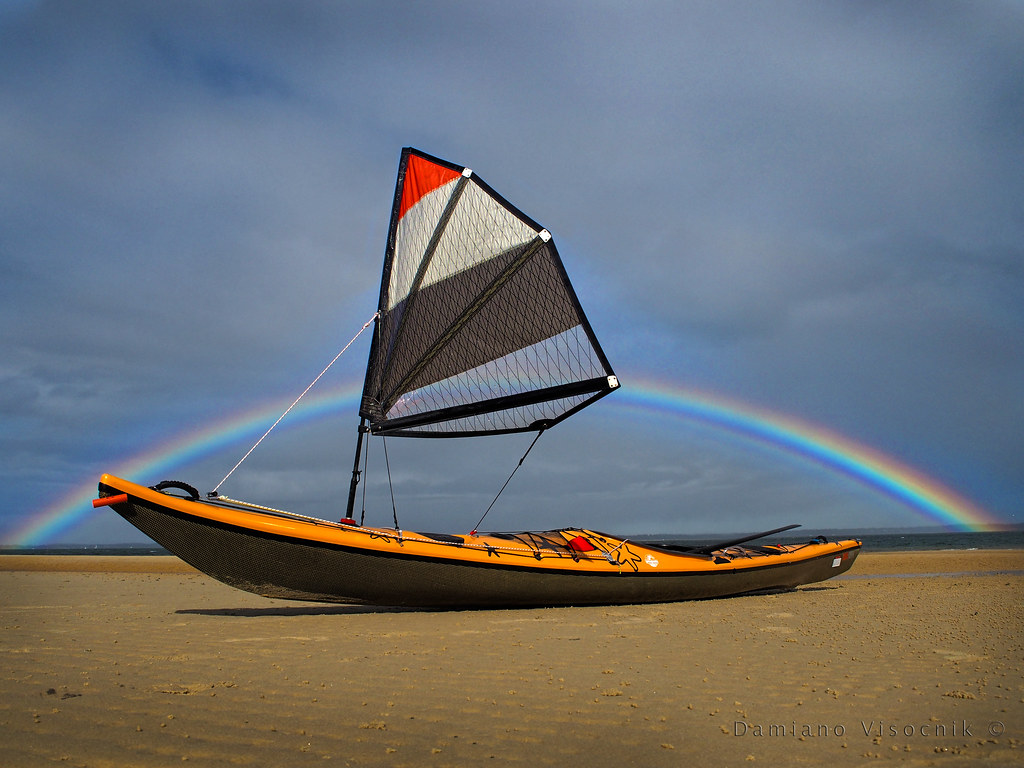
Photo: Pot of Gold

Legend goes that there is a pot of gold at the end of the rainbow.
Maybe it's true.

Commander at Straddie_1_c
SeaDog Commander in the sun shower

.

25 May 2015

GEAR: SeaDog Commander.

I fell in, again.
I have been surfing for an hour and now I was heading home.
I sailed for a while but then I turned directly into the wind and I wanted to stow my sail away.
Stretching myself forward trying to reach the shock cord to secure the folded bundle of my sail made my loose my balance and I kept on falling in.
I realized that I needed a sail that would fold easily on my kayak deck.

Commander testing_1

My high aspect SeaDog sail (0.7 Code Zero) catches the wind beautifully and allows me to cut into the wind at a higher angle than before, but I had a problem with it.
Since I like to have my spray deck area clear my sail is mounted differently than a typical set up.

Commander1 at Peel_r
image courtesy of SeaDog
A typical mount for the sprit style sail (SeaDog, Flat Earth etc.) calls for a tall mast with stays mounted below the boom.
I prefer to have my sail mounted lower to allow the mast not to protrude in my "paddling area" when stowed on deck.
I don't like a folded sail that encroaches the deck where my hands swing when paddling.
It's simple: I want that area clear so my hands don't catch the sail.

On my high aspect sail the boom is substantially shorter than the luff (mast section) resulting in an uneven bundle when the sail is lowered down: the boom is much further away from me when I lower my sail onto the deck.
In need to secure the sail firmly onto the deck I use a section of sock-cord to wrap around the mast, battens and boom to create one solid bundle that I know will not fill up with water when waves wash over the deck or I roll the kayak.
In the bumpy waters, I was now having trouble reaching that boom and I was loosing my balance.

SD_CodeZero 07_c_gd
SeaDog CodeZero 0.7, folded. In order to reach the boom this sail intrudes the cockpit area.

It has been in the back of my mind for some time now: I wanted a sail with a slightly lower aspect and a longer boom.
I consulted with SeaDog sails and after I proposed my design to Richard a technical compromise was hatched: the design I had in mind might end up less efficient and might cause some loss of upwind reach.
One other trait that I really desired in my new sail was that it would be quiet.
Douglas Wilcox aptly calls it "motoring"; the sound that the leech makes when sailing cross-wind.
I don't like that at all and a highly value a quiet sail.
I proposed a double batten to Richard and after some measuring we decided on an optimal length, given my initial request of "neat bundle" when folded.

SD_commander_5_c_gd
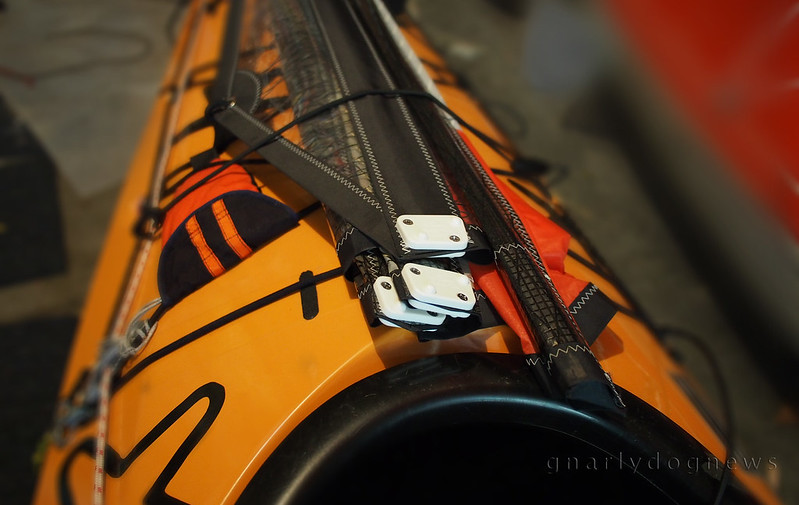
SeaDog Commander Mk1, folded on deck

SeaDog sails distinguish themselves for utilizing the very best high tech materials and superb cut and manufacture.
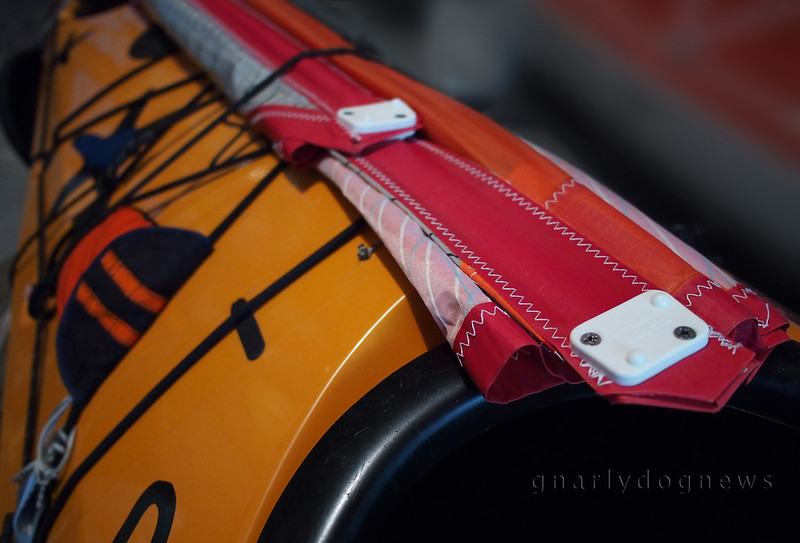
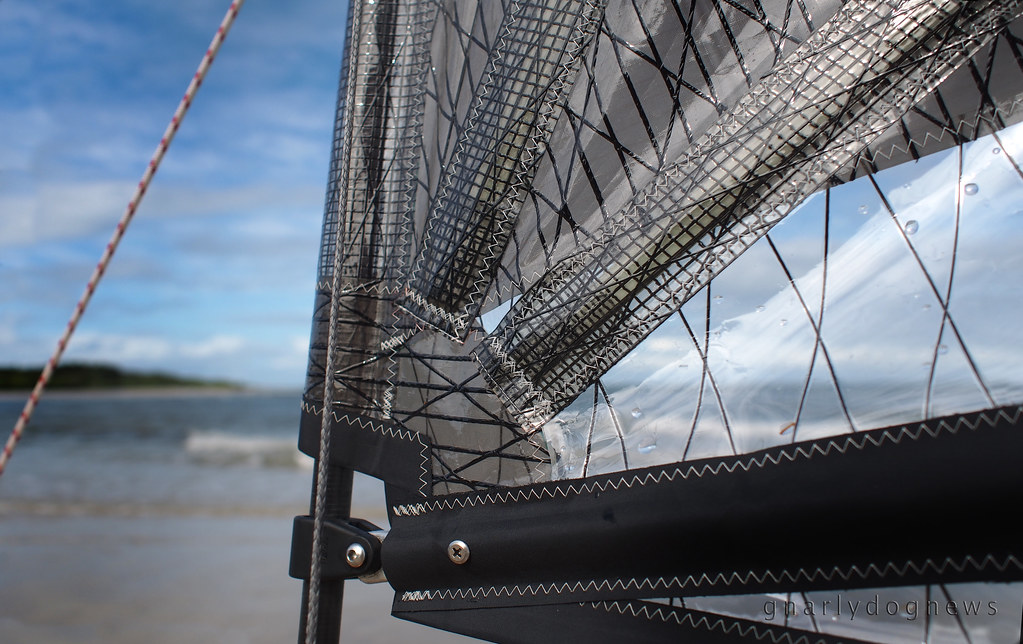
I love the pattern that the carbon fibre makes in the sail cloth used for the batten pockets; it looks really high-tech matching the finish of my Greenland paddles :-)
The twin battens shape the sail perfectly and there are no areas where the sail puckers; the sail stays aerodynamically shaped to catch light breezes allowing a high angle of head wind sailing.
My concerns for decreased upwind performance did not materialize: the SeaDog Commander stays inflated at really high angles too.

SD_commander_3_c_gd
SeaDog utilizes a special thin thread that is incredibly tenacious and UV resistant: the results is beautiful stitching.

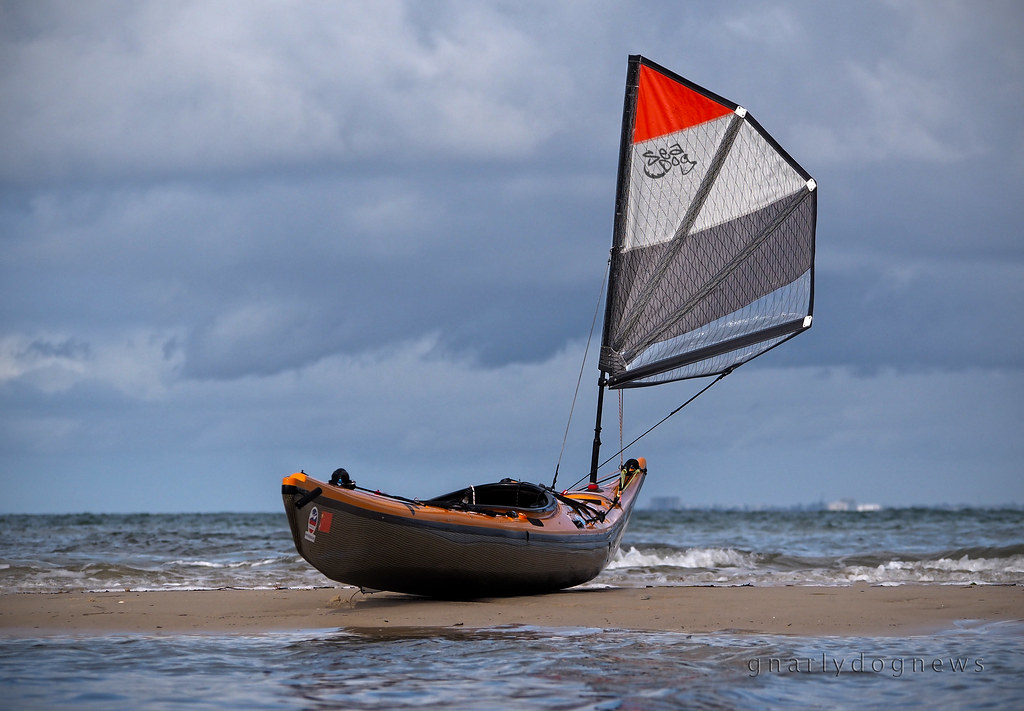
I asked for a combination of sail cloth that would be stretch resistant, dry fast and remain stable. I also wanted to add the Clear-View feature into the bottom panel so I could easily see where I was going. Somehow vinyl windows cut into my previous sails never really helped with forward vision; they were just too milky and were ruining a smooth surface with a puckered section of sail (different stretch).

The new Clear-View panel really offers a better vision of on-water obstacles and boat traffic while the sail surface remains perfectly tensioned and smooth.
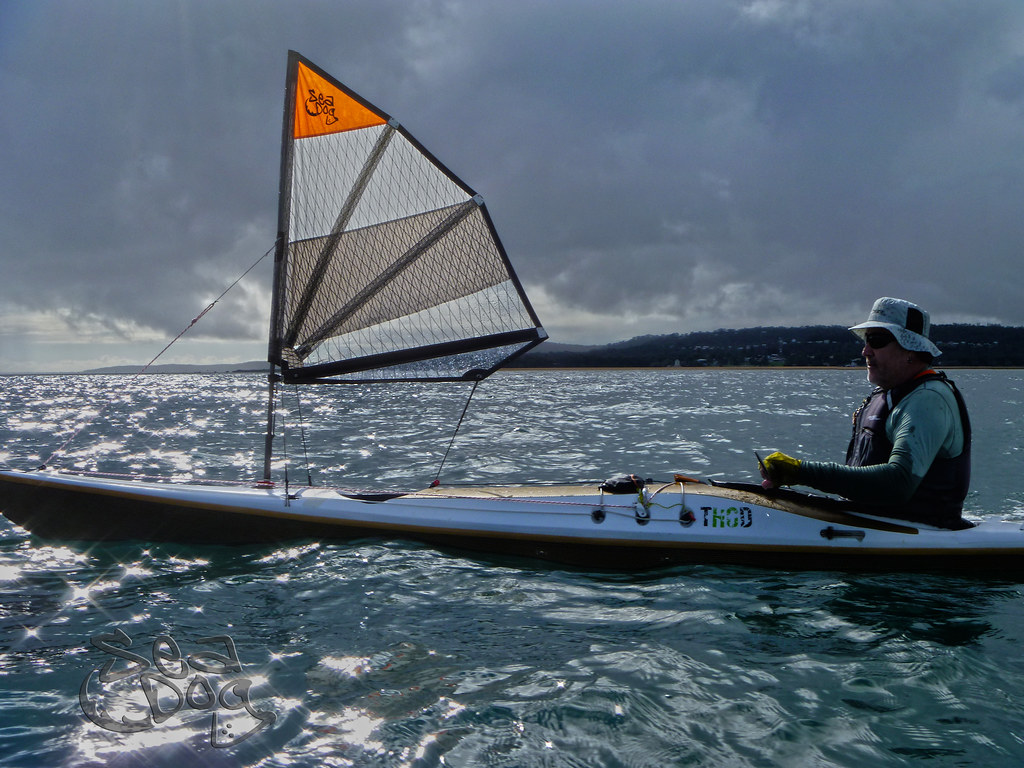
The orange tip adds incredible high visibility on the water while the pattern in the other panels makes for a stunning sail. The SeaDog Black Diamond series (with the Clear-View TM lower panel) are the highest technology sails that I have see so far: a true masterpiece.

SD_commander_2_c_gd

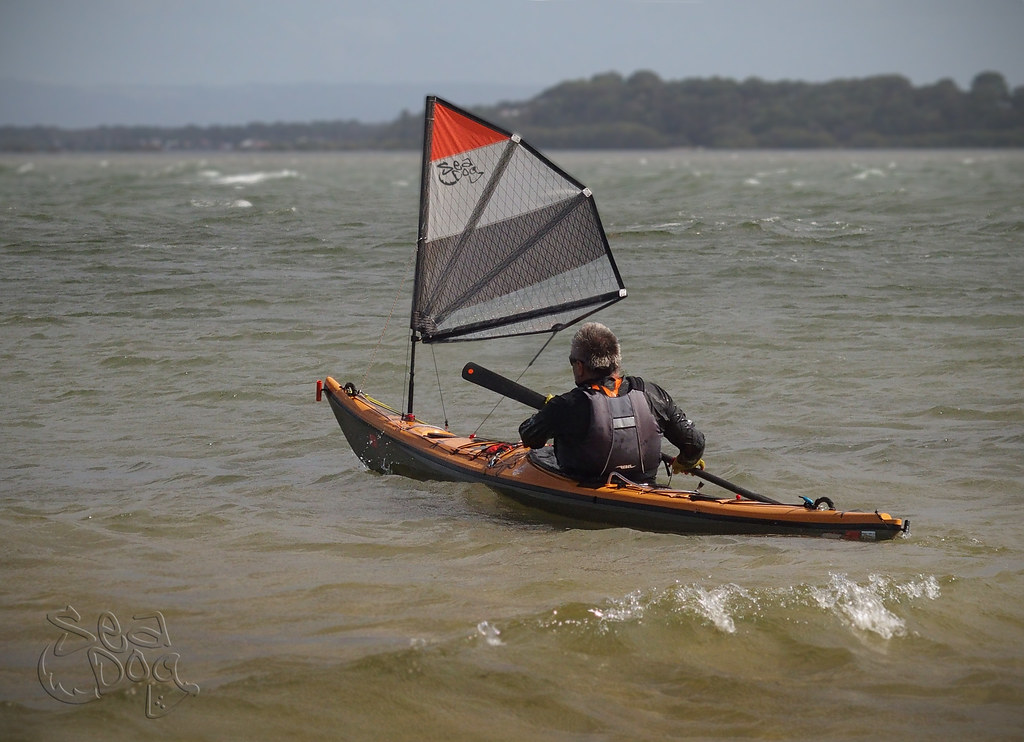
The new SeaDog Commander has a surface area of about 0.8m² to match the sail I most use in winds up to 20 knots.
Above 20 knots, in a beam wind, there is more heeling (pushing over) that I am comfortable with while my kayak does not really go any faster (max. hull speed).
If I know that there will be high winds forecasted I rather use my SeaDog CodeZero 0.7m²
I mounted this SeaDog Commander sail high enough on my carbon mast so I can reach it when folded onto the deck but not too high to intrude into my paddling area.

SD_commander_1_c

Disclaimer: my association with SeaDog has grown where we now collaborate on new projects. After purchasing my first sail from SeaDog I started to offer feedback and stimulated Richard with new ideas. Richard recognized that there was room for improvement with the original sprit sail design. Being able to quickly accommodate to special needs or requests with custom sails, SeaDog is able to blend high-tech sailing cloth to create sails that I wanted to realize for a while. I paid for the materials and he offers his workmanship: we both benefit from it.
 

24 February 2015

Video: Petra surfing Dugong

Let's name her Dugong!
Short, stubby and just a bit "a face only a mother could love" look... the Whisky16 (designed by Nigel Foster) is not a pretty kayak in a traditional sense.
Dugong seemed an appropriate name for Petra's new kayak.
While looks are often deceiving, this kayak fits Petra very well and being very maneuverable spurs confidence in rough water.
The inspiration for the name came from the previous day's event where Petra and I were kayak-sailing back from my favorite play spot. A dugong suddenly surfaced too close to my kayak and looked at me with spooked eyes: I don't know who got the bigger fright, me or the dugong.
Then he quickly dived, his tail flew inches away from my face wetting me completely while I ducked my head avoiding the slap as he desperately tried to miss my kayak.

That evening a sail was hastily mounted to the Whisky16's deck as next day's forecast was promising conditions for a pseudo tidal race: wind against ebbing tide.
With the new SeaDog sail mounted up front Dugong really brings smiles


click on image above to play video

Edging and rolling the Whisky16 seemed easier than the borrowed kayaks: a good fit where one can brace without having to splay the legs too far could be the reason.
The keyhole cockpit where the legs can be kept relatively close together, allowing some wiggle room but still offering a solid wide area of contact, is probably a better solution than the diminutive thigh braces wings I see in most kayak cockpits.
So far the two kayaks that I own with such keyhole cockpits are way more comfortable than the other system I have tried.
The rear deck is not particularly low in the Whisky16 however layback rolls are still reasonably easy since the seat is not jammed right against the rear of the cockpit rim.
For once the seat is not shaped as a racing short-pan paddler crunched-over design: a lower front lip allows for more relaxed seating.
My experience with short seat that have a higher front has not been positive as I often end up with "dead legs". A flatter pan and longer seating area is key for longer paddles where my thighs don't suffer from blood circulation cut off.
Petra, while being the exact opposite of my bio-metrics, seems to agree: she dislikes short peaked seats and loves the flatter pan. The seat of the Whisky16 is here to stay.

The front deck however has already been modified to accept a sail and place it at closer reach. Details here.

28 January 2015

Video: Best Moments of 2014 in Moreton Bay

Once a year a new video is edited focusing specifically on local paddling's best moments.
This one was shot over 2014 in Moreton Bay alone.


Of course, only a very small portion of "the fun stuff" is recorded despite spending most weekends on the water.
I compiled mostly "orphan" clips that were not previously included in a other videos; the shots are short and highlight the best moments of a day's outing.

In order of appearance: Gnarlydog, Vanilla and Petra.

PS: work has already commenced on the 2015 edition...

.

12 January 2015

Photo: sail-surfing the New Year

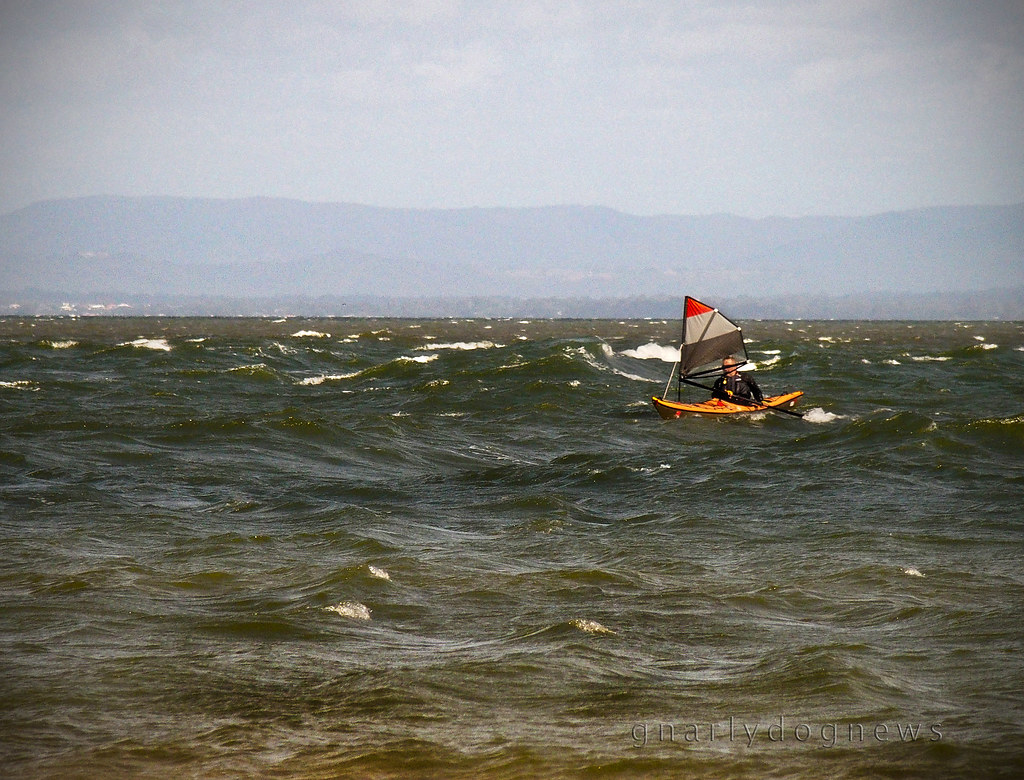
Conditions were just right: a running out tide met by an opposing 15 knots of wind created waves steep enough to be caught by a small sail.

Surfing Dugong Jan15_1

Petra sail-surfing with Northern Light paddle and SeaDog sail.

.

25 November 2014

VIDEO: sailing with SeaDog 0.7

This time the wind was really blowing and I was glad that I had my smaller sail installed on my kayak: the SeaDog 0.7m².
I could feel that there was less heeling as I didn't have to transfer all my weight to the windy side.
My large sail of 1.0m² would have been too much and harder to handle while my SeaDog 0.7m² was still giving me plenty of speed to surf the waves with ease.

Here is a short video of a few different outings with the SeaDog 0.7m²


I believe that the SeaDog 0.7m² is a great sail for when the wind starts to blow and white caps appear on the water; it offers me plenty of power while still allowing me to handle my more tippy kayaks without a white-knuckled grip on my paddle.
I figured out that a kayak can only go so fast and no matter how big of a sail I mount on the deck it just won't go any faster. A larger sail however just catches more wind and when loaded from the side wind it wants to push the kayak over. I have been at times hanging way over the side of my kayaks trying to keep them from tipping while not noticing any increase in speed over a smaller sail.

Of course, if the wind is from behind (stern wind) and the waves have built up to a size that they start to lift the stern of the kayak where I can surf; my kayak will indeed go faster than hull speed.
It is these times that I find the SeaDog 0.7m² exceptional and easier to handle. As I surf down the wave (on a wind right behind me) the kayak will come to a point where the sail no longer seems to be inflated. At the bottom of the wave I will have the boom flap loose over the deck and wanting to swap sides. Then the gust of wind catches up with me and with a shuddering noise the sail slaps to the other side taken in by the main sheet. It is in this moment that a smaller sail will save me from a sudden imbalance and possible precarious lean that might result in a dunk. I don't feel the raw slap that bigger sails give me in high winds: the 0.7m² is easier to handle.

Another benefit of a smaller sail is when things do go pear shaped and I fall in.
I have been practicing rolling with a sail; starting from dead calm conditions to increased breezes and more bumpy seas. I find that a sail with a smaller surface has much less drag underwater and in a roll I can scull up without too much effort. Recently I have been trying to forego releasing the main sheet and just leave the sail alone while falling in. While slightly more difficult than releasing the main sheet (or uphaul) I am more confident in recovering with the sail just left as it was before falling in.

As winds increase to 20 knots and above I wonder if a smaller sail would not be even better?
Maybe that is something I should look into...

.

22 October 2014

GEAR: SeaDog sail Code Zero

I nearly tipped in and went for a swim when a small set picked up my kayak and I started surfing.
I was in my "tippy" kayak and half an hour into testing a new sail: the SeaDog 0.7 mt² in Code Zero .
SeaDog Code Zero 0.7mt_1

I was having fun trying to catch the short wind waves that the tidal flow against a healthy breeze was producing.
I am familiar with this location and often I wait for the conditions to be just right to be able to surf with my kayaks.
I am not sure if the long waterline Swede form narrow beam low rocker kayak was ideal for the small steep short waves but I wanted to see if a smaller sail would be easier to use in a stiffer breeze.
I have several sails from Flat Earth of 1.0 mt² and 0.8 mt². They work great and are very efficient sails for sea kayaking. Their design is a derivative from the decade old, or more, proven system that the Tasmanian sea kayakers have been using in strong winds.
That lead to the development of a sail mounted further forward, away from the paddler's cockpit as explained here.
The SeaDog sail is an unapologetic close resemblance of  Norm Sander's rigs and Flat Earth sail.
Actually the design is strikingly similar.
SeaDog sail_3

I have been kayak sailing with other paddlers that have been using SeaDog sails for the last couple of months.
Richard, an avid SE Queensland Sea Kayakers paddler, is the man behind the brand and his passion for sailing is evident.
He can be seen paddling every weekend (and often during the week) sporting sails of his own creation on his kayak.
It all started innocently when Richard decided to add some color to his sail.
A special one was made just before Xmas and of course, inspired by the festive season, it was green and red. It was different and unique; people noticed.
Xmas sails_SeaDog
photo: SeaDog sails
I was impressed by his early work even tho I didn't share his passion for the color choice :-)
A few weeks later a new colorful sail appeared in the paddling group. Again the work was impeccable.
I watched those sail taking the wind very well and I noticed them filling with air at even very acute angles into the wind. One thing that I was very surprised is that Richard's sails did not flutter.

Eventually Richard made me a sail that I was missing in my quiver: I wanted a small sail that will allow me to be used in winds of 15 knots and above.
SeaDog sail_1

I have used my Flat Earth of 0.8 mt² in winds where I no longer was comfortable with the heeling force of the strong wind. Unless surfing, the hull speed of my kayak will really determine how fast I can go, no matter how big my sail is

As the small waves started to pick up my kayak the SeaDog sail was hit by a gust from the side. Any other time I would have to quickly react with a solid brace with the risk of tipping over.
This time the jolt was softer and the shock cord on the main sheet (the rope that pulls-in the boom) released some of the pressure from the wind. This sail being smaller helped reduce the heeling force that wanted to tip the kayak into the water. I was able to stay upright and continued to surf.

The downside of a smaller sail is that I have to work harder and paddle more when the wind is from behind (running with the wind). As the waves catch up with me I have to put an extra effort to then accelerate down the wave.
Side-by-side with a buddy using a 1.0 mt² sail I had to really crank to catch the marginal waves, while I could see that he was getting more push from the wind.
However, I am sure if the wind was 20 knots +  he would be a bit worried with his larger sail...

SeaDog sail_2

In essence the SeaDog sail of 0.7 mt² is best suited for stronger winds or paddlers that have just starting out sailing, possibly with less bracing skills. Lighter paddlers will also appreciate this sail as their lack of counterbalance body weight is noticeable in strong winds.
SeaDog sails also makes 0.8 mt² sails, in traditional colorful Dacron® or the fancy laminated Code Zero (unfortunately white only).
On closer inspection I notice very clean seams and stitching on the SeaDog; every stitch is continuous from one end to the other with absolute precision. Every end is reverse stitched to prevent unravelling and the tension on the bottom and lower cotton is perfect to create a very clean stitch.
Attention to details is superb and the finish is outstanding: every rivet and every reinforcement is very well executed.
SeaDog sail_4

Is SeaDog a better sail for me?
I can't say that as Flat Earth has served me well and I had no trouble for years now.
What I notice is no flutter in the leech, something that mildly annoys me in the Flat Earth sails.
I mounted the SeaDog sail with two back/side stays, as I have done on all my other sails.
Richard recognizes that kayakers have preferences in mounting styles and hardware used for doing so. He supplies the sail with the mast, Spectra stays and the flexible polymer base only, leaving the rest up to the sailor.
I much prefer that since some of the (Flat Earth) sail kits that I have used had parts that failed on me.