Showing posts with label North Face. Show all posts

03 September 2015

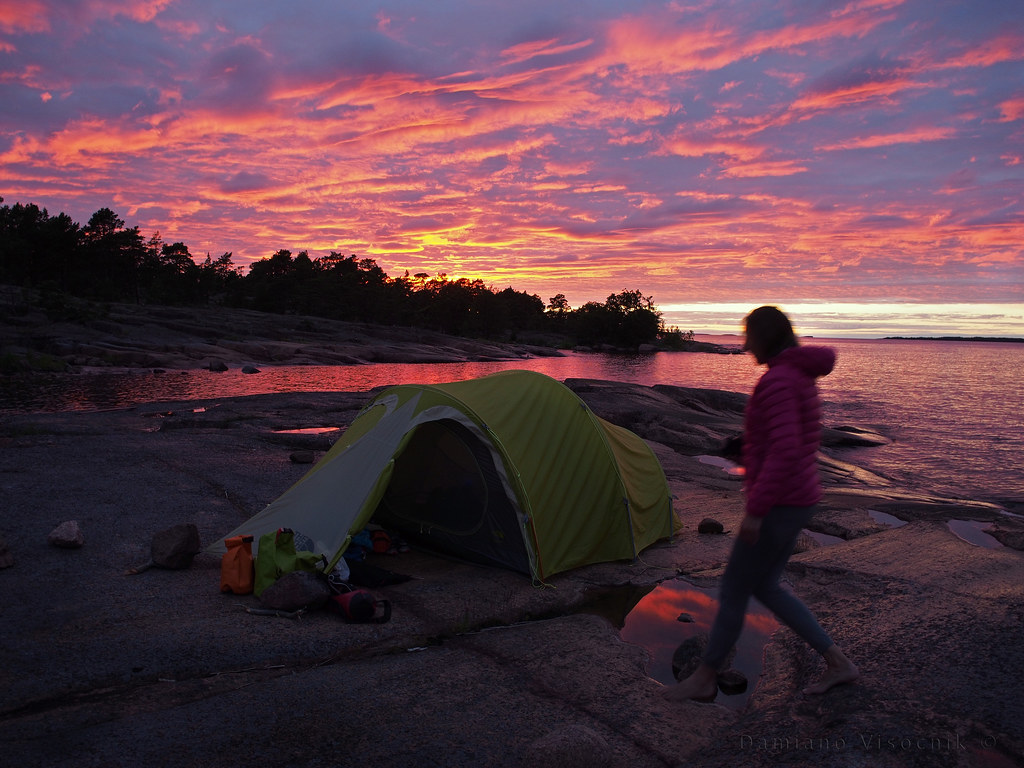
Photo: camp at Japanese Gardens

After one of the most intense days of paddling and sailing in swell against rebound against high cliffs the sheltered camp location we found was stunning.
The carefully arranged although natural setting of little ponds and low vegetation reminded me the look of Japanese gardens.

Aland sunset_4_c
more images appear on my photo blog

Polished granite slabs make camping easy as nothing gets dirty while sitting down and dinner can be had without sand in it.
Sunset only came very late and was not fully dark when we finally retired for the night.
Sea kayaking at very high latitudes has its advantages even if sea temperatures are not as balmy as back in Queensland.

.

02 April 2014

VIDEO: Swedish Baltic coast

.
It rained all day and the wind was blowing hard from the land as we paddled to a remote island to meet with Pia and Erik. All we had was a name for a location that was marked on our map, no other details.
We were not sure if our friends would show up: conditions were not that great for camping.
In the afternoon the rain eased and the clouds parted to reveal a colorful sunset. Shortly after our friends landed to then join us for a few days on our 4 weeks expedition along the Swedish Baltic coast.


 for a better viewing experience select HD, if you aren't using a mobile device

I love the outer islands of the Stockholm archipelago with their polished granite shores.
The sensual shapes are very inspiring luring me back to experience them again.
This summer (Northern hemisphere) I will be kayaking again in the rocky labyrinth, possibly crossing to Finland.

Contact me off-line at gnarlydognews(at)gmail.com if you want to catch up.

.

25 September 2013

Technique: pitching a tent on rocky slabs


My favorite natural environment is rock; granite to be precise.
I am not a rock climber these days but I have always gravitated to locations where exposed granite forms the landscape.
Last season I traveled to the  High Sierras, to a familiar area.
This season I chose to undertake a sea kayak trip instead where thousands of little island gently emerge from the sea and create incredibly smooth landscapes.
There is a strong similarity between the High Sierra and the Stockholm archipelago; both have glacially polished granite, the latter at sea level.
For the Sierras I chose a very light shelter since I knew I didn't need an inner tent to protect myself from insects.

PeeweeLake camp_c

For Sweden I chose a tunnel tent: a known design able to shed wind well.
I chose a non-freestanding tent over a more pitch-friendly free standing one because of weight and bulk. I dislike travelling with heavy gear and flying across the word to reach my destination usually limits my choice of equipment; there is an incredible difference between car camping and international travel.

Tunnel tents however pose some problems when pitching on hard ground.
Staking out the ends of the tent is essential  to keep the tent erect (unlike in a freestanding tent).
Since polished granite offers too much resistance for conventional pegging (like rock-hard ground!) a little tinkering on my part is usually necessary to have a secure shelter for the night.

Sunset at Windy camp_c

Instead of relying on pegs at the stake point I collect a stick and a couple of decent size rocks.
I insert the stick into the stake loop of the tent and place it horizontally on the ground where a large rock will secure it in place. I find that a rock on top of a stick is generally a way better anchor than a typical tent peg pushed into soft ground.

Furthermore, where the ground is a polished slab there are usually a few cracks.
Here is where I like to place a little wired metal wedge designed for rock-climbing  (aka stoppers, nuts, rocks etc).
A carefully placed wedge is bombproof and no amount of wind will rip that anchor out.

rock anchor_c
Black Diamond stopper
In locations where there is little to no trees, or large boulders to create a wind break, I am confident that my tunnel tent will stand  up to strong winds, even without any pegs secured into the ground.

Windy on Magic_c

rock anchor_gdn
Omega Pacific wedgie


30 November 2009

Keep it simple

Overcomplicating a design often makes things worse.
It's a real art (or some would call it science) to achieve the desired design and streamline it to where nothing superfluous is left.
Once you achieve that probably the design will hold.
In other words less is more.
I am guilty of often spending too much time over engineering a small item that could be simplified and made more efficient.
I often get inspiration from comments of other users to complete my ideas, like
while presenting my work at the 2nd Australian Sea Kayak Symposium where I gathered tips from the attending public.
It is a trap to have something too complicated and with too many features that in the end might lead to the failure of the primary function.
In the outdoor industry I admire designs like Arcteryx (a leading manufacturer of outdoor clothing and gear) where they strive to eliminate everything that is cumbersome and superfluous but at the same time achieving an aesthetically pleasing very functional product.
In my opinion, the exact opposite is North Face, also a leading outdoor gear brand.
Their philosophy is to add more features and gadgets where none could be added anymore.
Both are successful brands in the same field but they appeal to a different style/demographic.
I noticed more college crowds wearing the heavily advertised brand North Face while Arcteryx was worn by a more discerning mature outdoor folk.
There are many other brands out there but I wanted to make an analogy between these two clothing brands and sea kayaks.

How often I see novice paddlers impressed by kayaks outfitted with gadgets or wanting to accessorize their sea craft with those gadgets.


deck clutter?
I have been one of them and in some respect still am.
Boy, was I lusting after one of those deck bags: it would make me look like a real sea kayaker.
But the more time I spent on the water the more I realized that it's best to keep a clean deck since loose items are begging to be claimed by the sea or wanting to entangle you in the heat of the battle.

Fortunately that deck bag never made it “under the Xmas tree” .
Don't get me wrong, to some I am still known as gadget man and admittedly I go to great lengths to acquire (or fabricate) the perfect item.
My goal however is to have the least chance of that gear to fail while keeping bulk and weight to a minimum (I also like to stow most items under the deck, these days)
A project of mine can see design, test, redesign and retest to lead occasionally to an abandoned project if I can not pull off the two principles: sturdy but light/compact.
Less is more.


That leads to this coin:

How much simpler could a coin get.
It clearly says 1 rupee, and to reinforce the concept of "one" a raised thumb is depicted.
I would not call it a feat in artistic design but it's simple and clear.

It achieves its function: light, simple and economical to produce (unlike some bi metal coins out there).
Now, if only Fonzie would be still around to see that his signature move made it onto the face of a coin :-)