Showing posts with label Flat Earth kayak sails. Show all posts

25 May 2015

GEAR: SeaDog Commander.

I fell in, again.
I have been surfing for an hour and now I was heading home.
I sailed for a while but then I turned directly into the wind and I wanted to stow my sail away.
Stretching myself forward trying to reach the shock cord to secure the folded bundle of my sail made my loose my balance and I kept on falling in.
I realized that I needed a sail that would fold easily on my kayak deck.
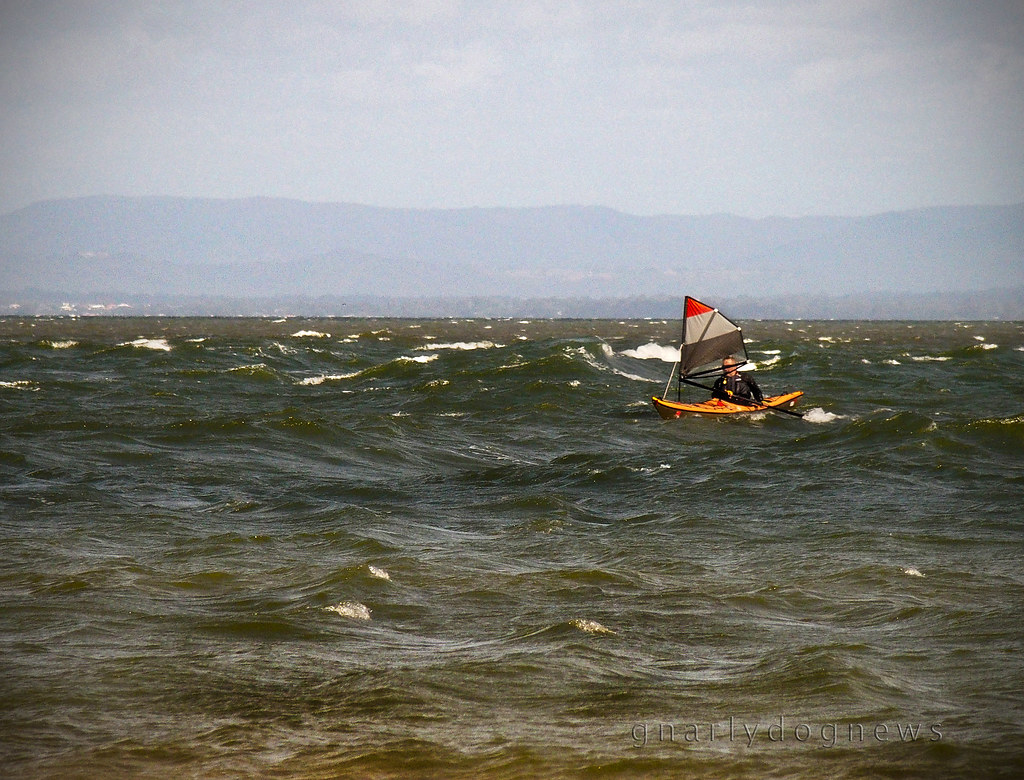
Commander testing_1

My high aspect SeaDog sail (0.7 Code Zero) catches the wind beautifully and allows me to cut into the wind at a higher angle than before, but I had a problem with it.
Since I like to have my spray deck area clear my sail is mounted differently than a typical set up.
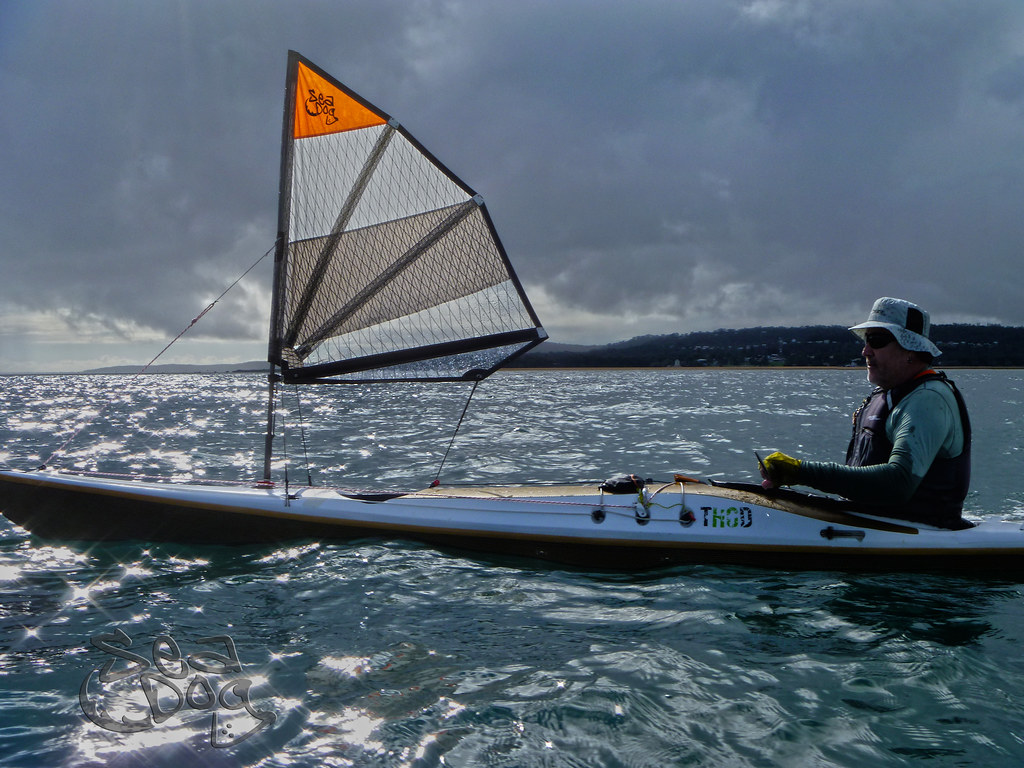
Commander1 at Peel_r
image courtesy of SeaDog
A typical mount for the sprit style sail (SeaDog, Flat Earth etc.) calls for a tall mast with stays mounted below the boom.
I prefer to have my sail mounted lower to allow the mast not to protrude in my "paddling area" when stowed on deck.
I don't like a folded sail that encroaches the deck where my hands swing when paddling.
It's simple: I want that area clear so my hands don't catch the sail.

On my high aspect sail the boom is substantially shorter than the luff (mast section) resulting in an uneven bundle when the sail is lowered down: the boom is much further away from me when I lower my sail onto the deck.
In need to secure the sail firmly onto the deck I use a section of sock-cord to wrap around the mast, battens and boom to create one solid bundle that I know will not fill up with water when waves wash over the deck or I roll the kayak.
In the bumpy waters, I was now having trouble reaching that boom and I was loosing my balance.
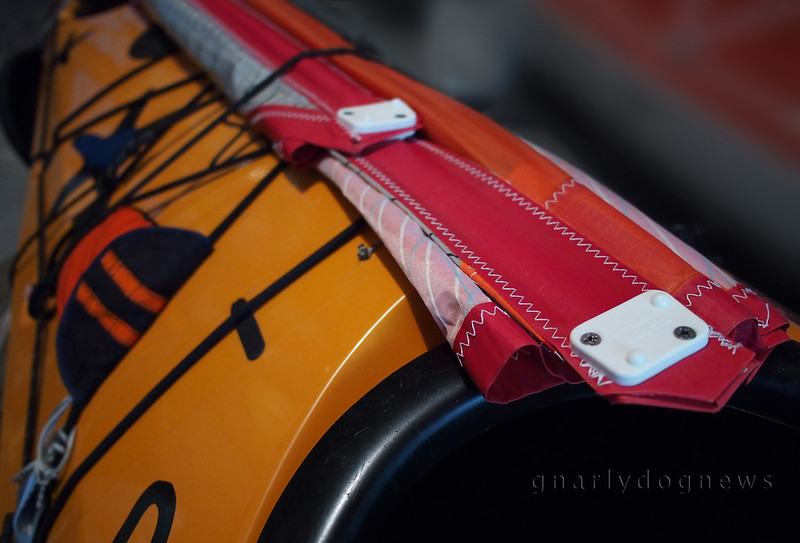
SD_CodeZero 07_c_gd
SeaDog CodeZero 0.7, folded. In order to reach the boom this sail intrudes the cockpit area.

It has been in the back of my mind for some time now: I wanted a sail with a slightly lower aspect and a longer boom.
I consulted with SeaDog sails and after I proposed my design to Richard a technical compromise was hatched: the design I had in mind might end up less efficient and might cause some loss of upwind reach.
One other trait that I really desired in my new sail was that it would be quiet.
Douglas Wilcox aptly calls it "motoring"; the sound that the leech makes when sailing cross-wind.
I don't like that at all and a highly value a quiet sail.
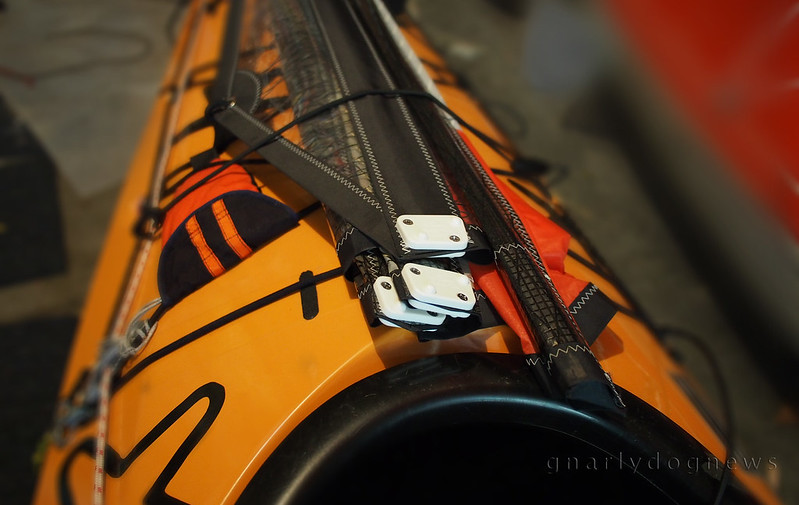
I proposed a double batten to Richard and after some measuring we decided on an optimal length, given my initial request of "neat bundle" when folded.
SD_commander_5_c_gd
SeaDog Commander Mk1, folded on deck

SeaDog sails distinguish themselves for utilizing the very best high tech materials and superb cut and manufacture.
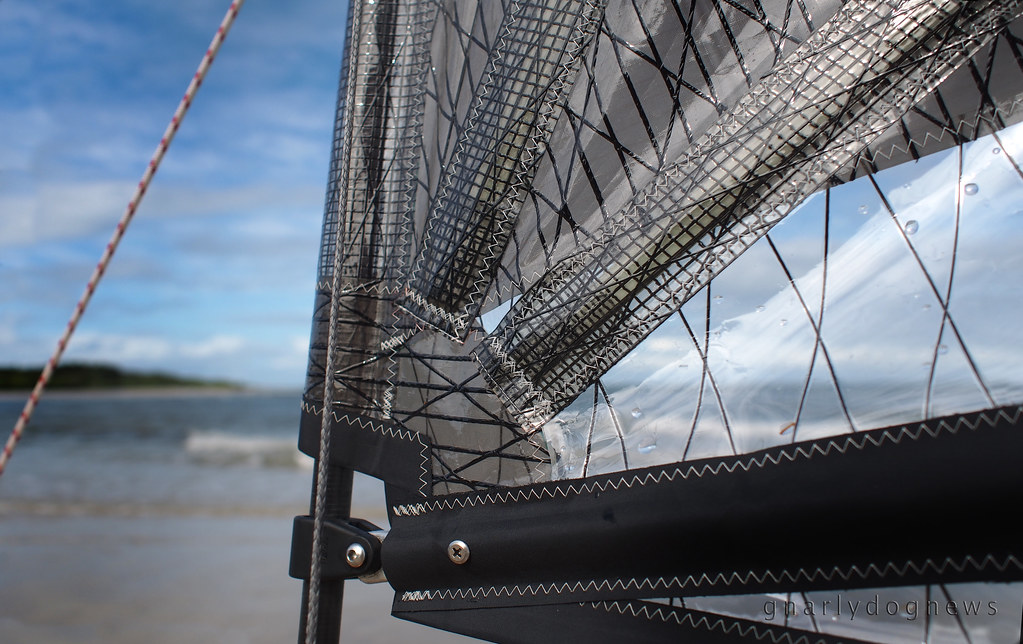
I love the pattern that the carbon fibre makes in the sail cloth used for the batten pockets; it looks really high-tech matching the finish of my Greenland paddles :-)
The twin battens shape the sail perfectly and there are no areas where the sail puckers; the sail stays aerodynamically shaped to catch light breezes allowing a high angle of head wind sailing.
My concerns for decreased upwind performance did not materialize: the SeaDog Commander stays inflated at really high angles too.
SD_commander_3_c_gd
SeaDog utilizes a special thin thread that is incredibly tenacious and UV resistant: the results is beautiful stitching.

I asked for a combination of sail cloth that would be stretch resistant, dry fast and remain stable. I also wanted to add the Clear-View feature into the bottom panel so I could easily see where I was going. Somehow vinyl windows cut into my previous sails never really helped with forward vision; they were just too milky and were ruining a smooth surface with a puckered section of sail (different stretch).

The new Clear-View panel really offers a better vision of on-water obstacles and boat traffic while the sail surface remains perfectly tensioned and smooth.
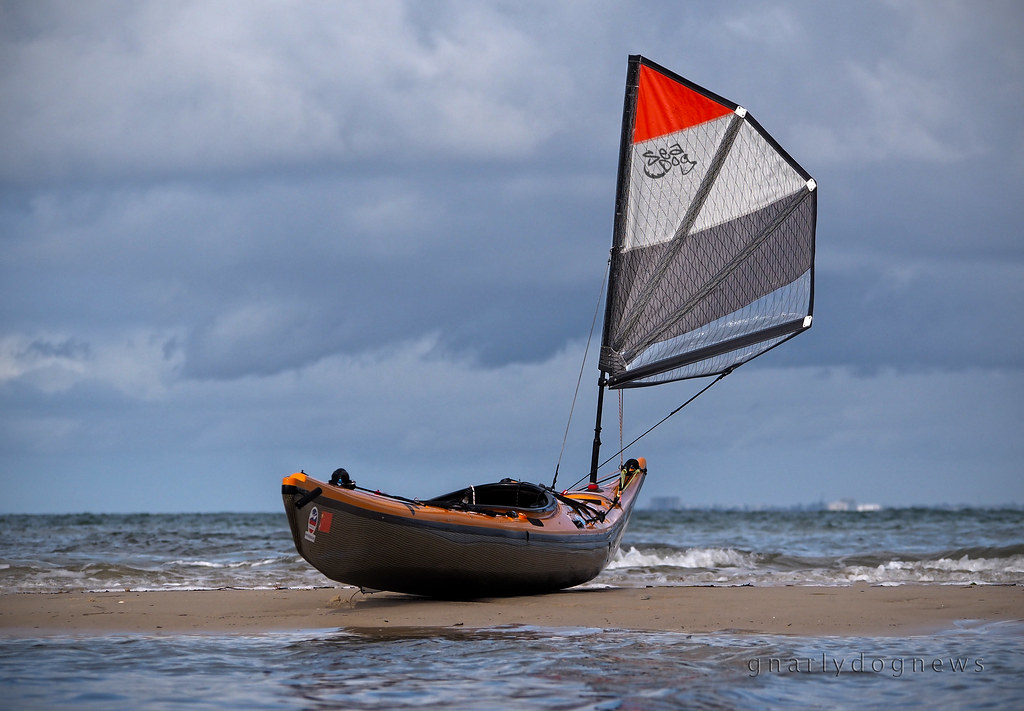
The orange tip adds incredible high visibility on the water while the pattern in the other panels makes for a stunning sail. The SeaDog Black Diamond series (with the Clear-View TM lower panel) are the highest technology sails that I have see so far: a true masterpiece.
SD_commander_2_c_gd

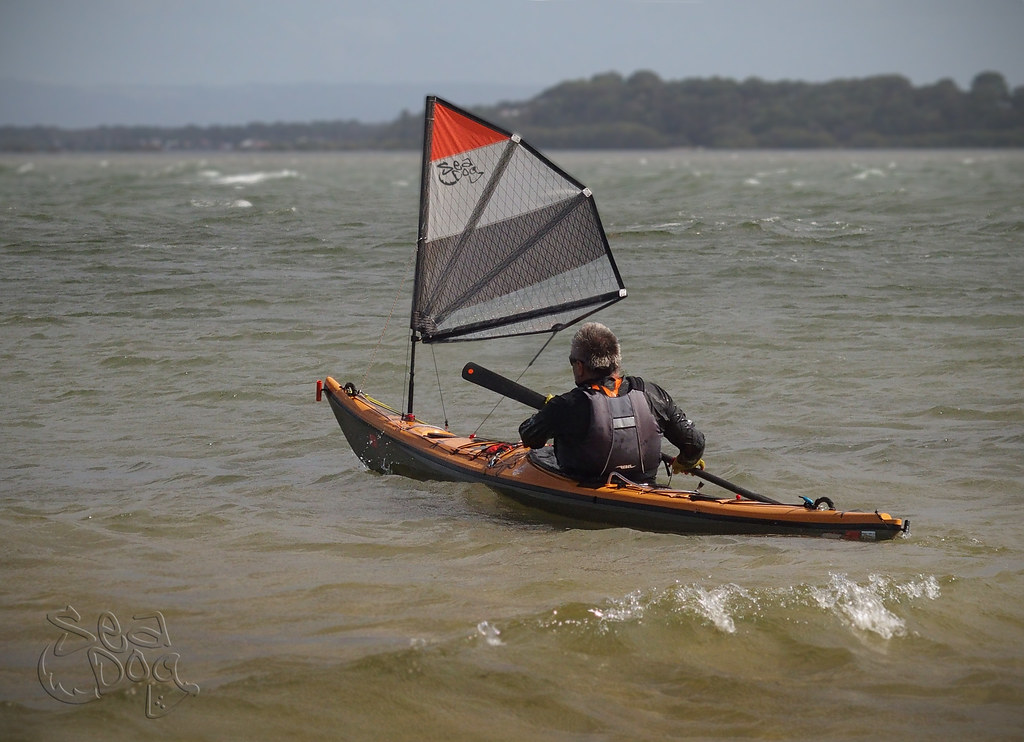
The new SeaDog Commander has a surface area of about 0.8m² to match the sail I most use in winds up to 20 knots.
Above 20 knots, in a beam wind, there is more heeling (pushing over) that I am comfortable with while my kayak does not really go any faster (max. hull speed).
If I know that there will be high winds forecasted I rather use my SeaDog CodeZero 0.7m²
I mounted this SeaDog Commander sail high enough on my carbon mast so I can reach it when folded onto the deck but not too high to intrude into my paddling area.
SD_commander_1_c

Disclaimer: my association with SeaDog has grown where we now collaborate on new projects. After purchasing my first sail from SeaDog I started to offer feedback and stimulated Richard with new ideas. Richard recognized that there was room for improvement with the original sprit sail design. Being able to quickly accommodate to special needs or requests with custom sails, SeaDog is able to blend high-tech sailing cloth to create sails that I wanted to realize for a while. I paid for the materials and he offers his workmanship: we both benefit from it.
 

02 April 2015

Video: I Have A Dream

Some dream of power, some dream of money.
Some dream of a slimmer waist and a bigger chest, some dream to have more hair on their head.
Some dream of a fast red car or those pretty shoes they saw in the window...
My dream is different.


reward yourself with full screen viewing in high definition on a larger screen, this one was not meant for mobile devices...

My dream is to be lost in a sea of islands, midnight sun and good friends.
A place where I don't need to keep time or answer my phone, no updates and no "likes".
And then the presence of mind to take it all in.

.

28 January 2015

Video: Best Moments of 2014 in Moreton Bay

Once a year a new video is edited focusing specifically on local paddling's best moments.
This one was shot over 2014 in Moreton Bay alone.


Of course, only a very small portion of "the fun stuff" is recorded despite spending most weekends on the water.
I compiled mostly "orphan" clips that were not previously included in a other videos; the shots are short and highlight the best moments of a day's outing.

In order of appearance: Gnarlydog, Vanilla and Petra.

PS: work has already commenced on the 2015 edition...

.

03 October 2014

Video: Aquarius Sea Lion LV

On a sea trip of 5 weeks in Sweden and Åland (Finland) Petra paddled a Sea Lion LV.


Aquarius of Poland sponsored her with a very light carbon/Kevlar kayak and we installed her Flat Earth sail to make our expedition more fun.
Petra picked the color scheme of her kayak and I thought the graphics were particularly attractive making the kayak very visible against the water and granite islands.
The kayak behaved very predictably in varied conditions and weather-cocked just enough to make it safe when windy, even in a storm.
The only real modification was removing the padding that was factory fitted on the seat; lowering the center of gravity made the kayak a bit more stable. Given that she has never paddled a Sea Lion LV before, Petra liked how she felt in that kayak right from the beginning.
Despite the cockpit maybe being a bit too roomy for her the key hole style thigh braces allowed her to brace efficiently when the waves picked up and tossed her around a bit.
Cargo space was sufficient for our extended trip and the main hatch covers (Kajak Sport) never leaked (the "glove box" needed a bit of sealing around the rim).
The skeg performed flawlessly and was butter smooth to operate. Adjusting the foot rests was possible even while paddling (without needing to exit the cockpit to reach the adjusting tab behind the foot rest!).
The shorter waterline and the rockered hull seems to be well suited to shallow waters with shorter waves (no ocean swell in the Baltic sea). Clapotis was not upsetting Petra and I noticed increased confidence in following seas where she was catching and surfing waves way faster than me, leaving me behind.
I think that the Sea Lion LV combined with a sail is a great fun kayak.
It performed well with just light loads in strong winds (slight leek cocking when sailing) and very steady when filled with camping gear, food and water.


23 June 2014

Call of the Baltic

I retire to the tent late, tired; it has been a long day.
I lost track of time because I did not need to know, my watch stowed somewhere deep in my kayak.
The sun has been shining since very early morning and now has almost made a full circle around the sky. I watched it eagerly skirting the horizon but it just doesn't want to set.

Sea kayaking in the Baltic sea is extraordinary.
The labyrinth of islands where I choose not to navigate electronically (no GPS for me) are truly endless.
I don't have to rush to find my campsite as I don't have a set destinations; there is an incredible abundance of good spots to stop for the night.
The wind has been pushing us North and made our journey easy.
The sailors we meet along the way are intrigued by our kayak sails and often question us.


I have  a great sense of freedom here.
The vast choice of routes and destination, places to stay for the night and easy waters create an environment suited for my style of travel. I am not pressured by tidal flows and timing needed to reach my camp, I get up when I feel like and paddle as long as I want; night comes too late to have to fret and usually I tire out way before I run out of daylight.
And there is no sand at camp: always a bonus for me. While sandy beaches are gentle on the kayak's hull they are my nemesis when camping. I rather have hard granite under me anytime over messy sand that seems to stick to all things it shouldn't.
The sea water is so much less salty here; I use it to cook pasta and potatoes but just a bit too briny for drinking. I don't have to carry much fresh water with me anyway since there are enough houses around with a hand pump in the back where I can refill every couple of days.
The Baltic sea offers me the perfect blend of civilization when I need it and remoteness when I want it. The islands closer to the mainland have more vegetation, more houses, shops. Further away are the outer islands: often desolate low elevation polished granite shores exposed to the wind and waves.A great place to camp in fine weather where I rarely seen any other sailing boats and hear no noise but the one of wind, waves and birds.

For the next couple of months is where I will be.

21 May 2014

Video: Vandreaming

.
Vanilla heard it clearly: it was the sound of his hull scraping on rock.
Now that his new kayak was finally baptized extreme care would no longer be necessary.
The lure of the gentle swell over the rocks was too great and, as if hearing a mermaid's song, we were drawn to it.
There was absolutely no need to paddle so close to those oyster and barnacle encrusted shores but the thrill of feeling the slowly pulsating water push our kayaks up to then suddenly drop away exposing the rock below, was measurable.


Allow yourself to view it on a large screen and headphones: enable HD for a better experience

This time the gentle wind and the calm ocean swell allowed us to explore a few tight spots that we missed on previous visits to these shores.
Food and water for a week and no scheduled itinerary is how we like to kayak. The mileage is irrelevant when there is so much to explore at close quarters in these tropical waters.
I was back in my old "big girl", a kayak that these days I only use for longer trips; when I thought I should spend more time with her. While maybe not as hard tracking and fast as some of my other kayaks, it was a refreshing feeling to be able to maneuver more nimbly around the rocks. A wider beam allows me to edge and release bow and stern for easier turning: I was able to avoid a few rocks...
We were too early in the season to encounter whales but saw a few large tunas leap out of the water.
Vanilla optimistically brought a hand line for fishing, with little success, given that he only tried once.
A realist, I carried dehydrated home-made meals that made fine dinners: just add water (and a bit of heat).
Being a team of just two allowed us much more flexible planning (read: none) and the days' destinations were simply shaped by the direction of the wind: if possible, we chose downwind.
.


06 May 2014

Video: Sailing with Vixen

Of the kayaks in my shed Vixen is the most demanding.
I have kayaks that are high volume and are great on extended trips although I find them a bit dull for sheltered waters paddling.  I have low volume kayaks that are oh so easy to roll and a bit tricky to handle in rough waters, I also have a kayak that despite having a tendency to lee cock a bit it is very easy to live with when I do hand's free photography on the water.
And then there is Vixen: a Point65North XP designed by Johan Wirsen.
I need to pay attention when I paddle that kayak; she won't let me be sloppy or careless.
I find her a demanding in short wind waves; because of her longer waterline she tend to bury bow and stern (video here).
With her deep V shaped keel she wants to sit on one side when stationary and novices find it disconcerting.
Vixen however is great for sailing: the deeper keel prevents some of the lateral drift in a beam wind and I can maintain a straighter course over waves.
The longer keel line in the stern resists broaching and I have to use less correctional strokes compared to my other fish-form British kayak.


If you aren't viewing this on a mobile device, go big and watch it in full HD glory
Over the week end the Westerly wind really picked up an despite the shorter fetch over the waters of Moreton Bay I had times when the wind was up to 30 knots.
It was then where I no longer could sail as the bow was getting pushed downwind; maybe a smaller sail could have been still manageable for the beam wind?
Even with the sail stowed on deck I had to take care of occasional lee cocking when the bow will crest a wave and then be blown downwind.
Myself and AdvetureTess had the bay to ourselves with only the occasional yacht enjoying the strong wind.

.

27 April 2014

Photo: Sail-surfing at sunset

.
I chase in my mind those idyllic scenarios where things feel just right.
And then sometimes those moments really occur.

Sunset sail-surfing_c

Riding a wave while sailing into the sunset.


.

17 February 2014

Photo: turtle's perspective

.
This is how a sea turtle sees a paddler at close range

splash_2_c

There are a lot of sea turtles where I paddle. I often see them surfacing, getting a couple big gulps of air while looking around to then disappear underwater again.
Occasionally I startle them as they might not see me coming; they pop out from below close to my kayak.
If I am paddling slow I have the time to observe them until they spot me.
But often I am just having too much fun to even see them...

Sailing Vixen2_c .

03 February 2014

Photo: warp speed

.
Not really "warp speed" but faster than I could ever possibly achieve under my own paddle power.
Gusting on 20 knots ripping it up with a 0.8 Flat Earth sail.

warp speed_1
using a Northern Light Greenland paddle in a Johan Wirsen design PT65North XP
.

27 January 2014

Photo: sailing in wind waves

.
I wished for wind and overcast skies over the Australia Day long week end.
My prayers were answered but next time I should be more specific: 25 knots+ was a breeze that I could barely handle.
Today it calmed down just a bit so I could enjoy some sailing and surfing without having to battle.​

Sailing in following seas_c

.

15 January 2014

VIDEO: Never Ending Fun in Moreton Bay

.
Once a year I edit a video of my best footage of sea kayaking in Moreton Bay, Queensland. No surfing ocean swell, no remote granite islands, no seal colonies and no dry suits here. The paddling fun is not far away and, even if I don’t live close enough to the bay for a quick morning paddle, most weekends are spend paddling and sea kayak sailing in the warm waters of my local pond.


I love a windy day where I can challenge myself on a few small waves sprinting to catch a short ride, sometimes aided by a sail.
I find calm waters more challenging than textured ones and paddling on a mirror-surface sea is not my thing. When tidal flow opposes the wind conditions mimic a small tidal race: I can paddle in one direction and surf while making very little ground. The waves don’t usually spill although they don’t last like in a real tidal race. Of course all the rough stuff is in name of training for real challenging conditions that I might find myself in when on an extended trip.
.

14 November 2013

GEAR: sea kayak sail set up options

I was now heading for the cliffs fast and frantically tried to depower my sail.
I had been sailing in following seas with increasingly stronger winds and having a ball.
My kayak was humming along and surfing from wave to wave; it was one of the most exciting days of a month long trip in the Swedish East coast archipelago.
I was in a borrowed kayak and loaded with a lot of gear and food, my kayak was tracking pretty straight.

FEKS high mount_gdn
borrowed kayaks set up with Flat Earth sails and KariTec hardware

I let go of my main sheet, the rope that holds the boom in position and with the wind from behind the sail swung to the front. I felt relief as my kayak slowed down and I was travelling now at a much lower speed thinking I had avoided ending up against the cliffs.
I then let go of my up haul (the rope that holds the mast upright) and nothing happened. I tried to lower my sail altogether and stow it back on deck but that just would not happen; the wind kept on pushing my bow downwind and the kayak would not broach on the waves coming from behind! I continued to head to the cliffs…

FEKS high mount3_c
not actual footage of event
Desperately I pulled the main sheet again hoping to bring my sail around but the wind was too strong and the boom was just stuck in a forward position. I was not happy, actually a bit panicky to tell the truth; I have never experienced that before.

On my sails when the conditions become unmanageable I just simply let my uphaul rope out from the cleat, the kayak broaches pushed by the wave from behind and the sail falls into the water.
The forward momentum brings the sail close to the cockpit where I can collect it and secure it on deck: I have done it hundreds of times.
With the sail set up with the boom above the side stays, the boom could swing all the way around instead of stopping on the stays at about 90 degrees with the kayak. Once the boom is in the forward position I could not bring it back to me as the wind was exerting too much pressure on the sail; the mast stood up proud and solid.
Eventually, with monumental effort, great acceleration and strong sweep strokes I managed to bring my kayak around enough to let the sail fall into the water. I caught up with my paddling partner who was new to sailing; she was having the same problem as me and I helped her out of danger of the cliffs. It was an experience that I did not predict and did not want to repeat. However a few days later the same thing happened but this time I was in open waters and I had time to get myself sorted.

Things I learned from this experience:
- I prefer the predictability of my sail set ups: if the wind is too strong I can just drop my sail anytime
- While theoretically the full swing boom should make things easier in high winds it did not for me as I could no longer lower the sail.

I paid close attention to some sail set ups in my paddling circles and noticed somebody with an additional rope coming from the mast back to his cockpit. He had boom-above-3 stays set up and explained to me that the additional rope was to bring his mast down when sailing down wind. It made sense to me: he must have similar problems than me although he usually does not sail in stiff breezes.

FEKS_high mount2_gdn
sail set up with additional down haul rope

One question remains: to bring down the sail in a downwind situation he must use two hands to pull the rope back in?
That reminds me of V sails where one must actively pull the sail down instead of letting it just fall down on its own. It was one of the reasons that I opted out from those sails: I wanted a more efficient way of handling dicey situations.

I understand that my system of two side/back stays has a few problems:
- there is more pressure from the mast onto the deck of the kayak; decks need to be very stiff or reinforced internally
- the boom can not swing all the way around for de-powering in case of a stiff breeze, but as I found out that might not be a good thing?

The advantages:
- there is less pressure on the mast as the stays anchor higher up. I wonder how many mast would I have broken by now if I used the other system ( I do hear of people braking masts in higher winds)
- sail mounted lower therefore less healing (force of wind trying to tip me over),
- two less ropes to deal with on deck. On the 3 stays set up more ropes add to more chances of entanglement if tipped over and trying to roll back up? I know that occasionally I have to wiggle my paddle out of a loose stays before I scull my kayak if tipped over.

While there is an increased risk with ropes on deck I am used to them now and deal with them. However I rather not add any more than I have to.

These are my findings on sailing with both systems: 2 side/back stays and 3 stays.
I know that there is a strong following with the 3 stays set ups but I also hear that that is not recommended for winds that I usually enjoy sailing in.
I wanted to share my experience of sailing sea kayaks for ten years, the last 4 with Flat Earth.

.

06 November 2013

VIDEO: sea kayak sailing best hits

A short collection of sea kayak sailing best moments.
From expedition distance paddling to fast afternoon outings Flat Earth Sails have been a trusted companion on my rudderless kayaks.
After years of using Flat Earth Sails these days I welcome windy conditions when sea kayaking.
Every kayak that I have fitted a sail to has delivered great fun, but some kayaks sail better than others.

 
Video produced for a sea kayak gathering in Austria. View it in full screen if not using a mobile device.

If the winds are blowing above 20 knots I prefer a smaller sail of 0.8m² since most kayaks I own have a relatively low hull speed; a bigger sail does not equate to higher speed. However, with lighter breezes I often can sail slightly faster with a 1.0m² as I usually don't reach the kayak's hull speed.
I prefer masts in carbon fibre with only two side/backstays instead of the often recommended 3 stays.
On my sail set ups the boom swing is limited to 180° and I now firmly believe that this configuration is safer than the full 360° swing of a 3 stays set up.
After recently sailing for a month and 500 Km (in borrowed kayaks) I have concluded that limiting the boom swing prevents dangerous situation when sailing in higher winds.
More details on my findings in this post here

.

10 July 2013

Photos: autumn paddling in Queensland

Blessed with windy conditions I have been sea kayak sailing in the last couple of months.
As the forecast has been calling for unfavourable conditions for the motorized crowd, quite often I would find the bay very quiet.
Gone are the pesky jet skiers and only sailing boats find the choppy waters to their liking.

Sailing Mockpool_c


Bribie Passage sailing_c

But not all forecasts have been accurate and often the conditions were mild.
There have been days that my sails have been stowed on deck and the cleared colder waters of autumn have created mirror like conditions.

Liquid silver_c

As the sun has been setting early I would often be still on the water to enjoy the last light of the day.

Bribie Passage sunset_c


Bribie Sunset_1

.

21 March 2013

VIDEO: Sailing with Flat Earth 0.8

.
A few months ago I received a new sail.
For years I have been using a Flat Earth Sails of 1.0 m² in all conditions and I wanted a new one to use specifically in higher winds. Paddling in stiffer breezes and sailing with the FEKS 1.0 has proven to be a bit tricky for me. I also have come to the conclusion that a larger sail does not equate to higher speed on my kayaks.

The large Flat Earth Code ZERO 1.0 mt sail seems to shine in lighter breezes up to 15 knots; my kayaks are propelled along at a reasonable speed where I still need to paddle along if I want to reach hull speed (the maximum sustainable speed achieved by paddling alone). At around 15 knots of beam wind I find that I no longer add to the kayak’s speed if I add my paddle strokes; maybe with a short furious burst I have a sudden sprint, but not a continuous increased speed.
At higher winds (like 20 knots) the kayak does not travel any faster, despite the sail offering more resistance and heeling over my boat.
As I have to lean over with the weight of my body to prevent the kayak from tipping and I don’t feel too comfortable in winds higher than 20 knots; I get tired from twisting my body.
In reality, the only time I can really make my kayak’s skeg hum is when I have following seas and my kayak is propelled by the wave hitting it from behind.
A few short fast strokes bring the kayak to the speed of the wave and suddenly I am surfing.
 

Sailing with Green-Piece: the lime-green Impex Cutticuk

I was intrigued to try the new sail: would it still give me the fun rides that I was used to with the big sail but make it easier in higher winds?
After a few months of using the new Flat Earth 0.8 sails (two different ones) I realize that less is more.
The smaller sail propels my kayaks (skeg, fish-form, British style 5 meter-ish) just as fast as the larger FEKS 1.0, when the breeze sends most small motorized watercraft back to the boat ramp.
The smaller sail gives me enough resistance to bring my kayaks to hull speed but not too much heeling over. I can handle the sail better in wind gusts.
 
While rigging the 0.8 sail I made a taller mast to allow me to reach the boom when stowing the sail on deck. In a lowered position the mast (pocket) is longer than the boom and to keep the two together, when folded, I now have the mast slightly protruding over the cockpit.
As sea kayak sails are generally useless for tacking (head wind) I lower mine and stow it on-deck. The mast, boom and sail cloth are bundled and tied together to prevent wind and waves catching the sail and balloon. A sail hastily stored on deck has filled up with water and made boat handling very precarious; I like my sails secure with a low profile to make head wind paddling easier too.
An unplanned advantage of having a higher mounted is to gain a clearer view between deck and boom without much need for a window.

.

27 November 2012

VIDEO: too windy

I believe in pushing myself in environments that are often outside my comfort level.
It is in conditions that test my skills and endurance that I gain a better understanding of my potential and abilities. I encourage others to do so too because I see it as the only thing that really improves a person's confidence, fast.
Lately I have been spending more and more time paddling in windy conditions because I feel that I greatly need to gain more skills in developed seas.
I used to dread a windy forecast; anything above 15 knots would make me reconsider my paddling plans. Now I look for winds that will oppose a tidal flow hoping for some waves that will mimic a tidal race. Bumpy is good.
Saturday's forecast was mild (up to 15 knots) but Sunday was shaping to have 25-35 knots wind against an ebbing tidal flow. I have paddled a few times there before and I knew that with onshore winds waves will form.
What I didn't know is that too much wind doesn't make for better fun.


I reefed my Code Zero Flat Earth sail to reduce it's surface knowing that a full square meter was going to be too much for me to handle.
Soon after I launched I was again glad to be paddling with a Greenland paddle remembering how much more wind effected my Euro paddles used to be in a stiff breeze.
My progress was a bit erratic and the strong wind kept on pushing my bow downwind. The British kayak I was paddling has proven a handful before I relocated the seat forward (to balance its trim for beam winds); this time her handling was really lousy. I wished I would have weighted the bow with ballast to release the stern a bit as I could barely turn my kayak around and paddle back out into the waves for another run.


I will take a weathercocking kayak over a "neutral" one any day. In a weathercocking one I can drop a bit of skeg; in a so called neutral, when the wind really blows, it suddenly becomes lee cocking, something I definitely DO NOT want.
My attempt at sailing was dismal: even with only half sail I could not get my kayak going and I quickly capsized. It was then that all the futzing with sculling training in clam conditions came handy as I managed to roll back up without having to wet exit in a rather tricky scenario. I packed the sail back on the deck and continued to just surf the messy waves.
After a few hours of battling with the wind I called it a day.
Getting the kayak back from the shore across the sandblasting beach with me leaning at a great angle into the wind, was another story.

.

30 October 2012

VIDEO: sea kayak sailing afternoon

Once again the forecast was not too conducive for sea kayaking as we know it: the wind was to blow up to 30 knots!
I didn’t have any specific destination in mind and no major crossing to tackle, so I resorted to have some fun with my kayak sail again.


What could have been a rather tedious slog paddling in a stiff breeze turned out to be a fun filled afternoon of zipping up and down the gentle wind waves.
I only wished that the tidal flow would have opposed the wind direction, to create a bit bumpier conditions :-)

.

29 August 2012

VIDEO: kayak sailing in the bay

A few years back I would cherish the days when the forecast would call for little or no wind; these days I prefer a bit of breeze to ripple the waters of the bay and occasionally produce a few small waves. And there is nothing like popping the sail on a beam wind to make paddling so much easier.


A common misconception is to assume that a sail on a kayak is only good for downwind sailing.
With a well designed sail like the Flat Earth Sail I find that I can sail out and back with very little effort from my paddling; the wind does most of the work for me. When the breeze is not strong enough (below 10 knots) a few strokes often help to catch a wave.

.

12 August 2012

Photo: sailing in rough waters

.
Sunday morning paddle in the warm Queensland winter sun...  then suddenly got bumpy.

Sailing in rough waters_c

A fun outing with just 12 knots of wind.
Flat Earth sail with Northern Light Greenland paddle.
.