Showing posts with label DIY. Show all posts

25 June 2015

Digital camera hand grip modification

.
I reached the limit of tolerance with my pocket compact digital camera as I realized my images were lacking sharpness when light conditions were not ideal.
Most of my images are displayed on monitors (web use) and only occasionally I print the very best pictures of mine.
While all images look great when displayed small things don't look so good once they are enlarged.
Add, low light and the tiny lenses of most compact cameras suddenly look a bit fuzzy.
If you believe that the images you take on your smart phone are good enough, then don't need to read any further: you are wasting you time.

I want better results for my photographic efforts but I refuse to schlep a large camera with me.
Weight and bulk are always my concern (some say, personal too :-) but gone are the days of toting around a large heavy camera.
If the subjects that I want to photograph would be within reach of a short walk away from the car I would worry less, but when I take my cameras in a backpack and lug it around for days in the back country, or it has to fit inside my kayak on extended trips, then size does matter.
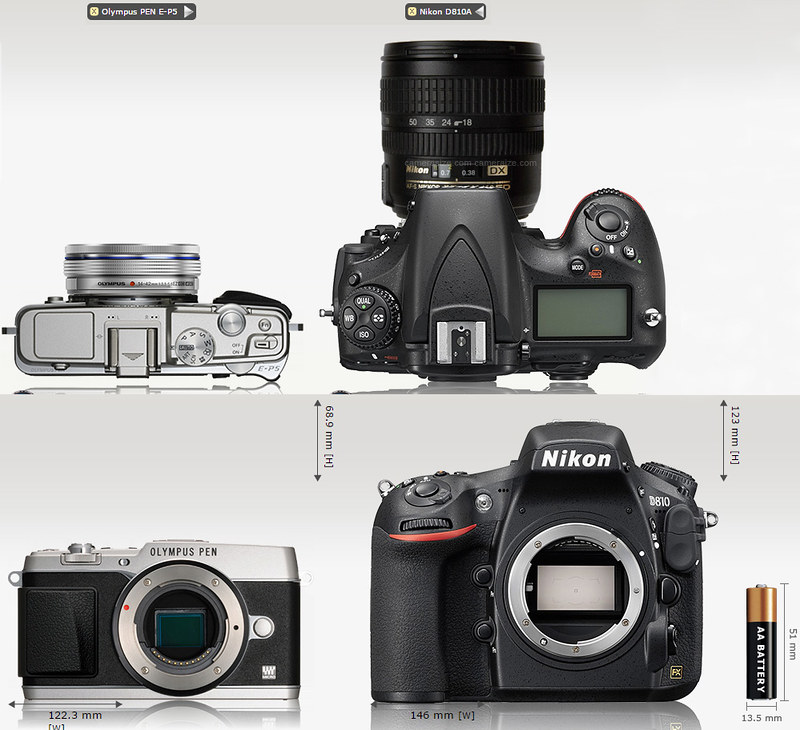
Oly vs Nikon_lens
Olympus camera and lens compared to Nikon, similar focal length, same f/stop
For my second trip to Scandinavia I wanted to have a higher quality camera, one that allows me to apply my skills and one that would reward my creativity. My intention was no longer to simply record my trip, I wanted images I would be happy to hang on my wall.

The Micro Four Thirds system of cameras is the perfect compromise for me: images are sharp and the cameras have features than no other system has, size being one of the major ones.
I can afford to have a camera body and a couple of lenses with me and not really feel it in my backpack, something I could not do with a lot of DSLRs.

But where the Micro 4/3 system excels it also poses some problems with users with slightly bigger hands: the hand grips are often a bit small.
As I started to attach larger/heavier lenses on my Olympus cameras I felt that the grip was a bit diminutive and I had to clutch the camera too tightly.
I could use their Pro models but that would defeat the idea of compact and light: I just wanted a better grip, not a bigger camera.
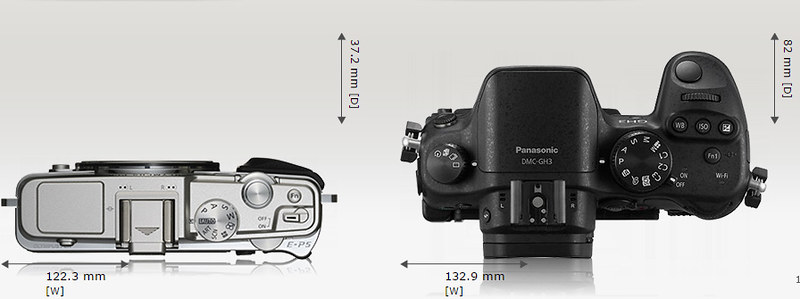
camera size comparison_3
same image sensor, different body, same image result
Commercially available add-on grips look too bulky (no need to have a base plate bolted to the bottom if one is not needed) and the glue-on aftermarket grips were not available for the camera I was using.
However those aftermarket grips looked really good and that prompted me to come up with my own DIY modified hand grips.
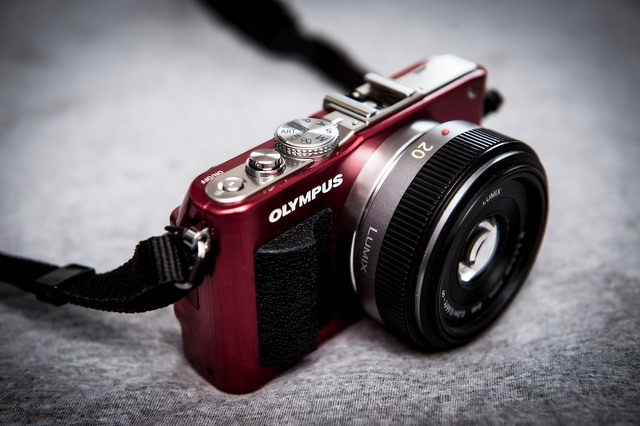
8653856259_d099d50b12_z
commercially available stick-on grip, here

I used Sugru, a silicon putty that feels like Plasticine but cures hard like rubber, sticks well and does not feel too slippery.
A small packet of Sugru contain enough material to shape a single grip if a large one is desired, or just enough for two smaller ones. Bright colors are available but I went with conservative black.
I have so far modified an Olympus E-PM2 (smallest of the M4/3 series) a couple of E-P5 and several E-M5.
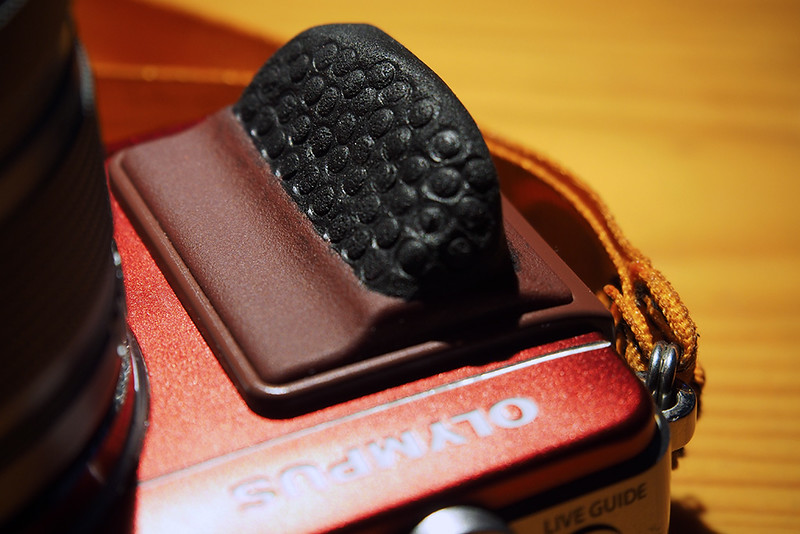
grip mod on PM2
Olympus E-PM2
Once the putty is kneaded and then firmly pressed onto the existing small protrusion where the fingers grip the camera, I shape the soft material with a small bladed knife to create a clean edge.
A moistened index finger keeps on shaping the putty until I am happy with the overall shape, then I run the back of the knife blade to create a perfectly uniform surface (not bumpy).
If the form of the grip is in its final shape I like to add some texture to enhance the surface and create more friction for my fingers.
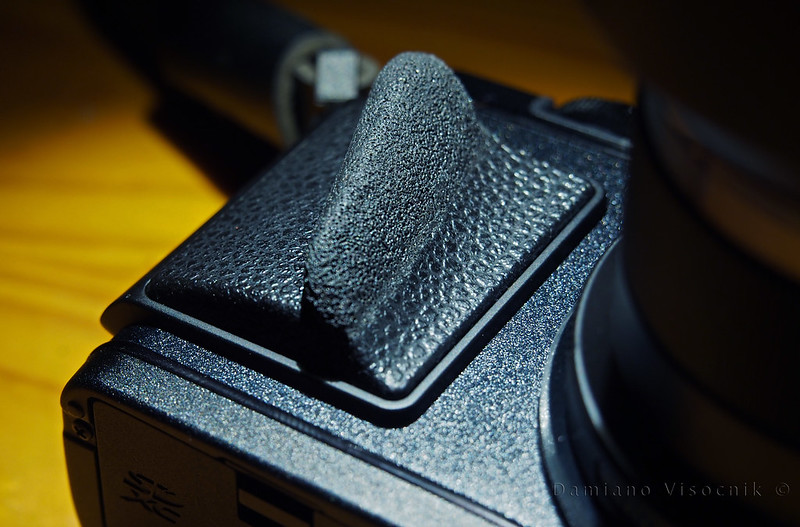
Sugru grip on P5_3
Olympus E-P5
Here I use a combination of pins, pen ends (to create little circles) and an old toothbrush for finer texture.
I try to achieve a look that matches the existing camera finish but I simply will never be able to replicate the faux leather surface.
Before I let the camera rest to cure I check that there are no bits of stray silicon putty on the grip, where I don't want it.
While the cured silicon does become hard like rubber it is not impossible to remove it mechanically but one needs to scrape vigorously to get it off.
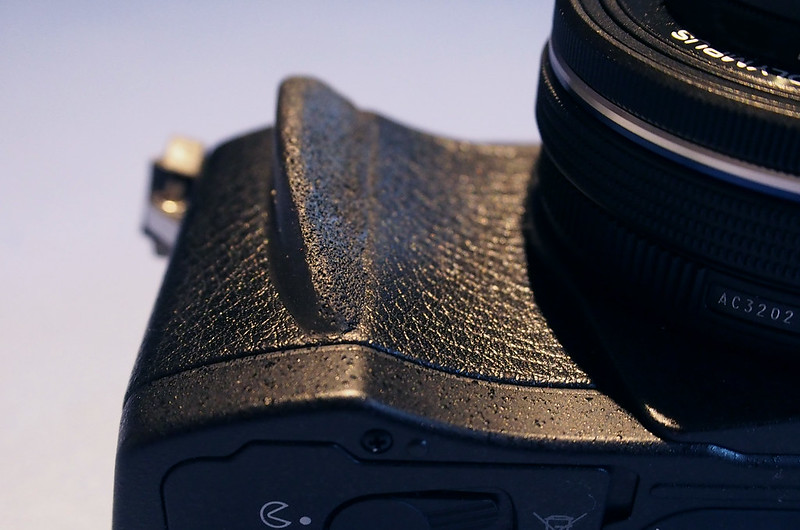
Sugru grip on M5_2
Olympus E-M5
I have seen some photographers push their fingers into the soft putty before it's cured to have an "imprint" look; I go for a more universal one where the grip is an extension of the original one and less fully-custom.
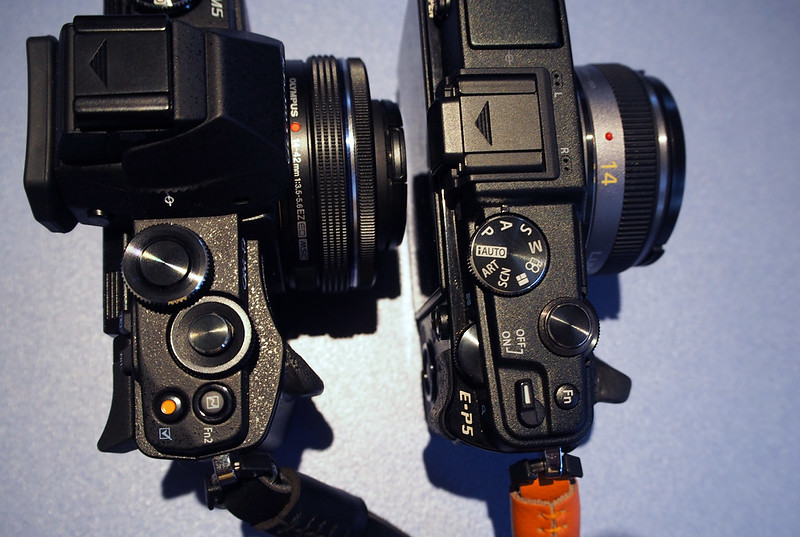
Sugru grip on M5_3
Olympus E-M5 and E-P5, modified grips

The grip on my Olympus cameras is now much more positive: my fingers don't have to clutch the body so tightly and the softer grip fatigues my hand much less when on longer photo shoots.

Photographing the sunset_c .

03 February 2015

SHOP: filling-in the compass recess

.
Mounting a sail on a sea kayak requires a few considerations: position and deck strength.
On the newly acquired Whisky16 the front hatch is positioned surprisingly way far forward.
In front of that there is a deck-mounted compass recess.
The previous owner of that kayak had a small sail mounted there and I used the existing holes to mount mine.

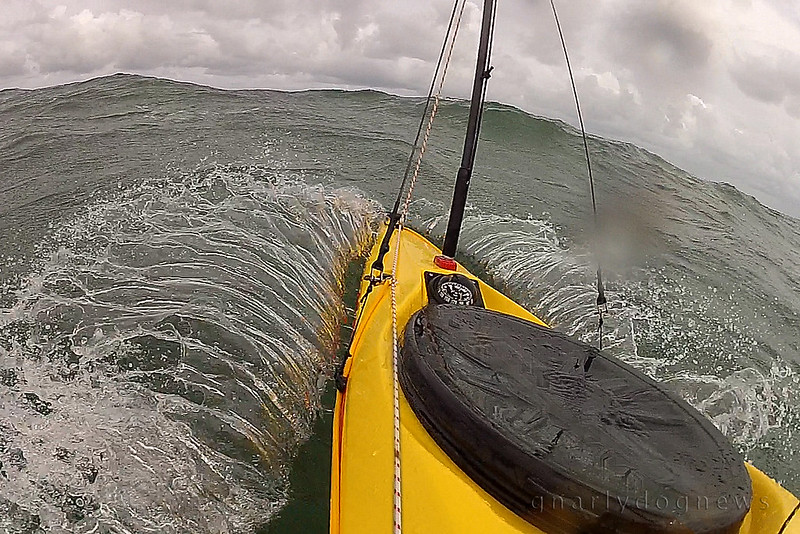
PT65N_Whisky16_bow
first run with the Whisky16
A test run revealed that the sail worked well on the Whisky16 but the reach was a bit too far for grabbing the sail and stow it on deck, securing it.
Most other sailing buddies use a 3 stay set up ending with a rather long mast.
I see their stowed sails going past the front of the cockpit ending with a sail mast half way across the spray deck. I prefer to have mine clear off my deck so I do not rub it with my hands when paddling.

The Whisky16 however has the sail mounting spot just a bit too far out or reach for the sail to fit nicely on deck. As I use my sails on several kayak I need to have them fit all decks well, with the same stay lengths.
I could increase the size of the mast and bring the sail higher (and make an ill-fit on other kayaks),  but I prefer to keep the sail as low as possible and minimize the heeling force of a beam wind exerted on the sail.
The compass was not really needed on that kayak so I removed it and decided to utilize that space to mount the sail closer.
I wanted to fill the void left (recess on the deck) and create a solid base for the mast fitting.
I could have used a simple block of wood somehow attached to the deck but I knew I could do better.
I shaped a block of foam (polystyrene) to fit a bit loose within the cavity of the recess. Shaping the foam was easy: a bit of coarse sandpaper on a cork block.

Once the foam was shaped I placed kitchen cling wrap (Glad® wrap) over the deck and wetted out some fiberglass with epoxy. I draped the block of foam (under side) and pressed it into the cavity.
Once cured (overnight) I removed the excess and trimmed the glass.
The finish was really rough; maybe I could have used wax and mold release to have a perfect fit but nobody was going to see that part.
The top was done similarly.
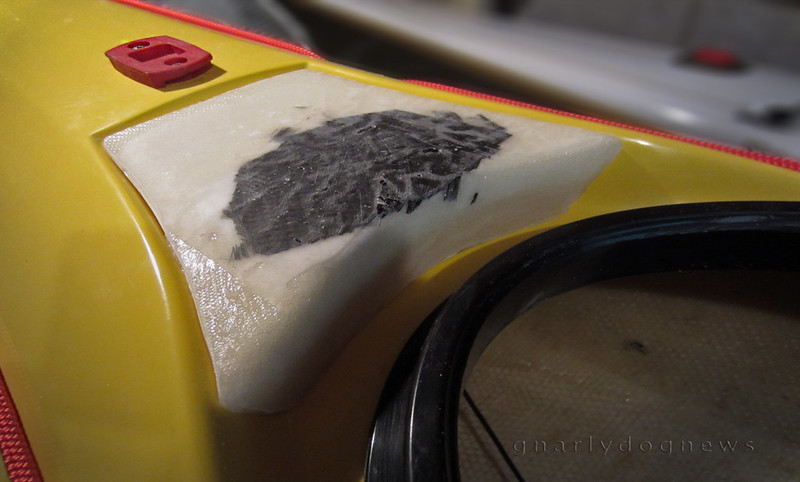
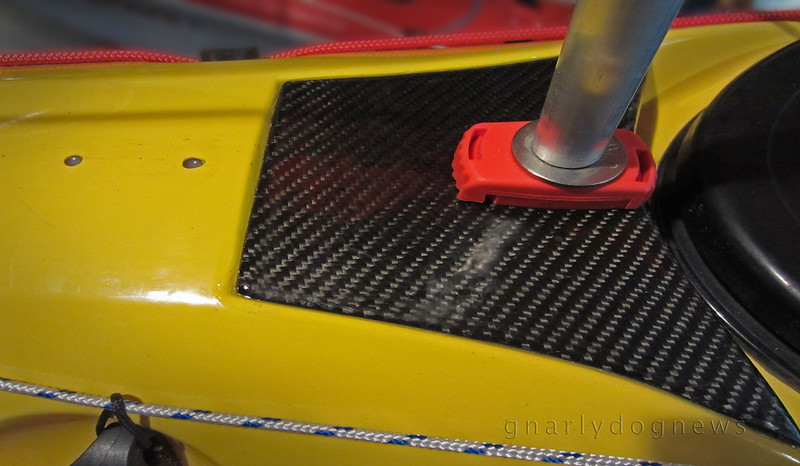
I carved out foam from the area where the screws for the fitting would go for my mast base and filled it with epoxy glue (mix of epoxy and microfiber). While wet I then used a few layers of glass for the top and a scrap of carbon fibre for where the main load would be.
Polystyrene foam compresses easily when spot loaded so I needed a sturdy surface.

compass fill-in1
the "black patch" is carbon fibre cloth over the carved-out foam filled with epoxy glue.

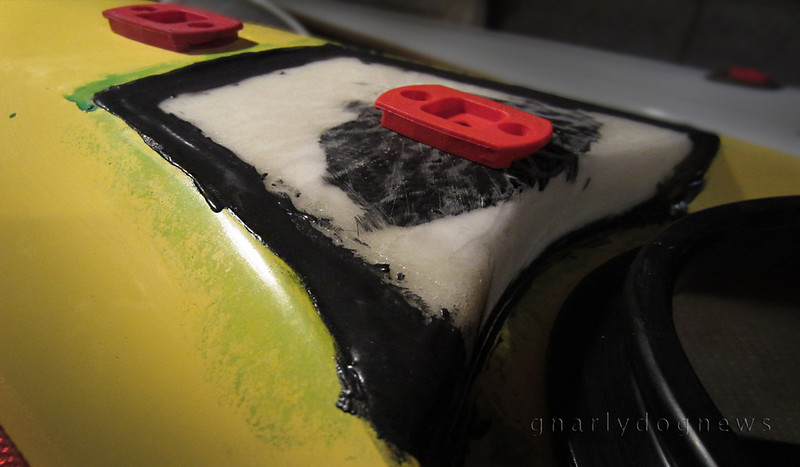
The next step was to clean and cut back the edges a bit leaving a bit of a gap between foam block and kayak deck. I filled that with epoxy glue again to create a hard edge and seal the two surface together creating a monocoque style item. Of course I waxed and prepped the kayak deck so epoxy would not stick to it...

compass fill-in2
the new mast-base fitting placed only for testing

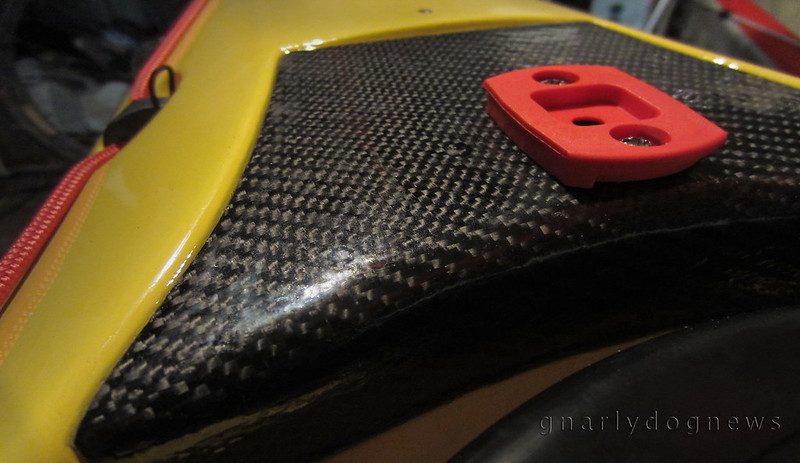
The last step was to add a nice layer of carbon fibre weave: partly structural, partly looks.
A few coats of UV stabilized epoxy later and my block was ready for installation of the mast base.
I used wood screws that secured the mount very solidly: the epoxy glue is very dense.

compass fill-in3
the foam block now covered with carbon fibre cloth

Final step: securing the foam block to the deck.
This one was simple: a small bead of polyurethane all around the edge (only!) to then seal perfectly against the deck.
The original deck void was now sealed and the sail mounted closer to the cockpit.

compass fill-in4
notice the difference between old position and new closer location for the mast base. The old holes will get filled with matching gel coat

So, do 4" make a difference? *
Not in handling of the kayak but when reaching for the sail to be bundled on deck when stowed (reaching for the boom particularly) is now much better.

*Hell yes, she said :-)

16 April 2014

Travel with camera gear

.
With two expeditions planned in the near future I have been busy organizing myself.
My main focus for the new season will be improving my photography skills and trying to capture higher quality footage.
I believe that the best talent will shine with any half decent camera equipment and since I don't fall into that category I am justifying my average efforts with the lack of equipment.
The saying "A good tradesmen doesn't blame his tools" comes to mind tho...

On my previous trips my footage has been limited to point-and-shoot style cameras.
Occasionally I wished for higher quality (even if my use is almost exclusive to computer screen display) and specifically more control over focus and exposure.
Also my on-board of kayak footage on last year's trip to Sweden was limited to hand-held angles; I want to have the flexibility of varied angles for on-deck camera mounts.
I need light and compact.
At home I have a garage full of custom made deck mounts that often take too long to set up and are way too bulky for international travel.
I drool over footage taken with Steady-cams and dollies while I realize that it would require more than a one-man-band to schlep and use that gear.
After 5 different prototypes I have finally come up with something I can transport with me without having to pay excess luggage when flying.
I can now set up my system to any kayak deck within minutes (no custom molded carbon base for each specific location) and have footage steady enough, even in surf environment.
The mount is made of carbon and Kevlar plates to be light, but stiff enough to prevent wobbles when extended higher up.
Here is a sample short video of the angle I can get


While I am confident on my tinkering I am not sure how well it will really work for weeks of continuous use. Stuff breaks and it does, fittings come loose and carbon snaps when hit hard.
Next week's one-week trip will be a good test before I fly to Scandinavia with my rig.

 My biggest challenge: recharging batteries where there are no wall power outlets.
8 different types of batteries are really going to be a handful. Again I need the lightest set up possible.
Here in Australia I just shove my gear in the car and then set up at launch. Flying with my proposed equipment is however a very different story..
There will be a compact solar panel on deck during the day and this time I am trying a Lithium battery pack to power my chargers at night.
Ah, the good old days of film cameras :-)

PS no images are available yet, until I am satisfied with my work.

27 February 2014

SHOP: DIY back band

.
Paddling comfort can make the kayaking experience great but an ill fitting cockpit keeps my mind away from truly enjoying my pursuit.
I have changed many seats in kayaks that did not fit me and often the back band is part of the equation.
In some kayaks the back band is directly attached to the back of the seat (Valley) while in others it is independently suspended by straps or webbing on the side cheek plates or coaming.

The seat of the Point65North XP was too narrow for my ass and too high up front; I replaced it by fabricating a new wider one out of carbon fiber.
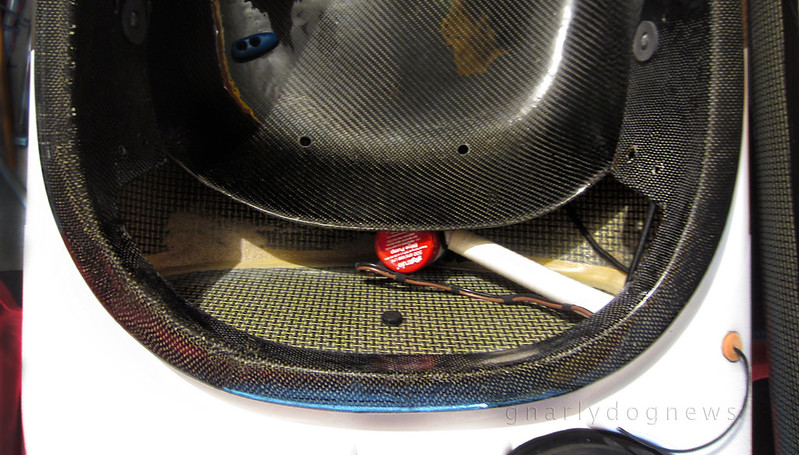
The bulkhead on the XP is really close to the rear of the coaming offering just enough room for an electric bilge pump.

foam backrest_2

I did not like the original back band that came from factory; it was cutting into the carbon fiber laminate on the pivot points. I also did not like the large plastic tabs digging into my hips.
In some of my kayaks I have installed a Immersion Research backband with a ratchet buckle/strap system (similar to snowboard bindings): I love the support and the low profile it offers still allowing me to do laybacks.
In this kayak the bulkhead was so close to the seat that I could create a backband out of foam and have it resting directly against the bulkhead.

foam backrest_1

In some kayaks I have made a pillar from closed cell foam that is nested and jammed between seat and bulkhead; in the XP is wanted to try a floating foam block to be able to access the bilge pump.
As a prototype I wanted to use cheap foam and some discarded packaging from electronic goods was good enough for my first try. I laminated two pieces by gluing them together with contact cement.

foam backrest_5

This type of foam is very easy to carve with a sharp kitchen knife and in minutes I had a nicely contoured backrest shaped to allow layback rolls. My intention were to test the foam back first on a longer paddle and see if it fitted OK.
After some minor reshaping following my initial trial I was happy with the shape of it.

Initially I planned to use high quality closed cell foam for the final product but this cheap foam was working well enough to not bother with higher quality foam, like the one in a block used for yoga.
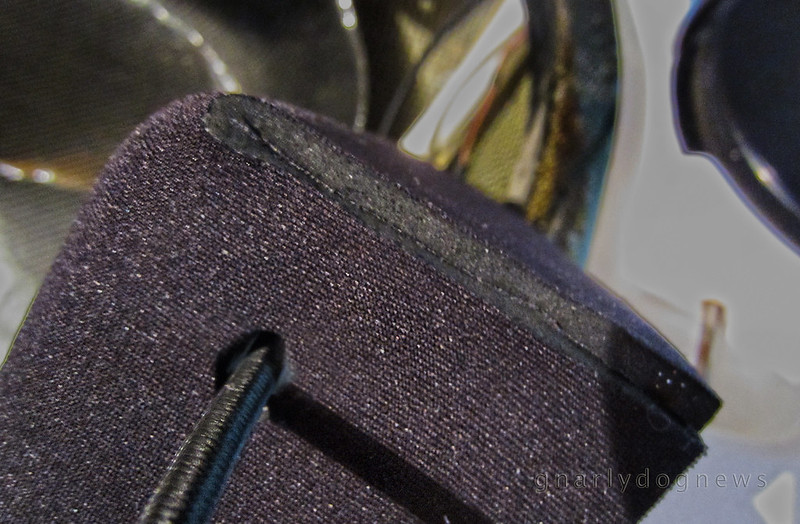
I just wanted to cover the rough surface with a bit of neoprene.
Again, I used contact cement to laminate the black neoprene.
I made a hole in the foam, the length of the block, to allow a bungee cord to secure it to the coaming of the kayak.

foam backrest_6

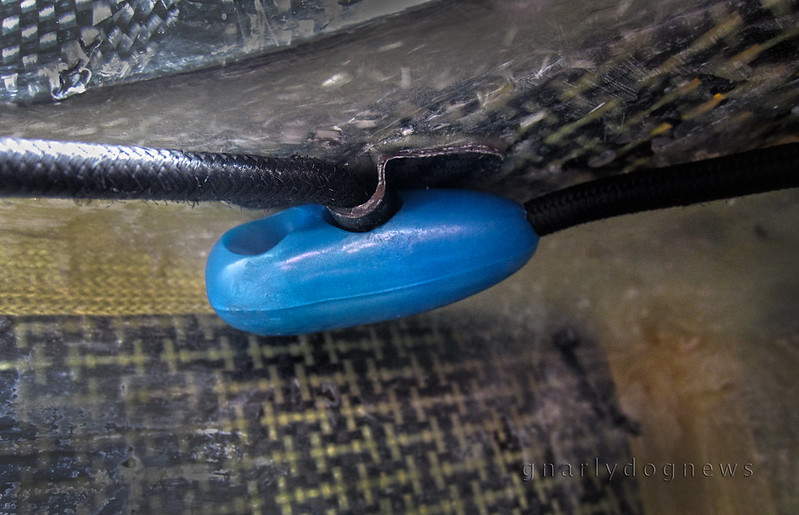
The bungee cord is attached to the underside of the coaming by little fiberglass saddles that I fabricated and bonded with epoxy glue. Alternatively small stainless steel saddles could be used instead.
I can tension the bungee with an olive cleat and while the backrest is firmly in place I can still access behind the seat to clear the pump from sand and debris.

foam backrest_4

The main advantage with this style of back band is that it does not end up under my butt when I enter the cockpit. I can slide from the back of the cockpit coaming rim and it will not get in the way, ever.
While some find the pod-style seats with no rear back band a great solution to this problem, I did not like that set up in one of my previous kayaks. I felt that I could not brace myself from sliding backwards when actively paddling and leg driving.

foam backrest_3


.

05 February 2013

DIY: repair a cracked paddle

It had to happen: I cracked the carbon fibre paddle.
Since I have been appointed ambassador for Northern Light paddles I have trying hard to see what that paddle can take.
From gingerly taking off in textured waters in a sprint first to becoming more aggressive with my rolling, I eventually took the NLP Greenland in the surf. To me it feels the most comfortable blade when paddling in waves but I had my reservations that it could take the surf and my ungraceful tumbles when tossed in a kayak.
But no matter what I subjected my paddle to it always delivered with no sign of problems.
Paul from Northern Light Paddles said that there was no reason I should hold back with the 3-piece Greenland and he really wanted to see what his paddles could do when treated rough.

NLGP_2

I obliged.
Pushing off from the shore when beach launching I would dig deep into the sand to propel myself before I hit the water. On rocky shores my timing would be out occasionally and I found myself pushing off rocks to prevent ending against them.
My previous wooden paddles were reinforced with epoxy to minimize tip damage but there was no way I could abused them like that.
Not to mention my high-end carbon foam-core Euro paddles where inserting them in the sand and then pry off would simply result in snapping the blade.

I was enjoying myself in shallow waters getting tossed around by the waves washing over a bank of sand. I was bracing to keep myself upright occasionally touching the bottom when suddenly a larger waves tossed me sideways and I instinctively braced and pushed down hard to keep myself upright.
My full body weight plus the force of the kayak sideways was leveraged on the Northern Light paddle.
I heard a creak and looked down. Nothing seemed to be wrong; paddle looked fine but I didn't want to push my luck and called it a day.
Later on at home I wanted to inspect the paddle and see what that noise was.
That's where I found the hairline crack.

NLP insert crack1_c

The insert on the loom of the 3 piece paddle had almost failed.
I was not too upset since a loom is fairly easy and inexpensive to replace but then I remembered the short insert that comes with every Northern Light paddle that transform it into a "storm" paddle.
It was the exact dimensions of the cracked insert bonded to the loom.
I knew that epoxy's melting point is not that high and a heat gun can soften the resin enough to make it loose its grip.
I would lie if I say that it was an easy job but 15 minutes later with the aid of the heat gun I managed to separate the insert from the loom tube.
I cleaned up the residual resin and used a bit of epoxy glue (epoxy resin and microfibre) to bond the new insert into the loom. I bolted the blades together making sure things were aligned.
The next morning the paddle looked solid and after testing everything looked kosher.
I was paddling with the same paddle the next day not showing any signs of damage or mismatching.
One thing is sure: no Euro paddle of mine can be repaired at home with such incredible ease.
As for the Northern Light Greenland paddle, I now play in deeper waters.

15 January 2013

DIY: paddle retention on kayak deck

.
A few years ago I came up with a great on-deck retention system for split paddles.
It was also just about then that I stopped using Euro style paddles and transitioned to Greenland paddles. The new style became my regular paddle and soon I totally abandoned the fat blades.
My spare paddle became a shorter version of the full length GP (also known as "storm") or a slip sectional full size one.
While the split Euro paddles fitted well on the front deck, I did not like carrying the Greenland storm on the front deck.
Some argue that a spare paddle should be readily available in case the main one (the one in the hand) is lost; in ten years it has not happened to me once. I also use a paddle leash most of the times so I minimize the risk of parting company with my paddle. It is a risk that I am now willing to take that if one day I will loose a paddle I will have to reach for the spare paddle behind me. Then again I often wondered if I would have the presence of mind to grab that half paddle in front of me anyway, in the heat of the battle.... probably not.
I am happy to carry my spare on the rear deck, to create an uncluttered front deck.

NLP on rear deck_2

The kayaks in my fleet all have bungee cord on deck for the retention of miscellaneous gear that one wants to access while on the water. Some kayaks have strategically arranged these bungee in view of carrying a spare paddle. The idea is to slide the paddle under the bungee and hope to retain the paddle.
My experience however shows that if the bungee is not highly tensioned those paddles tend to creep out in heavy seas and occasionally dislodge in surf.
Sliding the full length of the paddle under tensioned bungee is often tricky while I scratch the shiny gel coat (considering resale value).
I wanted a system that retains my paddle but would not require a slide.
On my expedition kayaks I devised a flat strap with a Fastex buckle.

paddle retention_4

It worked well; I could attach my split Euro paddle there with little fuss.
With the storm GP there is only one shaft (loom) and the buckle of the Fastex clip was not working well there: it would slide and become loose.
Borrowing the idea from my simple paddle leash I now use this system for my spare paddle retention.

paddle retention_2
laminated Western red cedar storm Greenland paddle by Greg Schwarz

paddle retention_1
heat-shrink over the bungee joint

Removing/attaching the paddle is very simple: I just pop the bungee loop off the little plastic ball.

paddle retention_3
retention system released

While the bungee retention system works very well for paddles I recently found out that it works also in anger when I need to attach something on the rear deck quickly.
One of my camera mounts failed in heavy seas and I had to stow it away as it was dangling in the water with my camera still attached (I did NOT loose that one this time!).
I had to jump in the water, take down the remaining mount and attach it to the deck, while bobbing up an down in waves (I was also happy to be wearing a PFD). The bungee and ball system worked very well allowing a swift attachment of the hardware that I would not be able to carry any other way.
Reentered and rolled, pumped the water out of the cockpit and I was sailing again on my way in minutes.

04 December 2012

DIY: keel strip

I am lucky that where I paddle the beaches are sandy. Landing my sea kayak, even with surf, poses very little chance of damage to the hull.
Sand is so much more gentle on gel coat than sharp rocks.
What I have discovered tho, that even if not gouging the hull's finish, sand is rather abrasive over time.
Dragging a loaded sea kayak to the water's edge can wear through the gel coat down to the laminate in a relatively short time.
gelcoat skid mark (c)
gel coat skid mark left by dragging the kayak
Typically I would take care of my kayaks by applying a resin strip (epoxy mix) to the hull. From bow to stern I lay UV stabilized epoxy (mixed with graphite and pigment) several layers thick to act as a sacrificial layer that every couple of years will need touching up. I prefer epoxy because it wears better (higher abrasion resistance) than gel coat; it takes longer to apply but I like the results. I won't describe here how to create a keel strip (there is plenty of very good info on the net) but I will say that it adds some degree of protection in areas of wear.
resin keelstrip_c
conventional resin (or gel coat) keel strip

On some kayaks the gel coat is very thick and it will take a while for sand to rub it off but on high end light kayaks the manufacturers try to keep the weight down and apply only a thin layer. Of course I could stop and exit the kayak before I hit the beach but often I launch and land in surf conditions where the most practical and safe way is to simply start/stop right on the wet sand. My light carbon/Kevlar hull was starting to show a bit of wear and I decided to try a new style of keel strip. I have heard of KeelEazy before but I have never seen a kayak with one. On my recent trip to USA I visited Kayak Academy in Washington's North West. Here I saw their entire fleet of rental kayaks covered with KeelEazy strip. I wanted to try some for myself. I decided I was going to cover part of the keel line, just the "pointy" areas where most of the abrasion occurs. The material resembles thick PVC backed with an industrial strength self adhesive glue.
The instructions were clear: clean the kayak's hull and apply neatly.
round edges_c
rounding the edge

I trimmed the edges to create a rounder corner to prevent peel-back once applied. I cleaned the hull with acetone making sure it would be really clean.
peel back_c
peeeling the adhesive backing

The glue on the KeelEazy strip is very strong and the blue protective backing is hard to get started
applying_c
applying over skeg box

I carefully centered the strip over the skeg box opening and pressed down lightly to then check alignment. Once I was happy with the position I lifted the tape back up and pulled on it to stretch it slightly. The tape tends to then fall over the edge of the keel and contour the hull's shape. Around the bow and stern keel's curve I used a heat gun set on mild and softened the tape a bit while stretching it. It conformed over the curve perfectly without wrinkling. I applied the pressure of the palm of my hand and let it cool down.
trim skegbox_c
trimming back around skeg box

Around the skeg box I used a utility knife and trimmed away the strip over the opening of the skeg's blade leaving little tabs to push them into the recess.
skegbox detail_c
skeg box finished

The whole application of the KeelEazy strip took me less than an hour; a far cry compared to a typical "wet" application of a gel coat style keel strip. I have however my reservation over the effectiveness of the KeelEazy strip and I can see potential problems happening from a "half" strip. While the protection over the centre of the hull is not as critical, in retrospect I think a continuous strip might be a better solution and prevent the strip's leading edge from peeling back when dragged over a sandy beach. Time will tell if the strip is as effective as my resin ones.
finished curved_c
wrinkle free around curve

07 August 2012

DIY: replacement carbon-fiber seat in Valley

.
Seats in kayaks seem to be often a deal breaker: some folk won't buy a kayak if the seat is not comfortable for them. Some kayak seats seem to fit more paddlers than others but there are also some seats that cause a lot of grief and paddlers go to great lengths to fix them.
The most common complaint I hear and read about from sea kayakers is the dreaded dead leg syndrome; after a while on the water (sometimes as brief as half an hour) some paddlers start to feel pins and needles or loose the feel of the legs altogether.
I am one of them: I find a lot of sea kayak seats not suitable for me. Maybe is my chunky thighs that force me to extend my legs lower to make them fit or something but I find most seats too short and too "peaked" (high up front) for my anatomy.
One seat that I have removed from more kayaks than any other one is the Valley plastic seat and the current model seems to be just as aggravating as the previous one.
In Adventuretess' Nordkapp LV I removed the seat and replaced it with a DIY fibreglass one removing the back band and replacing it with a foam block.
Steavatron recently borrowed Adventuretess's Nordkapp LV (Sialuk) and was amazed by the difference in feel and stability of the kayak.
Within half an hour of paddling Sialuk, he politely asked me if a similar seat was possible to be had in his own Nordkapp LV.
I agreed that with his help we could fabricate one for this kayak too, and we might as well go "bling".

carbon seat4

The plastic VCP seat is easy to remove: 4 bolts on the outside of the coaming hold the seat in place.
Once the fsteners were removed the seat came right out but revealed a little problem; the edge of the seat has been "shaving" the hull and a few layers of fibreglass have already been carved away by the motion of the seat slightly swinging when paddling. If not caught in time it would have holed the kayak from the inside out (the same problem occurred in Sialuk).
Patching that divot was dead easy and we restored the hull to full strength.

carbon seat2

The new seat is made from a laminate of glass fibre, double bias carbon under the sitting area and a veneer of the oh-so-sexy twill carbon fibre on top, for looks of course :-)
The edges of the seat have been reinforced with Kevlar to prevent the typical cracking that I have experienced in other factory chopped-mat kayak seats.

carbon seat1

The new seat does not hang on its own but I used "L" brackets to support it. The original VCP hardware was re-utilized and new stainless steel bolts are anchoring the carbon seat to the bracket.

carbon seat3

Stevatron was happy to reuse the original back band and hip pads. The back bands sling is attached to the seat with a short piece of webbing and a "D" ring. Existing straps firmly secure the back band to the rear bulkhead to prevent dislodgment when entering the cockpit.
After the maiden voyage Stevatron was happy with the position and height of the new seat and it was then finally secured to his kayak with a few dobs of polyurethane (Sikaflex) sealant to prevent any swinging and deliver a solid feel. In the event the seat would have to be removed for any reason a spatula will be inserted under the seat to break away those few spots of sealant.
Stevatorn finds the new seat a vast improvement on the stock VCP plastic one. The centre of gravity has been lowered and he finds that the Nordkapp LV has changed personality.
He is more confident on putting his kayak on edge and has gained stabilty when in textured waters.
Since the change and after a few paddles of several hours he no longer experiences the dead legs.

.

12 July 2012

GEAR: sea kayak sail_update

.
Several years of using sails on my sea kayaks has lead to refining my initial set up.
I no longer sew my sails but I still create my rigging, using custom made carbon masts.
On some narrower kayaks my sail set up was not as bombproof as I would like it to be where in a strong breeze (above 20 knots) the mast would not keep vertical and the little polymer base would deform under the lateral pressure of the wind. In a beam wind I would like to have my mast in a vertical position, making the sail more efficient and increase a bit of speed.
Mick at Flat Earth Kayak Sails has developed a brilliant way to reduce the down pressure on the flexible joint and is now shipping his sail with a new system where the mast contacts directly the removable fitting.
I want to use carbon fibre masts but I have been unable to find an off-the-shelf mast that would replicate Mick's system.
Not wanting to bond aluminum to carbon to create the oversize sleeve for the mast, the only way I could achieve what I wanted was to modify my existing masts to create the sliding foot sleeve.
mast base_sleeved_c
mast uphauled
Instead of having a larger diameter mast running the whole length, I just made a short sleeve out of glass fibre tape wound around a tube of slightly larger diameter than my carbon mast. Once cured I bonded a the sleeve section to the base of the existing mast and covered it with carbon cloth for strength, and looks :-)
The sleeve section slides over a stubby base with the flexible polymer allowing the mast touch the actual hard surface of the red plastic base.
No load is now exerted on the polymer so it will no longer deform when the mast is uphauled and cinched down hard.
mast base sleeve_c
mast lifted for demo purposes
Of course the mast can still be lowered as before and when the sail is folded onto the deck the mast slides back up just enough to allow the flexible polymer do its job.

mast folded_c

To prevent the sliding mast and the stubby base come apart I have used a short piece of shock cord threaded internally holding the two together.

boom junction_c

I have also improved my anchor point for the stays on the mast.
I no longer use a stainless steel ring riveted with a saddle to the carbon tube but I prefer the use of soft Dyneema core line bonded directly to the mast with a section of carbon fibre cloth.
The load is distributed better and there is no risk of cracking the thin carbon tube with the pressure of installing (pulling) a stainless steel rivet.
mast stays junction_c
mast rotated to show the carbon cloth anchor for the Dyneema cord
I have been using the new recessed anchors with great success, locating them right on the seam of the hull/deck to achieve a wider stance and a better load angle.
The stainless steel shackles are now heat shrunk (see warning below) to the Dyneema stays so they don't rotate when the sail is lowered on deck.

anchor and stays_c

The whole assembly, viewed from the bow.
on beach_c

WARNING:
update 04JAN13
Richard Sharp from SEQSK has this to say:
"I had the sail up in 20knots and got hit by a gust which tipped me in. It
was at that point that I noticed the sidestay had snapped. Finding it hard
to believe that this was possible given the breaking point of spectra, I
examined the break closely. It was then that I discovered that where it had
snapped the internal spectra cord was melted together. See the enclosed
photos."

P1010037

P1010038

It appears that the core has melted while the outer sheet remained OK.
Using a heat gun at close quarters causes the Dyneema/Spectra fibres to fuse and become very weak.
The melting point of Dyneema is much lower than the outer polyester (pictured here black) and no noticeable damage was visible from the outside.
He now prefers to use the heat shrink only over the loose end of the rope, not over the entire knot and apply very gentle heat for longer to allow the tube to shrink.

image001

01 June 2012

GEAR: the kayak sled by Hybrid

I busted my back lifting a kayak to my shoulders and carrying it to the beach.
X-rays revealed some spinal degeneration that apparently is caused by an accumulation of accidents.

The quack asked me:   "Have you had any falls on your back in your past, even as a child?"
Me:   "About one a year, if not more..."

The back injury is probably a manifestation of a life full of crashes on skis, motorcycles, mountain bikes and who knows what other back blows that I used to just shrug off when occurring. They are now catching up with me :-(
I am also sure that my current sedentary lifestyle (desk jockey) and lack of regular exercise during the week contribute to my now bad back. What bugs me is that I can't carry my kayak solo on my shoulders and look macho, even though I feel some of my kayaks are not exactly ultra light.
So, my back got bad again schlepping my boat across a bank of sand onto shore and into a back yard. Not a  long distance but long enough to compress my spine out of whack; I need a trolley even for that short of a stretch.
The kayak carts I have are bulkier than I would like; they also have wheels.
Wheels and the shallow small lagoon I have to cross don't mix: the axle would clog up and the bearing would suffer.
I then remembered attending a presentation at a kayak fest (NSWSKC Rock&Roll in 2009) where a kayak designer showcased a "sled" that required no wheels.


Hybrid kayak sled presented at Rock&Roll 2009
I needed something like that.
I contacted Andre Janecki, the brilliant designer behind the Hybrid 550 sea kayak and founder of the Hybrid Foundation. Andre has been tinkering and inventing all his life; his expertise spans from architecture to industrial design, including his passion for sea kayaking.
Andre is also a philanthropist seeking funds for producing a sea kayak that will enable wheel-chair bound paddlers to access the water unassisted, in a kayak. (More info here)

I asked Andre for details on the "sled" and he immediately offered to help sending me a new sample that he showcased a few years back.
Here is the "Kayak Sled"

sled mounted_c
Mounted on the stern, the bungee cords are not essential to the operation of the sled
Simple in design the sled is a good alternative to wheels, providing it doesn't get dragged over pavement too much. I would like to quote A. Einstein: "Anything should be made as simple as possible, but not simpler"
It weights slightly more than a water bottle and takes almost no space inside the hatch, when folded.
It doesn't rust and costs so little to fabricate that even the kayaker on the tightest budget can afford.


Adventuretess testing the Hybrid Kayak Sled
While they are easy to replicate, Andre Janecki holds the copyright to the design. He is happy to share his invention with all paddlers who donate $25 into the Hybrid Foundation account.
Chasing up individuals that want to forego his request is not his intention but I am sure he would have a legal team onto a commercial operation trying to swipe his idea.
For exact dimensions and details, please email Andre Janecki and support his project.

Included are a few shots of the   "Kayak Sled" showing general proportion as well as some details of the design.
Hybrid kayak sled_2
The double (or single) rope (shown with the white plastic hook) should be securely clipped to the deck fitting/s
The 316 Stainless Steel screw is 60mm long x 5mm thick and the nut is the nylon-lock type.
The PVC tubes are standard stock size 25mm  O/D diameter, sourced from an electrical/plumbing supplier.
Kayak sled_1
The Hybrid kayak sled folded
The 25mm tubes are further stiffened with the 20mm inner tubes. Please note: the inner tubes run top and across to approx. 2/3rd length only. This configuration assists with bending and distributing the load as much as possible.
CSC_6166
IMPORTANT: the cord exit point from the PVC tube should be against the hull

P.S. Of course, the cheap PVC tubes have only a very limited carry load capacity.
Andre informs me that the commercial version will use very different materials, including a custom made cross section, etc.

.