Showing posts with label rough water. Show all posts

15 June 2015

Hail hell

by Tess Dodd_Adveturetess

 I am almost halfway across, enjoying leaving the demands of a busy morning further behind me with every paddle stroke. My thoughts are filled with plans to paddle in Alaska.

Reading Audrey Sutherland’s books (87 days solo kayaking in Alaska, swimming and kayaking remote sections of the Hawaii coast); I recognized her spirit and felt inspired by her adventures. I spend many hours vicariously sharing her inflatable canoe. A deep rumble draws my attention to my right. I was no longer sharing Audrey’s inflatable canoe in Alaska, but alone in my Nordkapp in Moreton Bay.
Looking south, I can see darkness on the horizon. It’s distant and appears to be moving across the lower bay, out to sea, away from me. I can see the strip of white sand where my friends are camped. I know it’s not far for me to paddle now. I stop day dreaming and increase my cadence, keen to reach the beach before any rain falls. I don't fancy setting up my tent in the rain.

 Loud rumble. The storm is moving closer to me but still appears to be tracking out to sea. I stop paddling to hydrate and consider my options: I am closer to my destination than any other land.
If the storm moves towards me and not out to sea, no matter which direction I take now, I am going to get wet. I decide to continue my original course.
Before I move on, a sea turtles large head breaks the surface nearby, taking a huge gasp of air before sinking below. I notice a large shadow to the right, too big for a turtle, maybe a dugong? The shadow moves closer, rising from below to bump my boat, moving it with its body. Far out, a shark! It brushes my kayak as it moves away; I drop my drink hose, pick up my paddle and get moving.
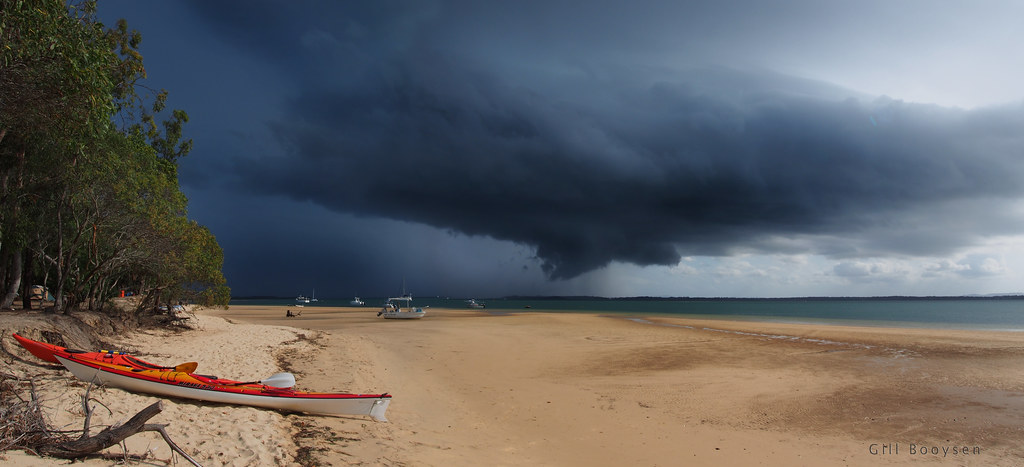
Hail storm at Bakesleys_Gill
Storm approaching, viewed from Blakelseys Landing _photo Gill Booysen

 I can see 2 motor launches near the island heading for anchor. Other watercraft have disappeared. At least I won’t have to worry about being hit by a boat out here.
BOOM… a BIG thunder clap. Louder. Closer.
The cell is moving as fast as my heart is beating – fast! I know I will soon be engulfed by this heaving beast. OK Tessie, don’t panic. Relax, think clearly, and make a plan. Stow the sail securely on deck. Point the kayak into it. Prepare to brace. (Larry Gray ‘storm brace’ technique – it works).

I glance behind me and see sunshine and blue sky. Bizarre. Ahead, I see people moving about on the beach, the storm cell has not quite reached them. I think about my friends and wonder if they can see me out here, knowing they can’t. I don’t want them to be worried about me. I wish I was with them right now. Looking into a sky that is now a deeper green than the water, I realize it’s going to hail.

I think of Australian Ironman Grant Kenny who was out training on his ski when a sudden hailstorm hit. The hail stones cut his head open. He flipped his ski over and used it for protection until the storm passed.
After the earlier shark bump, I was really hoping I would NOT end up in the water today, but knew I may not have a choice. I also hoped for small hail stones and a fast storm. The transforming beast of green and black was almost upon me. I could feel my body trembling, adrenaline I guess.

BOOM. …BOOM…crackle…The vibrations travel through me. I can no longer see the beach. The wind increases slightly as large drops of rain begin hitting the water around the kayak. It is a strangely beautiful moment. A bird sitting in the water just ahead dives below and does not reappear. Darkness wraps around me. Shit! A wave of anxiety washes through me. My senses tingle as I wait. Suddenly, a raspy sound becomes an almighty roar, heralding it’s arrival. I try to point the bow into it, bracing. The ferocious blast is more than I have ever experienced in the kayak before, EVER.


meanwhile on shore...
I struggle to stay upright, my ears fill with the roar of the wind, waves wash over my deck, my body is physically forced backwards over the deck. I bend forward trying to lessen the effects of the wind on my body. The drops of rain become bigger and the waves smaller. My saturated hat brim is down around my face. I can’t see or hear over the roar and have no idea what’s coming next. I focus on staying upright. A new sound joins the melee. Crack. Crack. Crack. Then, I feel it. HAIL! Hailstones begin hitting my head, my arms, my hands. Hail ricochets off the kayak painfully hitting my face and teeth! The hailstones increase in size. Taking one hand off the paddle, I cover the top of my head until my fingers hurt from the stinging ice. There is no relief. The noise is deafening. The hailstones bruise and sting where they hit my body. If this continues, I will have to get in the water for shelter. I don’t know how long the storm lasts, but neither of my hopes comes true. The hailstones are large and the storm is not over quickly. I endure an icy beating from Mother Nature until the storm cell eventually moves over me, the hail and wind easing to leave only gentle rain hitting my bruised face and body.
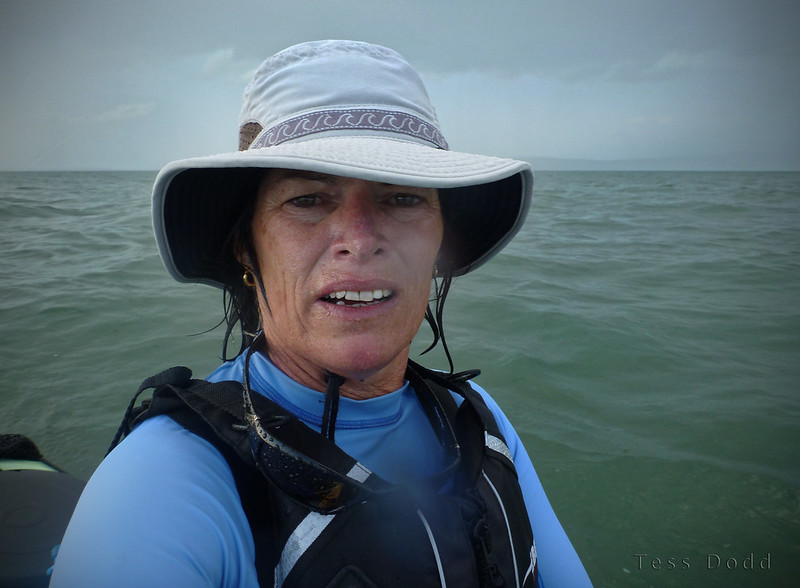
After storm selfie
After storm selfie
 Once again able to see, I look towards the island. It is further away but, in front of me is the bizarre sight of half the beach covered in grey sky, half blue sky with a rainbow…half storm, half rainbow! I self-assess. My kayak is still upright. I am beaten up but OK. I am close to tears, instead of crying, I begin laughing. Strange, stress relief laughter. I feel spent, alone and ready to resign the ‘Adventure’ from AdventureTess.
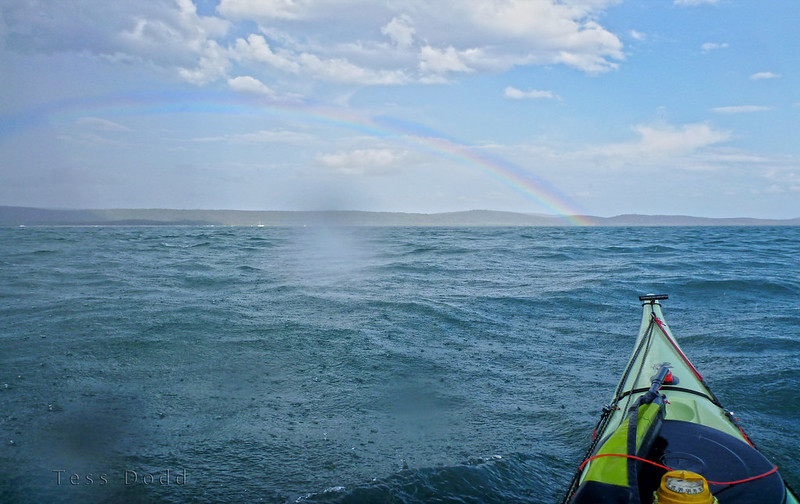
AFter the storm_Tess

But, I am in the middle of the bay and need to get moving again. The storm is north of me now, cutting a swathe over the water and Dunwich on the west coast of the island. I have a clear view of blue sky either side of this intense black and green field of energy. Eager to see my friends, I pick up my paddle and begin the work to reach them. I have been blown away from the island, so have additional distance to make up. While paddling, I reflect on the experience and my choices that day. I believe I made good choices and would have felt some comfort with company, but would company have created an additional concern? Using the last of my energy, I reach the beach. People are moving about, fixing campsites, and checking boats. I see my friends and call out. Relief floods through me as they make their way to the water’s edge to meet me.
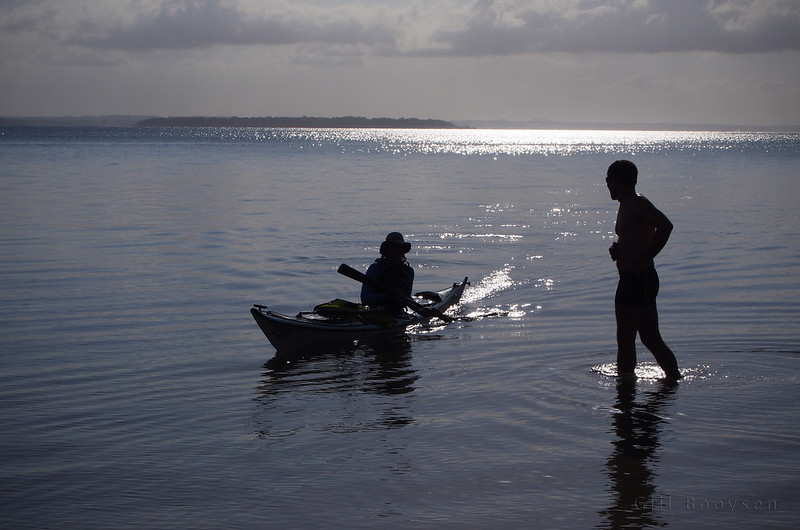
Tess' arrival_Gill

Note: I launched just after lunch to paddle 10km to meet my friends, who were waiting at camp. Conditions were mild. The water was bumpy with a 10 to 15kn headwind. A possible late thunderstorm was forecast. It was early and there were no signs of a storm when I launched. I often paddle alone and am familiar with this stretch of water. I have been asked about the wisdom and safety of my paddling alone. Even for these short distances in familiar water. I enjoy social paddling with a few close friends but feel confident in my skills and decision making ability to kayak alone.
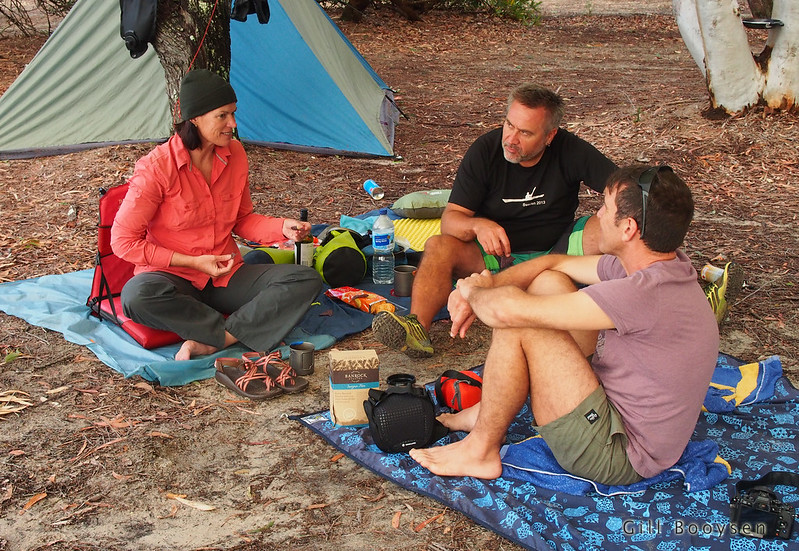
Recounting the story_Gill
great campsite story...                                                                                                                                       photo: Gill Booysen

.

11 November 2014

Video: Radikal Kayak Surfing

I love this video.
Beside the incredibly smooth kayak surfing demonstrating outstanding skills using an unconventional paddle, the footage capture and the editing is really captivating.


It inspires me to get out more in the rough stuff and play.
My aspirations: to be one day half as good as Marc.

.

10 December 2013

VIDEO: Surfing Vixen

.
My new kayak is tippy, with me on board.
A narrow beam and a deep V hull give me less initial stability but allow slightly higher speeds.
I have used the Johan Wirsen designed XP on the bay a few times; in milder conditions I chased the little short wind waves with ease as I can glide where usually I can’t with my other kayaks.
In steeper waves however the longer and less rockered kayak becomes more difficult to keep straight on the short waves. The bow seems to get caught in the wave in front of me while the stern is still getting pushed by the following wave, broaching the kayak.
Then every so often I get a decent longer wave and linking the one in front I get a free ride.


Conditions were rather windy with recordings of winds in excess of 25 knots all around the bay. The tidal flow was opposing the wind and the waves were starting to get blown over, flattening them. After an hour of surfing I no longer could paddle out against the wind as it increased beyond my skills: I had to call it quits. I pulled the kayak back to my launching spot and battled the wind trying to keep it in my hands once out of the water. I was tired, a bit frightened but happy to have overcome the initial tippines that I felt in the XP.

.

16 November 2013

Video: Neptun Kajakk

Every so often I come across a kayaking video that leaves me speechless.
And this is one of them:


Norway - Jæren from Roald Holm on Vimeo.

Worth watching in High Definition and full screen, not on a mobile device..

.

19 February 2013

VIDEO: The Hybrid550 project


I am bored of always paddling in paradise.
The perfectly smooth waters of Moreton Bay and the endless sandy beaches of South East Queensland often leave me longing for more challenging seas.
Lately I have been trying to go out paddling in rougher days when motorized boats stay put and only lonely sailors are about. I usually don’t have company as most local paddlers don’t like wind and waves.
However I am looking at the bigger picture: train for conditions that are more challenging than my back yard.

Andre Janecki has helped me before with the kayak sled and a while ago he invited me to come and paddle his part of the sea, the rugged coast of NSW, Sydney, Australia.
I was not sure how the two of us would go along: my limited skills overshadowed by my egocentric character against his extensive experience in large ocean swell and a much more humble personality…
 
Andre_r
Andre Janecki-Hybrid Kayaks Australia


Andre is also a philanthropist with his sights firmly set on the UNLIMITED project, and that is what attracted me to spend time with him.
I don’t think he is in for the money, actually quite the opposite, and the Hybrid550 kayak of his design is just a fundraiser for the bigger project: a kayak for double leg amputee and paraplegic paddlers.
The least I could offer him was to make a promotional video because for every Hybrid550 sold, $500 goes to the UNLIMITED 

Armed with high spirit I loaded my car with a few cameras and minimal camping gear for a few nights. The goal was to travel light since I was not sure of my surf landings on rocky shores would be as precise as I was hoping for: a light boat makes easy work when dragged over shore rocks.
And finally I was paddling along the cliff line that I have seen so many pictures of before.
I concentrated on capturing this new world for me, trying to hold the camera while steadying my kayak in the healthy rebound; I am just not used to this.
I was hoping to film for all 3 days, but I failed to captured the stuff that kept me white knuckled fearing of flooding the day hatch and capsizing next to cliffs while retrieving my camera.
 

for a better viewing experience select HD if you have fast Internet connection, and use headphones
While I paddled along Andre I noticed that he was having a much easier time than myself keeping that kayak humming along: I was sweeping regularly in my British kayak with skeg, he was just enjoying himself in his ruddered kayak.
The Hybrid550 looks so slick and low profile (reminds me of a Greenland form kayak) to then surprise me with the amount of volume that really has inside those hatches; maybe is the 'symmetrical' hull shape that can carry that much gear compared to my 'fish form' boat.  

The trip was a real success. The conditions were an eye opener for me as my local bay is too easy to be able to develop decent seamanship in ocean conditions.
I am planning to spend more time on the South Coast.


29 January 2013

GEAR: a rudder like no other

.
I found myself constantly sweeping on my right hand side with my Greenland paddle to keep away from the crushing waves against the tall cliffs.
The mild swell of 1.5 mt and the stern wind of 15 knots were affecting my British kayak like I have not experienced before.

Beecroft Pen_cliffs_JAN13
in a bay away from the heavy seas
I often paddle in environments where wind is the only reason for a bumpy sea.
Even on my extended trips I have dealt with following seas and breezes with ease where a bit of skeg control would balance the weather cocking of my rudderless kayaks.
I used to paddle kayaks with over-stern rudders and while I found the cruising much easier than in a skegged boat I eventually abandoned the pesky blade sticking from the end of my boat.

The deciding point of getting rid of those kayaks with “crutches” came when for the 3rd time my rudder was damaged when paddling in waves.
I was not happy with the unreliability of rudders.
As I transitioned to skegged kayaks I learned how to maneuver a boat with my body (by edging) and sweeping paddle strokes while directional stability was taken care by the adjustable skeg.
I now have 6 sea kayaks, all without rudders.
There is no denying that a skegged kayak is slower for me and that I don’t keep a perfectly true course in following seas. That does not bother me: I am in no rush and I usually don’t like to paddle too close to my buddies to be then bumping into them if my kayak sways a bit.

But all that I wanted right now was keeping myself off the big spraying smashing waves against the rocky coast. I looked over to my paddling buddy and I noticed that he was paddling with greater ease and I didn’t see any corrective strokes.
He was paddling a Hybrid550.

Hybrid550_1_c

The Hybrid550, designed by Andre Janecki, is a kayak like no other. It has features that I have not seen on any other boat. The thought process that went into designing and redefining that kayak is astonishing.
Unlike so many kayaks that capture my attention and look so similar to each other, the Hybrid550 is unique. Its cockpit concept is inspired by white water boats with outstanding ergonomics for this chunky body of mine while still perfectly accommodating a more nimble paddler. One thing that concerns me is the width of the cockpit rim since my, how can I put it, “love handles” might rub after a while.  I hope one day Andre will produce the Hybrid 550 L (larger cockpit) but I understand his priorities are with the “UNLIMITED”  www.hybridfoundation.org.au
 
What intrigues me however is the unique design of the rudder.

Hybrid rudder_1

As I was dissatisfied with my own rudder boats many years ago I looked at the alternative integrated rudder of Mirage kayaks. I liked the look and I like the idea of not having anything above deck, nothing to swing and insert in to the water with so many less parts moving resulting in a simpler design. What concerned me though is the fact that the Mirage rudder is always there, even when I want to seal launch or beach land and drag the kayak.
After repairing a few split rudder blades from friends' Mirages I decided that if I wanted a rudder boat it had to be stronger than that.

I did the initial mistake of confusing the rudder design of the Hybrid550 as a copy of the Mirage but I never had a real close look at the details.
I now know that the pivot points are totally different, the action of the swinging blade is different and the construction is nothing like the Mirage...
 
Hybrid rudder_2

I had a GOOD look at the rudder on the Hybrid550 and I have one thing to say: brilliant.
It can take a reverse surf landing, right on the blade. What other ruddered kayak can do that?
None that I have seen so far.

Hybrid rudder_3
rudder folding away and bending when being hit
I am a skeg man, I don’t paddle with ruddered kayaks. I came to the realization that rudders are not suitable for my style of paddling.
With the Hybrid550 however I now have to rethink my philosophy. 

Psychologists have found that familiarity breeds fondness: Repeated exposure to a new idea leads to progressively lower fear and avoidance and even, eventually, sometimes, to acceptance. (Megan Kimble)


24 January 2013

VIDEO: Bumping around in waves


I found myself getting tossed around more than usual in those short dumpy waves.
It has been a while since I paddled Green-Piece, the quirky little lime green Currituck from Impex.
Yes, it felt little compared to my other kayaks and with my hefty weight it does not suit me as multi-day tripping boat (I think I am at the load capacity limit). I find that boat quite nimble and I seem to be able to turn it faster than other hard tracking kayaks.
I wanted to take it surfing and find out what it can do for me.


select HD for a superior viewing experience

I noticed the bow getting pushed under the surface faster than my other larger kayaks and occasionally it would pitch and broach; I think a lighter person will find it more forgiving.
Reverse surfing made me spin quicker than in my Zegul and I had find again the balance point before it would tip over.
It was refreshing to be paddling a kayak that I have neglected for a while thinking that it just was not suited for me.
It gets to show what a difference a few years make and with new skills what fun I can have in a kayak that I find boring otherwise when flat water paddling.
.

01 January 2013

PHOTO: Start of the Year

Somehow the conventional NYE celebrations left me wanting for something a bit more real this year.
On the 1st of January, not having to nurse a headache, I headed to the beach instead.
The surf was promising and I was in an unfamiliar kayak.
Not wanting to hold back I decided I was starting 2013 head on.

Start of Year_c
New Year's resolution: more of this :-)

.

27 November 2012

VIDEO: too windy

I believe in pushing myself in environments that are often outside my comfort level.
It is in conditions that test my skills and endurance that I gain a better understanding of my potential and abilities. I encourage others to do so too because I see it as the only thing that really improves a person's confidence, fast.
Lately I have been spending more and more time paddling in windy conditions because I feel that I greatly need to gain more skills in developed seas.
I used to dread a windy forecast; anything above 15 knots would make me reconsider my paddling plans. Now I look for winds that will oppose a tidal flow hoping for some waves that will mimic a tidal race. Bumpy is good.
Saturday's forecast was mild (up to 15 knots) but Sunday was shaping to have 25-35 knots wind against an ebbing tidal flow. I have paddled a few times there before and I knew that with onshore winds waves will form.
What I didn't know is that too much wind doesn't make for better fun.


I reefed my Code Zero Flat Earth sail to reduce it's surface knowing that a full square meter was going to be too much for me to handle.
Soon after I launched I was again glad to be paddling with a Greenland paddle remembering how much more wind effected my Euro paddles used to be in a stiff breeze.
My progress was a bit erratic and the strong wind kept on pushing my bow downwind. The British kayak I was paddling has proven a handful before I relocated the seat forward (to balance its trim for beam winds); this time her handling was really lousy. I wished I would have weighted the bow with ballast to release the stern a bit as I could barely turn my kayak around and paddle back out into the waves for another run.


I will take a weathercocking kayak over a "neutral" one any day. In a weathercocking one I can drop a bit of skeg; in a so called neutral, when the wind really blows, it suddenly becomes lee cocking, something I definitely DO NOT want.
My attempt at sailing was dismal: even with only half sail I could not get my kayak going and I quickly capsized. It was then that all the futzing with sculling training in clam conditions came handy as I managed to roll back up without having to wet exit in a rather tricky scenario. I packed the sail back on the deck and continued to just surf the messy waves.
After a few hours of battling with the wind I called it a day.
Getting the kayak back from the shore across the sandblasting beach with me leaning at a great angle into the wind, was another story.

.

12 August 2012

Photo: sailing in rough waters

.
Sunday morning paddle in the warm Queensland winter sun...  then suddenly got bumpy.

Sailing in rough waters_c

A fun outing with just 12 knots of wind.
Flat Earth sail with Northern Light Greenland paddle.
.

17 July 2012

VIDEO: Zipper Zone Futzing

.
I like it bumpy, always have.
From bicycles pedalled on rocky terrain, motorcycles ridden off road to bushwalking cross country I recognize a passion for the challenging conditions.
Mindless rhythmical power exertion of my body does not interest me and I usually seek locations where skills and balance are more important than muscles. The same goes for sea kayaking: I seek waters that offer a bit of excitement and unpredictability, where I have to use my body and bracing to keep myself upright.

select HD if you have fast Internet connection

 My local paddling location is a sheltered bay away from ocean swell and lacking a rocky coastline I don’t have anywhere to practice my balancing skills in clapotis rebound. Moreton Bay however has a decent tidal flow with 6-7 feet of height variation at spring tides creating shifting banks of sand a few miles from the shore. Power boaters avoid the area and take a different route to travel to the big sandy Moreton Island. I instead seek those locations where tidal flow, residual ocean swell and small wind waves, from the opposite direction, meet over shallow waters of sand banks. The opposing forces of the two waves collide and at the right moment peak high with a great splash. With the confidence offered by the Northern Light Greenland paddle, I play in the area hoping to get caught in the very spot of collision to get tossed high in the air.

.

02 July 2012

PHOTO: zipper play

.
The wind was gone and so were the waves. I looked for something to play in and I had to content myself with a small "zipper".

Surf play_3_c

It's when two waves from different directions collide together at a slight angle and form this imaginary zipper that appears to close together. The bay I often paddle has decent tidal flows that create banks of sand miles away from shore. Leaving the fishing folk behind, I played around in the shallow water trying to get caught in the zipper zone.

Surf play_1_c

.

26 June 2012

TECHNIQUE: Greenland paddles used in all conditions

.
The popularity of Greenland paddles has been growing rapidly. I no longer feel like being the "ugly duckling" when I meet other paddlers on the water and while there is still some disdain in certain circles the majority of the paddlers are accepting GPs as an alternative style to the high angle big blade Euro paddling.
But like all things that are different and don't conform to the status quo, they attract resistance by the old school masters. Ironically Greenland paddles are one of the oldest forms of paddles, it's just that modern materials have allowed for advancements in paddle design that led to short and wide blades that then became the norm and the old form was nearly forgotten (even tho short and wide was not unknown, just not as popular as in modern times).
The renessaince of the Greenland paddle would seem to be driven by nostalgia and would appeal to sea kayakers that work with timber and like to make their own equipment.
And that is true for the vast majority of the Greenland paddlers.

As Greenland paddles excel for rolling and plenty of paddlers practice the art of rolling with GPs, they are often also associated with paddling in calm conditions where an easy steady pace to cover distance is often sufficient and matches the speed of Euro paddling.
But things change when we talk about dynamic waters.
A lot of paddlers shake their heads when I suggest that the GP is a very useful and powerful paddle in the textured waters. Surely there is a difference between the skinny stick and the fat blade, is their argument.
Yes, there is an undeniable difference between the "big water" short blade of white water inspired sea kayak paddle and the distributed surface of a GP.
I would like to emphasize the "distributed"
A lot of Greenland paddles have a surface area that is similar to touring Euro paddles. Yep, if one measures the whole blade of the GP the numbers add up. If the GP is on the long side (230cm+)the surface area is actually surprising large and can exceed the widest Euro paddles, however I find no need to have an extra wide or long GP for playing in dynamic waters. A typical cruising GP stroke is a low angle one where often just a portion of the blade is inserted into the water.
That is actually all is needed to cruise in a sea kayak: very little effort in propelling that hull in the water.
If one wants to then push the kayak and get close to hull speed more energy is required. While the common conception is that one has to paddle "faster" (higher cadence) to go faster with a GP I tend to change the angle of insertion of the blade into the water.
Once my stroke angle becomes higher I can deliver more blade into the water (more surface) and I have more resistance (less "slipping" back of the paddle) to apply more energy to my stroke. I can travel just as fast with a GP than with a EP.
So how does that translate to dynamic water paddling?


James Manke using a Greenland paddle (Northern Light) in all comditions
I use a higher angle when paddling in the surf zone, where I want a faster acceleration with my kayak; more blade enters the water allowing me to have more grunt.
Of course, water being a fluid substance, will flow around the skinny GP easier than a fat EP and while the difference is noticeable is not impossible to overcome. It is at this moment that I apply a higher cadence to achieve the desired initial propulsion in my kayak.
I think of it as driving a smaller engine car that is delivering the desired power by revving higher than a big block V8; the feel is different but the results similar.
So, in the surf zone where acceleration is really needed I have a higher angle and a higher cadence.
It is a short burst that is needed to get me gliding along with the energy of the wave.


The biggest benefit I find in a GP is the gentle support that it offers in a high brace.
As I surf along the wave I often broach, where my kayak is suddenly in line with the wave and getting pushed along sideways. If I don't want to get tipped I use a high brace to stabilize myself, like an outrigger.
As the waves can be occasionally powerful when I broach, the paddle in a high brace position tends to get elevated to the surface of the water. I feel that with a Greenland paddle that force is never as strong as with a wide bladed EP where a high position of my elbow could risk getting me a dislocated shoulder.
I seem to be able to contain that force and try to keep my arm in a much safer location.
Few can demonstrate the validity of the of the GP as an all rounder paddle better than Warren Williamson can in this video of extremely fast and turbulent waters of Deception Pass in WA, USA.


And while the current record of paddling around Vancouver Island is held by Joe O'Blenis with a Greenland paddle, we even have the Brits joining in the retro revolution with paddling around their big island .

.

22 June 2012

VIDEO: having fun at dawn patrol


This guy knows how to have fun!

Embracing temperatures that I would consider rather cold for wet fun, Fat Paddler is happy to get out of bed when is still dark and line up at the beach for first light with his surfski.
I rarely have the opportunity to be on the water when the sun rises (OK it did happened once and it was just on freezing) but to then be chasing the “green room”?


Fat Paddler recommends full screen and full blast sound
I have never been know for raising early but given this prospect I could be talked into it  :-)
Fat Paddler has been exploring the waterways of Sydney Harbour and beyond for the last couple of years.
He doesn't discriminate between canoes, sea kayaks, white water or skinny surfski: he loves it all.
Occasionally he even grabs a skinny paddle to mix it up.
Chasing no records and ruled by no governing body his love for the water is infectious.

More stories of his aquatic journeys at Fat Paddler website.


29 May 2012

When the journey matters more than the destination

.
From Tsunami Rangers site:

"To mosey is not to become oblivious to the reality of kayaking on the exposed open coast, but rather to be deeply present and aware by not always following the map, the plan or the objective. Sharing this way of being on the water is one of the elixirs, the absinthe of the Tsunami tribe but can be part of any sea kayaking journey by anyone, anytime."


ex Cap_30

That pretty much sums up my view on travelling on the sea (or land, by human power).
There is a marked contrast between the destination being the objective or the journey itself being the focal point. When you want the journey to never end, when rushing does not seem right; when the highlight of the day were those beautiful waves crashing into the rocky point or the encounter with a whale then you know that the journey means more than the destination.
If the little islands with white sandy beaches and the pretty lagoons or the deep sea caves with the surging swell lure you more than the results on your GPS then you might value the journey more than the destination.

whitsundays09_2

My most memorable trips are not the ones that were run under strict schedule or plan but those that just evolved as the days went by. My favorite way of planning trips is where enough research goes into delivering a relatively safe environment but not a rigid schedule or itinerary. I still laugh at the prospect of some paddlers mapping their journey at home on their GPS by "breadcrumbing" the waypoints with such accuracy that a warning beep will tell them that they are off-course, by mere yards.
My ideal plan is where I look at a map and I see a lot of potential along an interesting coastline that might deliver a rugged environment.

Manolo Pastoriza's
Photo: Manolo Pastoriza _used with permission
Since I am not one for large crossings that will see me off the visual security of landmarks, I probably would get bored with endless pushing of the paddle with a compass or GPS as my only stimulation.
I also like the unknown, the discovery. I often feel that there is not enough interesting coast line in my area that would make sea kayak travel mysterious enough. I wish I lived along an unpopulated rocky coast with endless islands to explore where I could spend weeks covering just a short distance.

whitsundays09_1

I envy my Swedish friend's backyard archipelagos although I don't covet his country's climate. Just like my other passions; mountain biking and backpacking, for me the sea kayak journey has to involve fun and play time.
When I was heavily involved in mountain biking, occasionally people would ask me: how many miles did you ride this week end? (knowing I just came back from a mtb safari) “Only 8 this time” was my reply. But little they knew that those 8 miles where very intense. They involved crawling over improbable boulders with friends spotting me to save me in a wipe-out on a radical move. We would spend hours trying to "solve the problem", not unlike in bouldering.

creek crossing

The same reason why now sometimes I am just happy to go rolling my kayak in the sea, covering only a few hundred yards that morning.
For me it has never been about speed  (well, driving 200 Km an hour on the Italian or German Autobahn not counting) or distance. I have never owned a road bike, never participated in a ski race and never took up running. My style is usually slow and bumpy where skills are more important than muscles, where the fun factor always wins.

26 April 2012

VIDEO: wave dump recovery

The wind subsided but the swell was still there. Myself and Johan Wirsen wanted to have a closer look at waves smashing onto rocks but misjudged the sets.


select 720p if you have fast internet connection
It would have been wise to wear some helmets but we didn't have them with us on this mini-expedition. After this little incident we distanced ourselves from the rocks and went sailing instead (video coming soon)
For full story of the trip click HERE

.

03 April 2012

VIDEO: backsurfing with a stick

I am gaining confidence with my Northern Light Greenland paddle and slowly I have improved my maneuverability in small surf. From the small shore break I have progressed to something just a bit more challenging.


select 720p if you have fast Internet connection
I still have not had the opportunity (and the courage) to tackle large waves and I am working on edging my kayak when the world slides backwards.
In the meantime I am learning how to control my kayaks when surfed in reverse and avoid being broached too soon.
The thrill of not seeing where I am going and the fear of getting pitched stern deep into the water compensates for my lame technique. This play-boating teaches me timing and body-weight shift to maximize the free ride.
Would a rudder help me?
.

11 March 2012

Photo: Sidesurfing fun

Trying hard to break that Northern Light paddle :-)

Side surfing with NLP_GP


video coming soon

05 January 2012

REVIEW: Northern Light Aleut carbon sectional paddle

Paul from Northern Light Paddles sent me a while ago a couple of Aleut sectional carbon paddles. He asked me to test them in the surf and report of my findings.

I have previously used the Aleut several times in flat seas with a maximum of a 1' wind waves but on NewYear’s Eve I took it to a familiar surfing place. Finally I had the opportunity to give the Aleut paddle a go in the rough water.

Surfing Kadzait_2_r

The waves were small but the tidal flow was still running in at a decent pace which made hard work to paddle out and catch a couple of good runners. I was in a new kayak and I was still finding the particular traits of that rather stable British boat which paddles very differently than my hard chined low volume Zegul520.

The Aleut feels different than my Greenland Northern Light paddle and also different than my Western Red Cedar Vanstix. At a close inspection I notice that “back side” is not really flat (there is a general consensus that the flat side of the paddle is the non power face, but nobody knows for sure how the Aleuts used to orient their paddles) . On the blade, closer to the loom, the surface is actually concave creating a gentle spoon. Not as drastic as on a true wing paddle the NLP Aleut does however favour a wing style motion to get the most efficient stroke.

Aleut concave_gdn
"back side" of the blade

With a Greenland paddle I tend to cant the blade and create “lift” and a clean quiet stroke; with the NLP Aleut I don’t cant.
I tried paddling both sides: power face and back side; interestingly enough the paddle works both ways. With the ridged side as powerface the paddle feels stable with no flutter but I found that my stroke was not totally silent; I was introducing air in my catch. The paddle is easy to use, somehow easier than the GP if a beginner had to use it for the first time since no canting is required.
Paul suggested that I try also the backside as powerface.
Reluctantly I inverted the paddle assuming it will flutter similarly to my Vanstix (not designed to be paddled inverted). Initially the paddle felt a bit odd as it didn’t have the same gentle entry of a canted GP. I adjusted my stroke to a more square catch and pushed diagonally outwards, away from the hull. I didn’t measure my speed with a GPS (I am a low-tech paddler) but I am sure there was more resistance at the blade than with a GP. And there should be: the concave shape of the blade prevents water from “spilling” and anchors the blade firmly into the water. There is also more surface on that blade resulting in more power generated for the same stroke. If I maintained the same cadence as with a GP I felt that I was gaining more ground err.. water.
Theoretically this Aleut paddle would suit surfing better where powerful strokes are needed to quickly accelerate the kayak down the face of the wave.
I guess it worked. Watch the video:


select 360P if you have slow Internet connection
Otherwise the Aleut offered me the same amount of support that I like when bracing a broached kayak. Rolling was solid but I find that the GP sculls easier since it has finer edges and a lower cross-section profile. The Aleut is longer than my GP therefore presents more surface in the water. The loom is the same as on the GP (just longer): sectional, oval/squared-off and inserts into the blades in the same way utilizing stainless steel fasteners to secure the 3 sections.

Aleut joiner_gdn

Since the asymmetrical blade (from power face to back side) is also offset it acts as a cam in your hand. The power face sits easier in the hand and when the blade is inverted I had to grip the loom just a bit stronger. I find the shoulder transition between loom and blade gentle on the powerface side but when I use the paddle inverted it is more noticeable: the blade finishes more abruptly against my hand and the shoulder is sharper.
If I had to pick one paddle only I would prefer to own the GP as an all-round paddle and while I feel the Aleut offers more surface, it reminds more of a typical resistance of a Euro paddle.
I have been paddling traditional paddles for too long to be able to say with certainty that the Aleut would be an excellent transition paddle for somebody wanting to venture into the world of skinny paddles but fearing they lack power. For surf work maybe the Aleut could have an advantage but I honestly have to give it more time and testing before I can be sure of that.
I have been appointed as Australian East Coast ambassador for Northern Lights paddles. I have a selection of Greenland and Aleut sectional paddles to try. Feel free to contact me at gnarlydognews(at)gmail.com for a demo paddle.


.

06 October 2011

VIDEO: Tidal Race Surfing with hard chined kayaks

.

We can only watch and envy the brilliant conditions that some sea kayakers have. Where I live there are no tidal races worth playing on with a sea kayak: there are no decent standing waves to surf.
What we have to content ourselves with is a medium tidal flow (up to 3 knots) over a flat sea bed that produces just ripples.

But not all is lost: given the right conditions one can find a mock tidal race.
If a strong wind opposes fast flowing water moderate size waves are created and caught on the right day one can dream to be at the Skooks (not really).
The waves are generally short and not really standing: they form and peak for a short time and then fall again.
The flow is there but the waves are not constant; getting a ride on one of those waves requires a bit of effort (furious paddling) that is rewarded with a short glide.
It is similar to short wave surfing but the waves generally don’t crest and break.
The weather forecast was indicating that Sunday was going to be rather windy (20-30knots) and touring onthe Bay would have been hard work (unless we decide to kayak sail).
Since the tide was flooding to midday and the wind would be pushing against the flow, in the morning we hoped to find a spot that would produce waves to play in.
It was weird to be pointing the bow out to sea to surf our kayaks, usually one would be coming in with the waves onto shore.


select 720p if you have fast Internet connection


I find that an ideal boat for such conditions is a shorter sea kayak with rounded chines that can be edged well and that is responsive to the paddler’s input.
A short British style boat comes to mind where one does not rely on the rudder to manoeuvre the boat but uses the hull shape turned on its edge to carve a turn.
My Zegul 520 is not exactly a boat that fits that description; it’s a bit on the long side (at the waterline) with not a lot of rocker and it’s hard to turn since I find that with my weight the extended keel does not released when edged. A lighter person would find the same kayak perform way differently.
I have kayaks that would surf those conditions way easier than this hard chined, low rocker narrow low volume boat.
So why do I use it? Because it’s challenging and makes me a better kayaker.


I assume it must be the same reason why some motor enthusiasts disable the auto traction control to have “more fun” when driving their cars aggressively :-)
Probably why some mountain bikers choose to run a single speed on steep and rough terrain instead of a cluster of gears.
I have to work hard not to fall in the water; hard chined boats are less forgiving as rounded ones. I am heavy and I push the hull deeper into the water; edging the narrow hull does have less effect on manoeuvrability compared to my higher volume British style kayak. I have to sweep stroke aggressively to make that kayak turn.
The kayak does bury her bow into the water when surfed down a steep short wave and gives me a few moments of mild panic hoping it won’t pitch me over.
Hard work but more fun since it keeps me on my toes.


Greg Schwarz also likes his hard chined low profile/low volume kayak for surfing small waves. His kayak is maybe  a bit shorter than mine (at waterline) and has less volume, it's more manoeuvrable but requires good technique to keep it upright in textured water. He finds the Tahe Greenland an excellent kayak for rough waters but Greg is a very skilled kayaker.
With a shorter waterline that helps quickly accellerate the kayak down the wave, the flat bottom puts it on the plane to allow fast runs. Turning that kayak is a real breeze. Carved turns are very effective but sloppy technique would make using that kayak in rough water a handful.
I feel that hard chined kayaks seem to surf better than round hulled ones as long as I concentrate and handle the grabby nature of hard chines.
In the meantime I am learning on how to become more relaxed in bumpy conditions trying to gain better balance.

.