Showing posts with label review. Show all posts

25 May 2015

GEAR: SeaDog Commander.

I fell in, again.
I have been surfing for an hour and now I was heading home.
I sailed for a while but then I turned directly into the wind and I wanted to stow my sail away.
Stretching myself forward trying to reach the shock cord to secure the folded bundle of my sail made my loose my balance and I kept on falling in.
I realized that I needed a sail that would fold easily on my kayak deck.
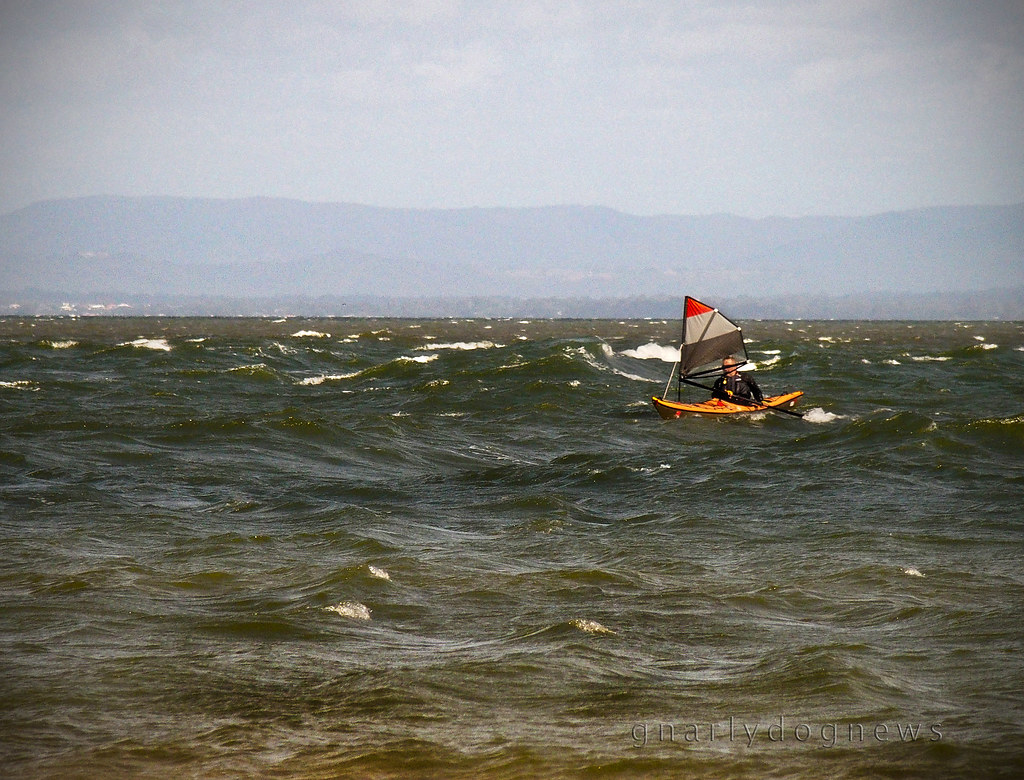
Commander testing_1

My high aspect SeaDog sail (0.7 Code Zero) catches the wind beautifully and allows me to cut into the wind at a higher angle than before, but I had a problem with it.
Since I like to have my spray deck area clear my sail is mounted differently than a typical set up.
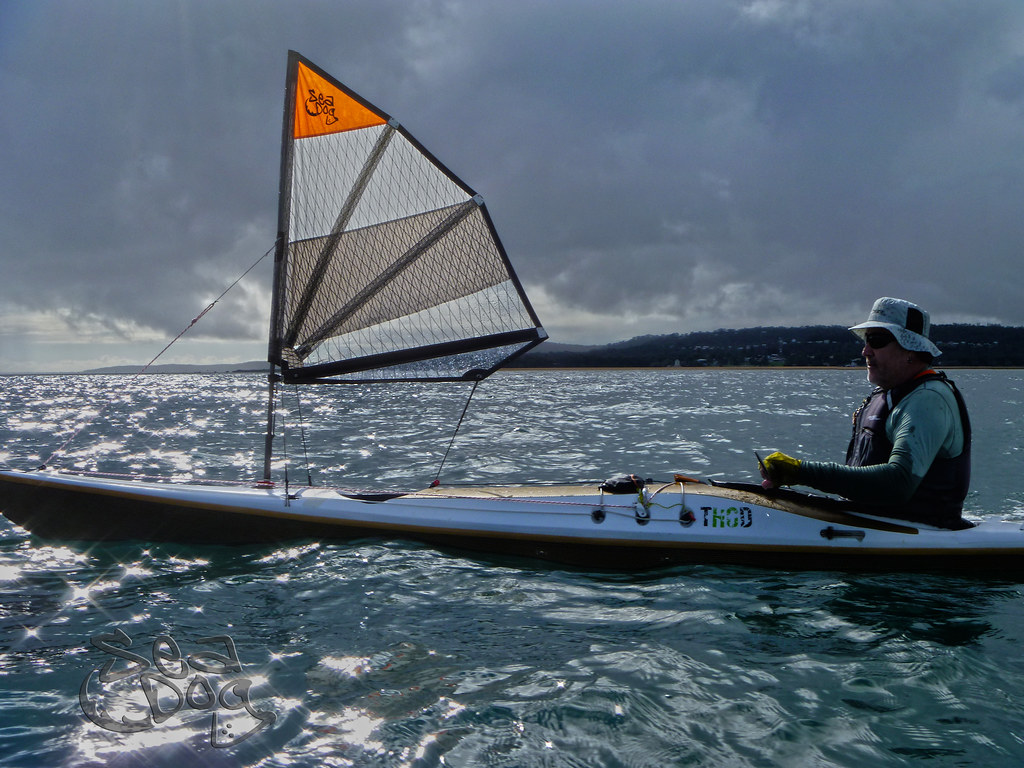
Commander1 at Peel_r
image courtesy of SeaDog
A typical mount for the sprit style sail (SeaDog, Flat Earth etc.) calls for a tall mast with stays mounted below the boom.
I prefer to have my sail mounted lower to allow the mast not to protrude in my "paddling area" when stowed on deck.
I don't like a folded sail that encroaches the deck where my hands swing when paddling.
It's simple: I want that area clear so my hands don't catch the sail.

On my high aspect sail the boom is substantially shorter than the luff (mast section) resulting in an uneven bundle when the sail is lowered down: the boom is much further away from me when I lower my sail onto the deck.
In need to secure the sail firmly onto the deck I use a section of sock-cord to wrap around the mast, battens and boom to create one solid bundle that I know will not fill up with water when waves wash over the deck or I roll the kayak.
In the bumpy waters, I was now having trouble reaching that boom and I was loosing my balance.
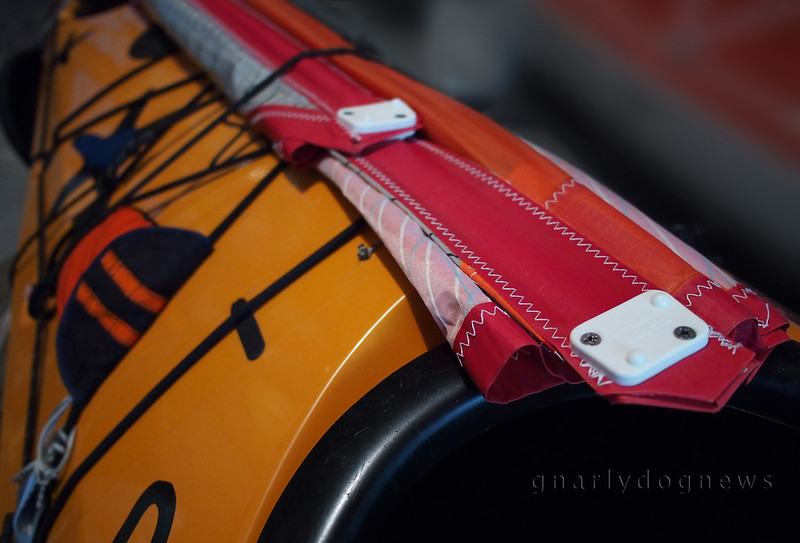
SD_CodeZero 07_c_gd
SeaDog CodeZero 0.7, folded. In order to reach the boom this sail intrudes the cockpit area.

It has been in the back of my mind for some time now: I wanted a sail with a slightly lower aspect and a longer boom.
I consulted with SeaDog sails and after I proposed my design to Richard a technical compromise was hatched: the design I had in mind might end up less efficient and might cause some loss of upwind reach.
One other trait that I really desired in my new sail was that it would be quiet.
Douglas Wilcox aptly calls it "motoring"; the sound that the leech makes when sailing cross-wind.
I don't like that at all and a highly value a quiet sail.
I proposed a double batten to Richard and after some measuring we decided on an optimal length, given my initial request of "neat bundle" when folded.
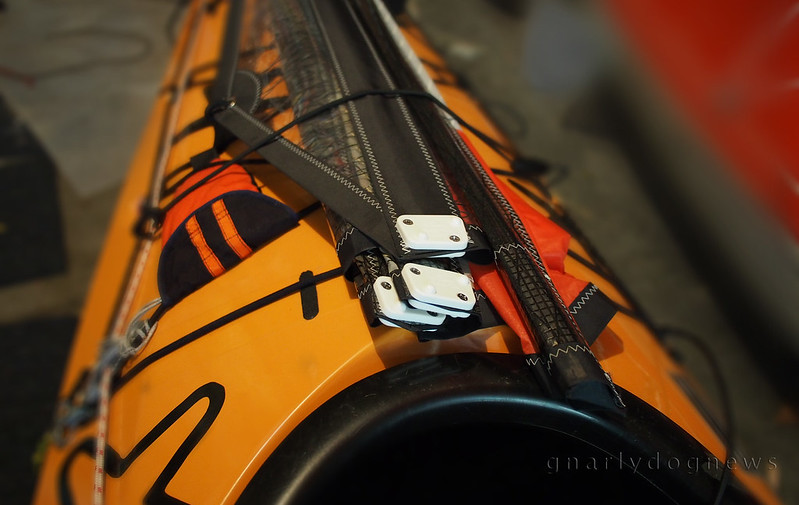
SD_commander_5_c_gd
SeaDog Commander Mk1, folded on deck

SeaDog sails distinguish themselves for utilizing the very best high tech materials and superb cut and manufacture.
I love the pattern that the carbon fibre makes in the sail cloth used for the batten pockets; it looks really high-tech matching the finish of my Greenland paddles :-)
The twin battens shape the sail perfectly and there are no areas where the sail puckers; the sail stays aerodynamically shaped to catch light breezes allowing a high angle of head wind sailing.
My concerns for decreased upwind performance did not materialize: the SeaDog Commander stays inflated at really high angles too.
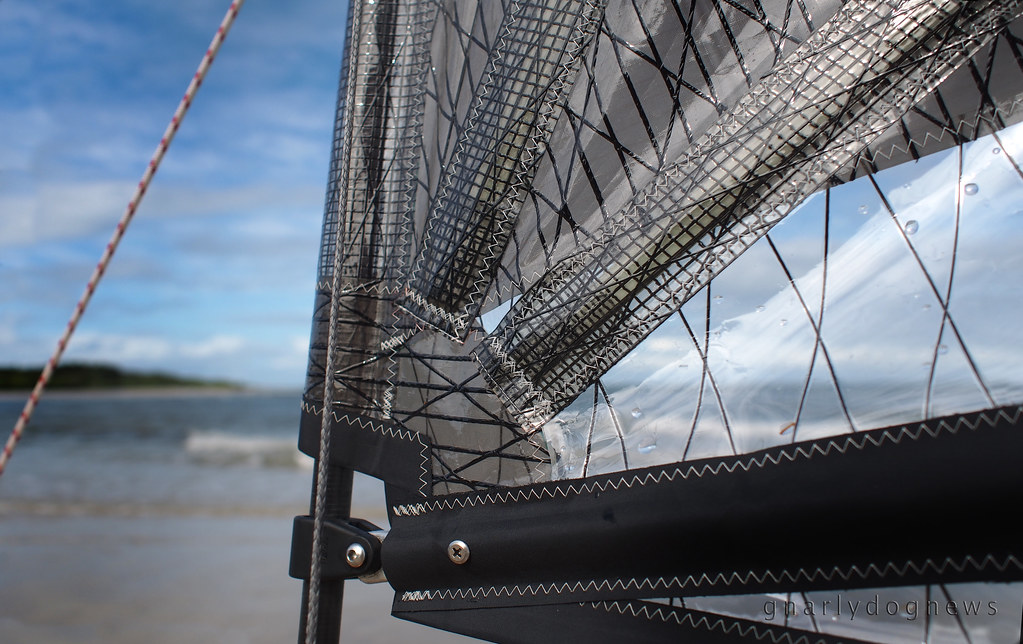
SD_commander_3_c_gd
SeaDog utilizes a special thin thread that is incredibly tenacious and UV resistant: the results is beautiful stitching.

I asked for a combination of sail cloth that would be stretch resistant, dry fast and remain stable. I also wanted to add the Clear-View feature into the bottom panel so I could easily see where I was going. Somehow vinyl windows cut into my previous sails never really helped with forward vision; they were just too milky and were ruining a smooth surface with a puckered section of sail (different stretch).

The new Clear-View panel really offers a better vision of on-water obstacles and boat traffic while the sail surface remains perfectly tensioned and smooth.
The orange tip adds incredible high visibility on the water while the pattern in the other panels makes for a stunning sail. The SeaDog Black Diamond series (with the Clear-View TM lower panel) are the highest technology sails that I have see so far: a true masterpiece.
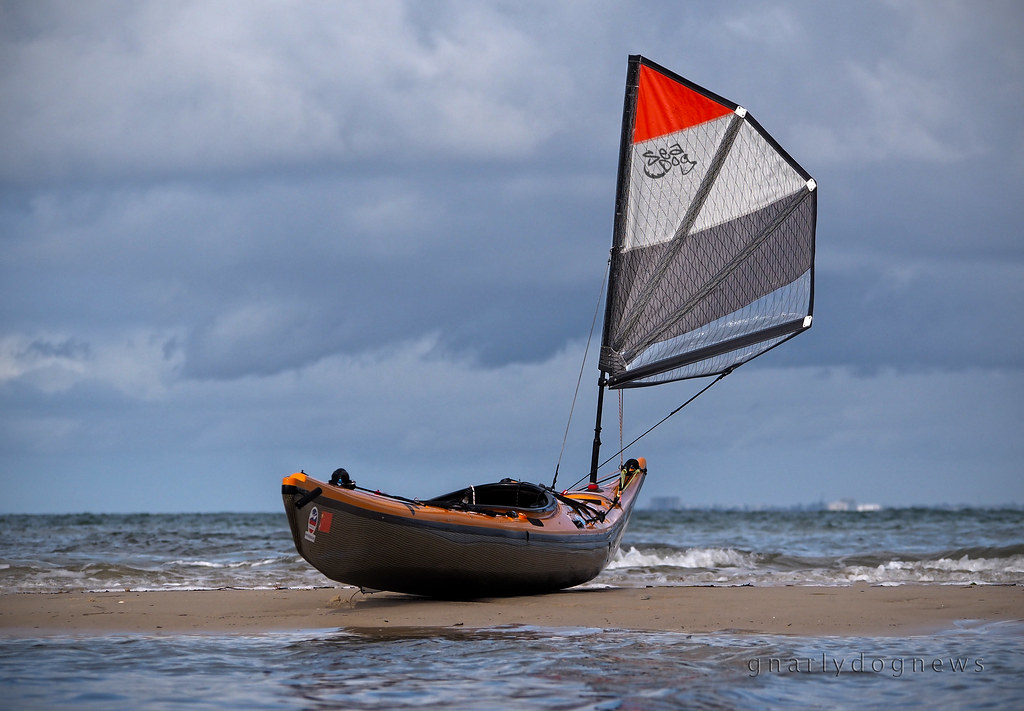
SD_commander_2_c_gd

The new SeaDog Commander has a surface area of about 0.8m² to match the sail I most use in winds up to 20 knots.
Above 20 knots, in a beam wind, there is more heeling (pushing over) that I am comfortable with while my kayak does not really go any faster (max. hull speed).
If I know that there will be high winds forecasted I rather use my SeaDog CodeZero 0.7m²
I mounted this SeaDog Commander sail high enough on my carbon mast so I can reach it when folded onto the deck but not too high to intrude into my paddling area.
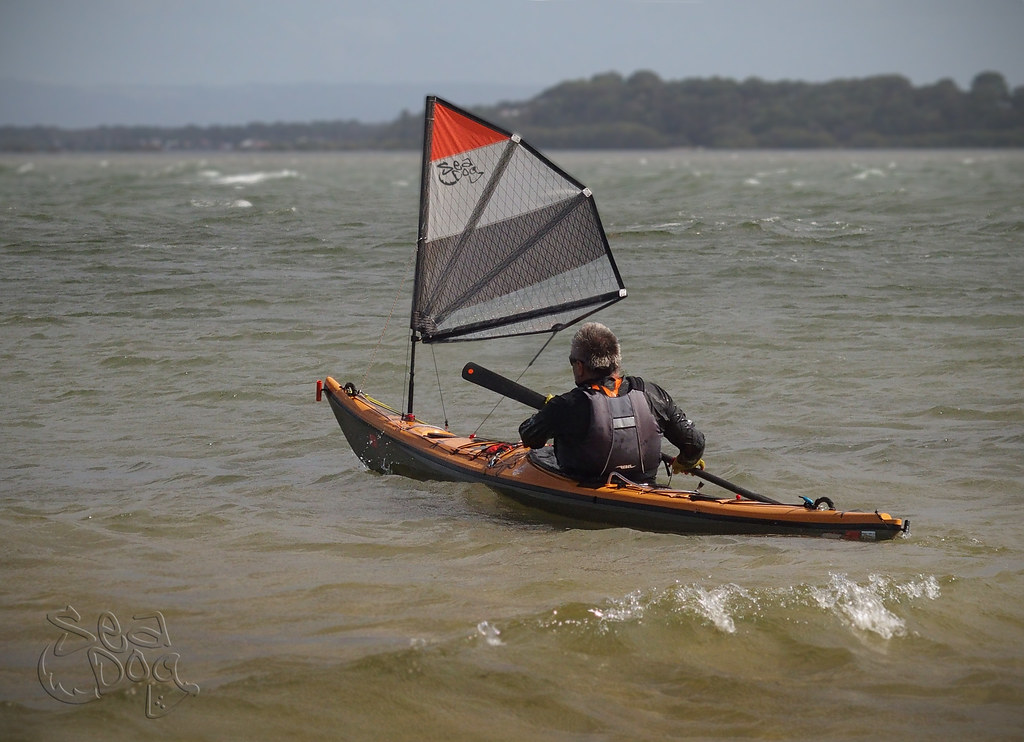
SD_commander_1_c

Disclaimer: my association with SeaDog has grown where we now collaborate on new projects. After purchasing my first sail from SeaDog I started to offer feedback and stimulated Richard with new ideas. Richard recognized that there was room for improvement with the original sprit sail design. Being able to quickly accommodate to special needs or requests with custom sails, SeaDog is able to blend high-tech sailing cloth to create sails that I wanted to realize for a while. I paid for the materials and he offers his workmanship: we both benefit from it.
 

03 November 2014

GEAR: cheap light stoves

.
There are a few things easier than cooking on a gas stove when camping, eating cold food is one.
I love the simplicity of canister gas stoves: turn the control knob, light the flame and we are "cooking with gas"

stove comparison_c

I have made a previous post about the virtues of compact gas stove here.
I have since updated my stoves and opted for something that is stable but still light.
I prefer to cook with non-dedicated pots that are not part of a system (with flux ring, like JetBoil and MSR Reactor).
I like the flexibility of being able to use a small frying pan (that I picked up at K-Mart for under $10) when a fancy dinner or breakfast is in order.
Therefore I looked at stoves that are close to the ground, have a decent footprint for stability and have a large burner (Pocket Rocket's small burner head scorches light pots).
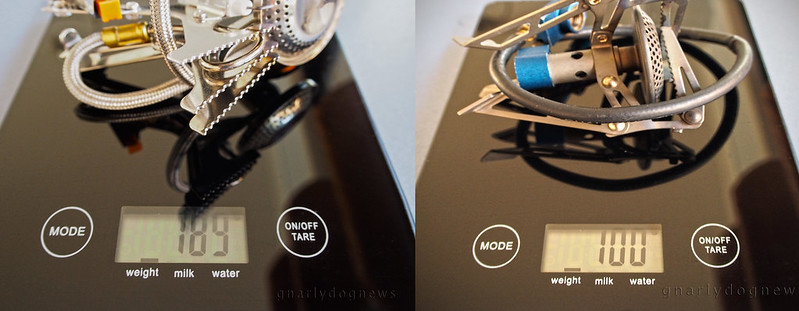
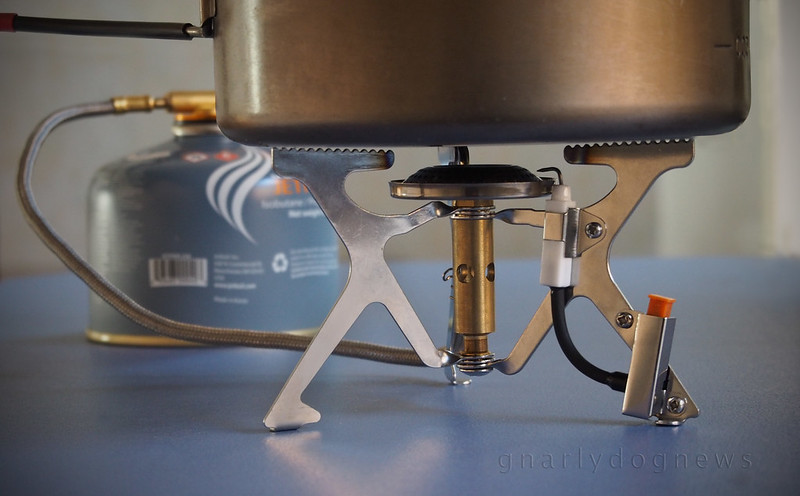
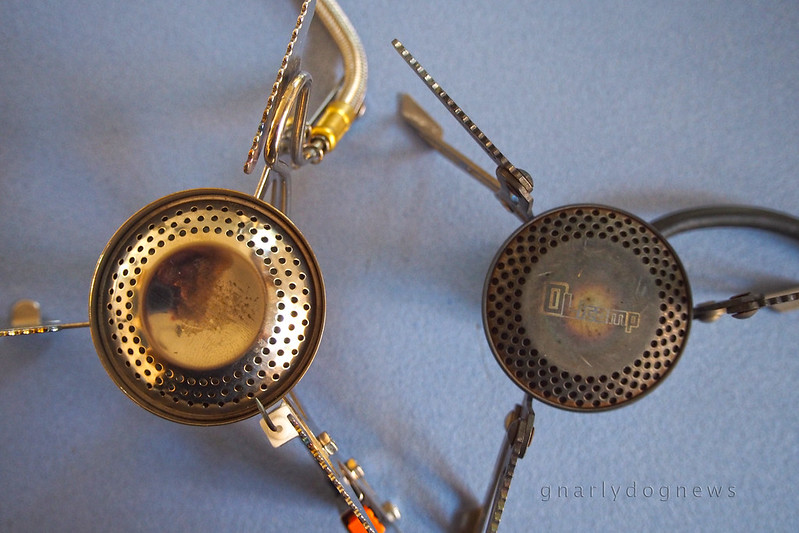
Above are two stoves: left is a very cheap one in stainless steel from eBay, right a bit more expensive one in titanium.

weight comparison

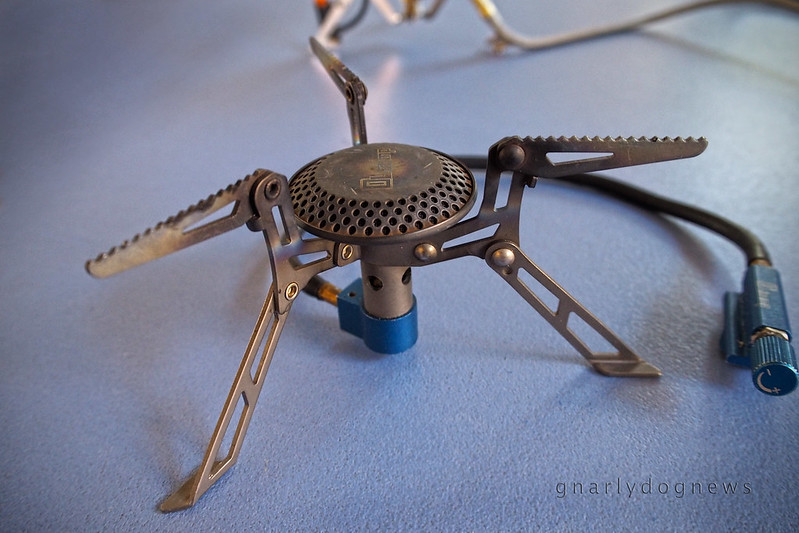
For the last 18 months I have been using a light titanium stove that sits low to the ground. At 100gr. is very light, packs away small and shows no signs of rust.
The stove is so light that a small movement of the flexible hose tips it over if no pot is on the stove

Olycamp Ti stove_c

I have used this stove for approximately 100 days, cooking extensively meals for two, occasionally for 4.
Coupled with a light windshield (very thin aluminium sheet) it has worked well in above freezing temps, even in very windy locations. The windshield is critical when there is a breeze as it retains heat and saves fuel.
When cranked to the max the stove roars and emits too much heat; I usually have it regulated at about half power.

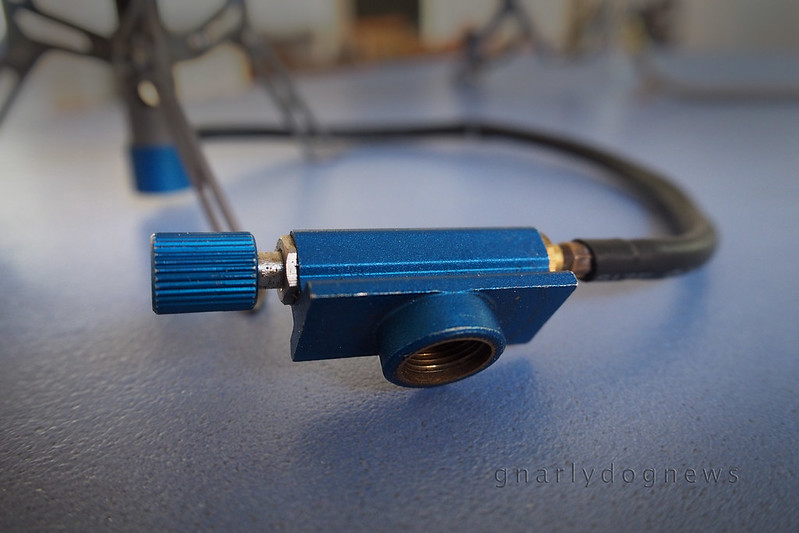
Olicamp fitting_c

The flame control knob is at the canister spigot, away from the heat of the burner and easy to adjust when the stove is going. I like that: no burned fingers trying to reduce the flame when I feel my risotto is about to get scorched.

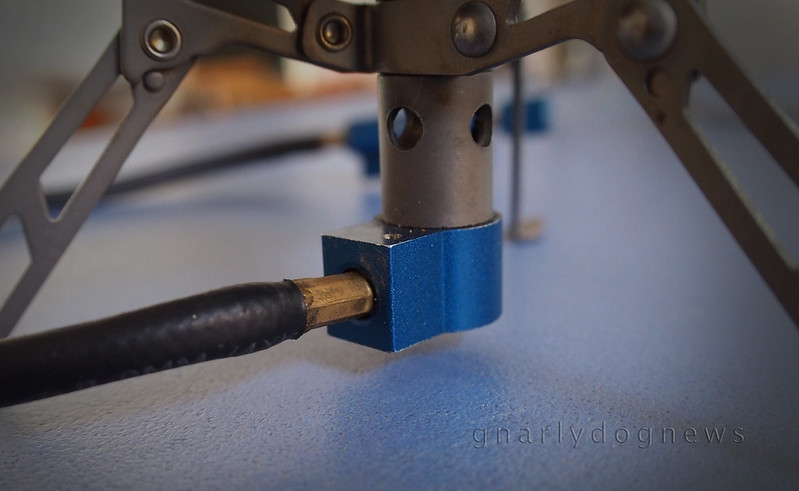
Olicamp hose_c

But there is little fault: the hose junction into the base of the burner's jet.
While the hose does have an O ring on the shaft of the hose intersecting the (blue) aluminum base, the hose can not freely rotate. A slight redesign would make this stove even better.

Trolling on eBay I came across this stove: a compact stainless steel design with large burner (did I mention I don't care for burned food?).
Labelled as "Lingyun portable gas butane stove..."  I was impressed by the price: $17.99
I ordered one as I thought it would be great as a back-up stove.

Lynun stove_1_c

The difference on this one are the legs, the fuel supply and the ignition.
I don't care about the piezo ignition where the stove can be started by just pressing a button: my experience is that they don't last. Luckily I can unbolt the unit when it will stopped working and use my trusty BIC lighter.
The legs of the stove are however made of one-piece sheet metal; they can not be accidentally folded and collapsed while operating the stove making this unit a bit more sturdy, requiring less care.
The downside is that this stove is not as compact as the titanium one, when stowed.

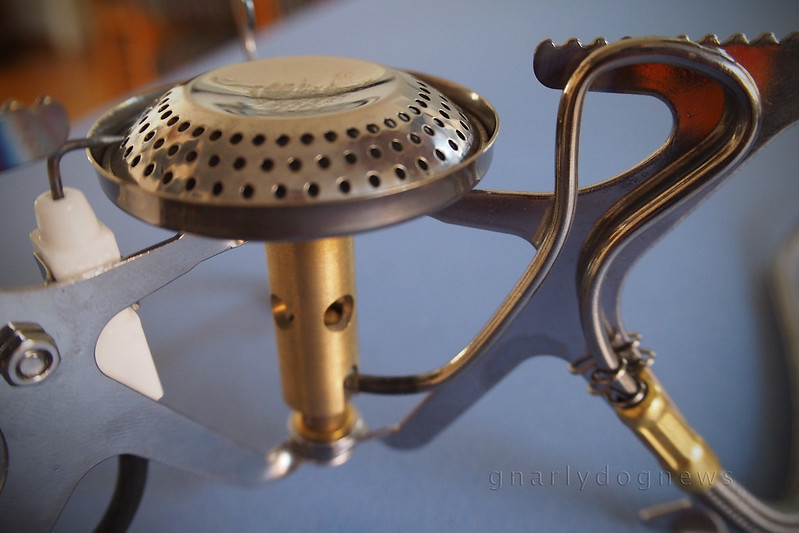
Lynun stove_2_c

Last but not least the fuel supply.
The gas travels from the canister to the stove via a flexible hose and then, just before reaching the jet is makes a loop of solid pipe passing close to the flame area.
It is intended to vaporize the butane/propane gas before it reaches the jet when ambient temperatures are low, close and below freezing.
While not really a concern to most sea kayakers in tropical locations, outdoor users in colder environments lament poor performance of gas canister stoves when temps are chilly.
The preheating loop takes care of that and delivers hot gas to the burner (once the stove has been operating for a minute or so).

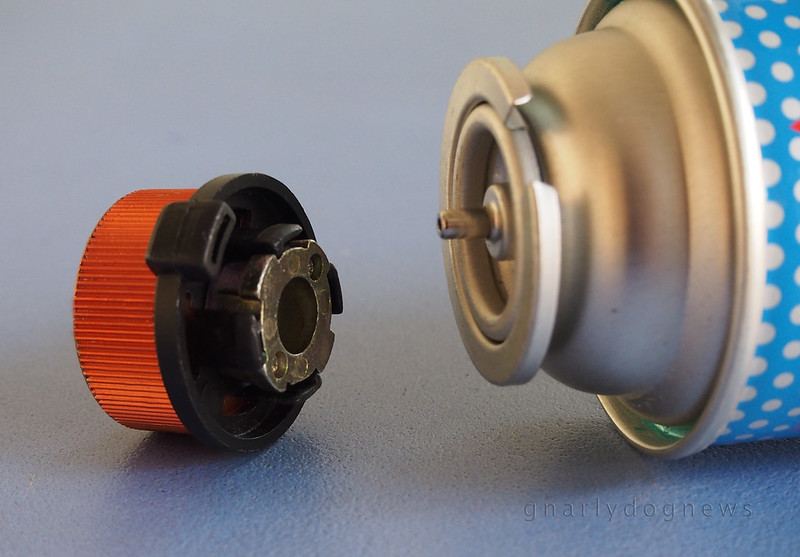
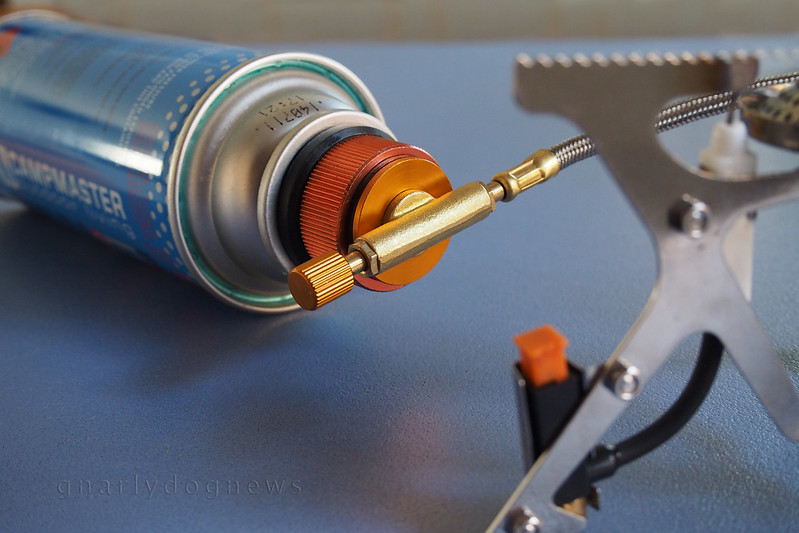
And while I write about gas stoves I should mention this little adapter.

adaptor1_c
*If you run the canister sideways with the notch up, your canister will deliver fuel vapors.  If you run the canister with the notch pointed down, your canister will deliver liquid fuel.

The gas canister stoves use a Lindal valve, where the stove or regulator are screwed-on to create a leak-proof seal. Gas canisters are usually a mix of butane/propane for better performance in low temperatures. They are readily available at good outdoor stores but not so easy to find elsewhere.
I had a bit of trouble locating the Lindal valve canisters in Sweden but I saw plenty of push-on style butane cans.
Again, on eBay I was able to source an adapter that allows screw-on stoves to be used with the much cheaper ($5 for 4 cans)  option of push-on cans.
The push-on cans are often just basic butane, more suited for warm climates; however I have also seen the butane/propane mix ones.

adaptor2_c

And to get that gas stove working well in windy places (cooking inside the tent is a bad idea) I sourced a matching windshield.

windshield2_c

This shield is a bit heavier than my super thin one that I have used for decades, the advantage is that it has little spikes that can be driven into the ground to keep the stove and shield well connected.

in the field_c

.

22 October 2014

GEAR: SeaDog sail Code Zero

I nearly tipped in and went for a swim when a small set picked up my kayak and I started surfing.
I was in my "tippy" kayak and half an hour into testing a new sail: the SeaDog 0.7 mt² in Code Zero .

SeaDog Code Zero 0.7mt_1

I was having fun trying to catch the short wind waves that the tidal flow against a healthy breeze was producing.
I am familiar with this location and often I wait for the conditions to be just right to be able to surf with my kayaks.
I am not sure if the long waterline Swede form narrow beam low rocker kayak was ideal for the small steep short waves but I wanted to see if a smaller sail would be easier to use in a stiffer breeze.
I have several sails from Flat Earth of 1.0 mt² and 0.8 mt². They work great and are very efficient sails for sea kayaking. Their design is a derivative from the decade old, or more, proven system that the Tasmanian sea kayakers have been using in strong winds.
That lead to the development of a sail mounted further forward, away from the paddler's cockpit as explained here.
The SeaDog sail is an unapologetic close resemblance of  Norm Sander's rigs and Flat Earth sail.
Actually the design is strikingly similar.

SeaDog sail_3

I have been kayak sailing with other paddlers that have been using SeaDog sails for the last couple of months.
Richard, an avid SE Queensland Sea Kayakers paddler, is the man behind the brand and his passion for sailing is evident.
He can be seen paddling every weekend (and often during the week) sporting sails of his own creation on his kayak.
It all started innocently when Richard decided to add some color to his sail.
A special one was made just before Xmas and of course, inspired by the festive season, it was green and red. It was different and unique; people noticed.

Xmas sails_SeaDog
photo: SeaDog sails
I was impressed by his early work even tho I didn't share his passion for the color choice :-)
A few weeks later a new colorful sail appeared in the paddling group. Again the work was impeccable.
I watched those sail taking the wind very well and I noticed them filling with air at even very acute angles into the wind. One thing that I was very surprised is that Richard's sails did not flutter.

Eventually Richard made me a sail that I was missing in my quiver: I wanted a small sail that will allow me to be used in winds of 15 knots and above.

SeaDog sail_1

I have used my Flat Earth of 0.8 mt² in winds where I no longer was comfortable with the heeling force of the strong wind. Unless surfing, the hull speed of my kayak will really determine how fast I can go, no matter how big my sail is

As the small waves started to pick up my kayak the SeaDog sail was hit by a gust from the side. Any other time I would have to quickly react with a solid brace with the risk of tipping over.
This time the jolt was softer and the shock cord on the main sheet (the rope that pulls-in the boom) released some of the pressure from the wind. This sail being smaller helped reduce the heeling force that wanted to tip the kayak into the water. I was able to stay upright and continued to surf.

The downside of a smaller sail is that I have to work harder and paddle more when the wind is from behind (running with the wind). As the waves catch up with me I have to put an extra effort to then accelerate down the wave.
Side-by-side with a buddy using a 1.0 mt² sail I had to really crank to catch the marginal waves, while I could see that he was getting more push from the wind.
However, I am sure if the wind was 20 knots +  he would be a bit worried with his larger sail...

SeaDog sail_2

In essence the SeaDog sail of 0.7 mt² is best suited for stronger winds or paddlers that have just starting out sailing, possibly with less bracing skills. Lighter paddlers will also appreciate this sail as their lack of counterbalance body weight is noticeable in strong winds.
SeaDog sails also makes 0.8 mt² sails, in traditional colorful Dacron® or the fancy laminated Code Zero (unfortunately white only).
On closer inspection I notice very clean seams and stitching on the SeaDog; every stitch is continuous from one end to the other with absolute precision. Every end is reverse stitched to prevent unravelling and the tension on the bottom and lower cotton is perfect to create a very clean stitch.
Attention to details is superb and the finish is outstanding: every rivet and every reinforcement is very well executed.

SeaDog sail_4

Is SeaDog a better sail for me?
I can't say that as Flat Earth has served me well and I had no trouble for years now.
What I notice is no flutter in the leech, something that mildly annoys me in the Flat Earth sails.
I mounted the SeaDog sail with two back/side stays, as I have done on all my other sails.
Richard recognizes that kayakers have preferences in mounting styles and hardware used for doing so. He supplies the sail with the mast, Spectra stays and the flexible polymer base only, leaving the rest up to the sailor.
I much prefer that since some of the (Flat Earth) sail kits that I have used had parts that failed on me.


03 October 2014

Video: Aquarius Sea Lion LV

On a sea trip of 5 weeks in Sweden and Åland (Finland) Petra paddled a Sea Lion LV.


Aquarius of Poland sponsored her with a very light carbon/Kevlar kayak and we installed her Flat Earth sail to make our expedition more fun.
Petra picked the color scheme of her kayak and I thought the graphics were particularly attractive making the kayak very visible against the water and granite islands.
The kayak behaved very predictably in varied conditions and weather-cocked just enough to make it safe when windy, even in a storm.
The only real modification was removing the padding that was factory fitted on the seat; lowering the center of gravity made the kayak a bit more stable. Given that she has never paddled a Sea Lion LV before, Petra liked how she felt in that kayak right from the beginning.
Despite the cockpit maybe being a bit too roomy for her the key hole style thigh braces allowed her to brace efficiently when the waves picked up and tossed her around a bit.
Cargo space was sufficient for our extended trip and the main hatch covers (Kajak Sport) never leaked (the "glove box" needed a bit of sealing around the rim).
The skeg performed flawlessly and was butter smooth to operate. Adjusting the foot rests was possible even while paddling (without needing to exit the cockpit to reach the adjusting tab behind the foot rest!).
The shorter waterline and the rockered hull seems to be well suited to shallow waters with shorter waves (no ocean swell in the Baltic sea). Clapotis was not upsetting Petra and I noticed increased confidence in following seas where she was catching and surfing waves way faster than me, leaving me behind.
I think that the Sea Lion LV combined with a sail is a great fun kayak.
It performed well with just light loads in strong winds (slight leek cocking when sailing) and very steady when filled with camping gear, food and water.


13 March 2014

INTERVIEW: Johan Wirsen, the kayak designer

.
Johan Wirsen is today one of the most prolific kayak designers.
His home is in Scandinavia and his heritage of sea fearing Vikings is well represented with his skillful art of designing modern sea kayaks.
I was lucky to meet Johan in 2011 when I invited him on a trip to the Queensland tropical coast.
A very understated person with great insight, Johan is an incredibly likable character.
Humble and considerate in his thoughts and trusting by nature has not always been an advantage in the cut-throat business of sea kayak manufacturing.
He has been designing and constructing boats and kayaks since early teens and it is his livelihood.
Last July I visited him in his hometown of Borgholm on Oland Island, Sweden and he revealed to me that something big was brewing in his shed.
After years of designing and working for other manufacturers, fed up with some of their attitude and malpractices (he got ripped off several times)  he decided that it was time to launch his own brand: Rebel Kayaks.

Rebel ILAGA rolling1
Ann-Kristin Skinlo at Göteborg Boatshow_ image with permission from Lars Jönson


I took the opportunity to interview Johan Wirsen:


gdn) You have started a new brand of sea kayaks called Rebel: why another brand ?

JW) -You know, since 2001 I have been working independently with kayak designs for a number of companies. Of course I was building and designing my own kayaks before that so I more or less took the experience I had and transformed that from “one off” designs to a serial production. But as you know, the kayak business is also quite dirty and some of the companies I have been working with were also very greedy, so I have decided to terminate some contract with the “big ones” and start all over with this new little company Rebel Kayaks and try to keep the passion for the sport and paddling alive for myself.

Where and when will these kayak be available?
- For the moment we are that lucky that we have been contacted by so many high end retailers, dealers and customers that we can’t satisfied them all!! 
The truth is that we are too small and can’t produce that many kayaks, yet. When we shift our production to Poland we naturally will start to sell our kayaks here in Northern Europe.

Rebel kyk_Janusz
image courtesy of Janusz Kowalski from Rebel kayaks


What style of kayaks are you focusing on under your brand Rebel?

-    The first two models that we put into production are my two Greenland styled kayaks: the “ILAGA” and the ”T”. Those are the type of kayaks that I personally feel a lot for, and since they are well known they are like a signature for me. It feels important to me that I design and in the future build kayaks that I would like to paddle myself. 
Since our production capacity is not too big, we also prefer to put the effort into building light and stiff. – Why build something you would not want for yourself ?

Petra on Traunsee_c


Are you still designing for other manufacturers?

-Yes I still do some work for other companies, and for the moment I am working on a Coastal Rowing boat.

I notice a certain consistency of style in your creations even if the kayaks that you have designed have different goals in mind. How did you get involved in boat design and what is the driving force for your passion?

-Born on an island, and growing up with a father that had all kinds of boats (anything from fishing to sailing and even a water-ski boat) it is not that unusual that I got this interest and eventually I went to school to become a boat builder. I have always tried to build or rebuild my own stuff, even motorbikes! 
But boats and especially traditionally boats with smooth lines have always appealed to my eyes. And there is something special about boats and the tree dimensional shapes that should be put together in a smooth way (to achieve less drag).
For ex. The single coastal rowing boat that I recently designed where I had to learn new traits while listening to skilled rowers to get the ergonomics right. I am not a rower myself so there was a lot to learn.
Another kind of boats I love is our traditional wooden boats and of course to sail them. 

Johan sailing

 The picture shows my 17´ “Sandbacken” which is our traditional type of boats from our Island

What? Rowing boats???  

- Yes, this is actually really funny.
It started as a small project that then won tree medals in last World Championship!! (Gold and Bronze – men, and Silver – woman)
Mats Leo (rower and the owner of the project) asked me if I could help him to design a boat and together with one of the most skilled rower here in Sweden, Peter Berg, we got this far!!
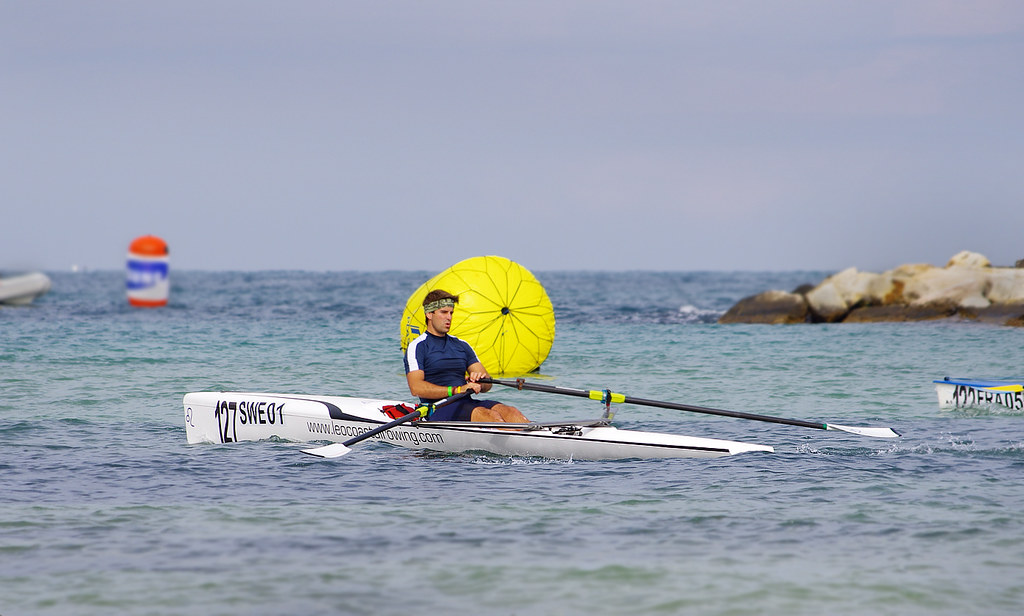
-For more info check    www.leocoastalrowing.com

Peter Berg rowing
Pictured Peter Berg. Recently Peter Berg also won a race in Monaco

Sea kayak sailing: what do you think of that?

- I must admit that I have not experienced sailing with a kayaks before I visited Australia. But I really got hooked!  It is fun, it is energy saving and the “Flat Earth Sails” are working well. The position of the mast is not ideal on a sea kayak, however at the same time you don’t want it to interfere with paddling. But it works, and I recommend paddlers to try out.

Swede form or Fish form: what is the best hull shape?

- A quick explanation, or to say when and where is best would be hard to describe here in a short form. 
A Swede form (the widest part aft of centre of the hull ) creates less drag and wave resistant on the surface resulting in more laminar flow and less turbulent flow than on a fish form, that has the opposite shape. However there are also so many other things to be taken in consideration when designing a kayak or a hull.
In my current designs I concentrate on the thought of how strong we are as a paddler, and I try to make a kayak as fast as possible in the low speed area, let say in 3 – 4 pound drag area; because this is where most of us ordinary paddlers fit with our “touring sea kayaks”. 
If you would like more info please visit www.marinerkayaks.com and click the link at the bottom about designs. It does not tell every thing but can give you something to think about.
When I am working on a new design, in most cases I also build and test paddle my kayaks. It gives me the possibility to make adjustments before the kayaks goes in production, unlike many other producers today that make something up on a computer and then email it to a CNC-machine shop. Furthermore, in their catalog,  they will then tell you all about the kayak's advantages before they even ever built the first one.

Johan, you know that this is a passion of mine: What do you think of Greenland paddles?

- In the beginning I did not find the Greenland paddles interesting. I had been using a Euro paddle produced from our Swedish brand VKV for many years and modified the size of the blade more for a touring paddling, since the original blade was too big for long distance paddling; I also made the paddle shorter and I was happy with that. 
When I started to become more focused on rolling and was paddling more Greenland style kayaks I had to re-think. I can’t say that I have a pure Greenland paddling technique and while I do more what is intuitive and adept to the situation I almost never use anything else than a “stick” today.  If speed is a concern the Greenland paddle is not limiting, and if we talk about feeling I have the biggest respect for that paddle. 
I love to hold onto a wooden paddle, even if I have had in mind to make some carbon ones. However hollowed ones made out of cedar are around 650 gr.

Johan in ILAGA
image courtesy of Janusz Kowalski from Rebel kayaks

- If anybody here in Scandinavia is interested in learning good rolling, or paddling techniques, consider Helen Wilson and Mark Tozer from Greenland or Bust in partnership with Rebel Kayaks, on their “Nordic Tour 2014”:  a three months long tour around Sweden, Denmark and Norway.  For more info visit www.greenlandorbust.org

I have seen you tool around with the shape of the Greenland paddle and I have seen an interesting twist to the traditional shape. Thoughts on that?

- I started to make my paddles like that a few years ago. I like the shoulder on the loom as a position for my thumbs; at the same time I just make the other (top) side smoother for my hand to hold onto. What is most important is that the edges of the blade should be sharp so the paddle works quietly. I also have my tip of the blade more rectangular and at a slight angle. Some of my paddles have been copied and are for sale at Rebel Kayaks now. The paddles are made of cedar with ash edges as a harder more durable wood. The length of my paddles is often around 2.18m total, while the width of the blade can vary. 

Johan JUL2013-cr
   
Last words?

 Well I guess that would be: With paddling try to make it your own journey.
 The experience I have is not “one size fits all”. We all have to listen to our self and it is not always that important what gear we are using or if we go to the most exotic places; your own bay is often good enough. Paddling or sailing is mindfulness in itself for me, and hopefully for you too. 
/ Johan Wirsén


Summer storm_c

.

29 January 2014

GEAR: outstanding customer service at REI

.
 As avid consumer of outdoor gear I have purchased enough stuff to fill a small house. OK, maybe not but I am getting pretty close.
It was not always kayaks; it used to be mountain bikes, backpacking and dirt motorcycles before that.
I haven't ridden seriously in years, backpacked much less lately but I still acquire light camping gear for my kayaking trips.
When I lived in USA the local REI shop employees thought that I was on their payroll, I was that often at their store. Eventually I took a job at REI, as Master Tech managing one of their bicycle departments. Half my wage would be "reinvested" directly into gear that the shop sold. I would not buy anywhere else as the warranty offered by REI was outstanding.

 I use my gear, some of it a lot. If a manufacturer offers lifetime warranty I have no reservation buying that item. I am confident that REI will honor a possible claim. Gear that I buy is not cheap, often the very best in that category and I believe in buying quality that lasts and offers the security of service when I need it. Cheap big box stores don’t appeal to me as I don’t like replacing failing items just because they are cheap while I have to deal with sub-standard equipment robbing me of my outdoor experience.

 REI sells excellent tents for hot climates under their own label, design and specification. Of course their tents are made in China, just like 99% of the most reputable brands are. I purchased two tents that were light, compact and sturdy, offering ease of pitching and good ventilation.

ex Cap_27

I used them on many trips and I never felt that they would not stand up to what the weather was throwing at me. They never failed, never broke a pole and never got wet in them. Solid, as I expected. Then one day the seam sealing tape of the fly of one tent started to deteriorate and peel off in chunks. The fabric became a bit sticky and the crumbling seam tape compromised the waterproofness.

IMG_7215

I purchased that tent 5 years ago, online.
I was not sure if REI would really stand behind their promise of lifetime warranty since I often I hear manufacturers interpreting “lifetime” as lifetime of the tent. Nowhere is disclosed what that means and how many years that warranty is good for; it’s at the discretion of the manufacturer to establish that, of course after I have a problem with my item.
I contacted REI via email and told them of my problem. The next day (time zone difference) I received a reply that I should take my tent to my local REI store (they have over 130 stores, all in USA tho) or send it in for them to inspect.

Santa Rosa REI_c

When I lived in USA I returned a faulty item to REI and they replaced it there and then without any fuss. This time I was supposed to send my tent to USA; the postage via Australia Post would be worth half of the tent! (shipping from USA via USPS is substantially cheaper)
I asked if detailed images of the tent would be acceptable to REI for assessing my claim. They agreed and I supplied the images. Two days later I received an answer from the Technical Department confirming what I thought: the tent was found to be faulty in material and a refund was organized for me. They were kind enough to understand that sending the tent to them for assessment was not economically feasible and rectified the problem with a refund (they would not send me a new tent as it was purchased in USA and not originally shipped to Australia).
Now, that is what I call customer service!

Camp at Fraser (c)

It is in such a stark contrast with the service that I have received in a similar store here in Australia where the manager of the store belittled me, accusing me of causing the fault when a self inflating mattress delaminated and failed: he said I rolled it up too fast when deflating it (?). Needless to say his ignorance and arrogance ill served Kathmandu’s business and I no longer wish to shop there. After the manager shared his belligerent opinion with me he replaced the faulty mat anyway, so I did not understand his point/view of arguing with the customer anyway. Ego/power trip? Who knows…

REI has always met my expectations, often exceeded. Their gear is solid, maybe not the most trendy or desirable in the outdoor fashionista circles but nevertheless great value for money. And since it’s a co-operative all profits are shared back to its members in a yearly refund of approx. 10% (of purchase) , with a portion donated to environmental/community projects.

.

19 June 2013

REVIEW: shoulderless Northern Light Greenland carbon-fibre paddle

The new Northern Light paddle recently received is different: it's a shoulderless version of the three piece carbon fibre Greenland paddle that Paul produces. 
The sectional loom is the same as all the other Northern Light paddles (Greenland and Aleut) but this blade is much narrower than my standard Greenland paddle, which I have been using for all my paddling.

NLP_nar_2_c

I have grown to love the Northern Light Greenland paddle that, despite my best efforts to destroy it, has never let me down.
Despite me abusing it, all I managed to create was a hairline crack in the insert after a wave dump and high brace onto a bank of sand, which was later easily repaired. 
No other paddle would stand up to the abuse I now subject my Northern Light paddles.

The new carbon-fibre Northern Light paddle is shoulderless and my hands slide along the shaft without feeling the familiar notch of the shoulder. Initially I thought I needed to feel my hands centred on the paddle and the blade’s shoulders of my Greenland were the reference point, but as I paddle kayaks with skegs I tend to wiggle a bit and often extend the paddle on one side.
Ruddered kayakers find it odd that waves slide my kayak sideways a bit and make it broach just so slightly needing corrective strokes.
To address directional changes I use sliding strokes where my hands let the paddle extend to one side; all without being even aware of such technique.
I no longer keep my hands in the exact same position on the loom (as I used to with Euro paddles); they are literally all over the place.
When I want to accelerate hard I extend my Greenland paddle to insert more blade into the water and create more resistance.  If I want to correct my direction a bit, I extend the paddle and slightly sweep, all unconsciously. This new paddle lends itself perfectly to my “wandering’ hands.

NLP_nar_3_c

The Northern Light “Skinny” Greenland is incredibly smooth and has an organic feel in my hands.
The edges are very fine allowing silent insertions into the water; canted strokes feel effortless. It
literally slices through the water.
The “Skinny” has been in the works for a while and Paul spent a lot of time talking to some of the best known Greenland kayakers like Maligiaq and Dubside before he and Carlos (his former partner) came up with the dimensions for this paddle.
The paddle has actually been in production, with prototype testing going on for over a year now.

I thought that such diminutive paddle (if compared to big blade Euro style) would lack purchase resulting in reduced kayak speed.
But as Maligiaq demonstrates, a fine edged Greenland paddle used with correct technique (canted) and a higher cadence can produce hull speeds equal to larger blades, the proof seems clear in his results against world class sprinters.

As the blade is so fine I expected to experience some flutter, as most Greenland paddles seem to have in the first ten minutes or so until my brain “learns” the traits of the new blade and adjusts.
The “Skinny” was immediately at home with me and no adjustment was needed. Canting it was super easy (maybe it’s the pronounced flat surface on the loom) and I noticed no splash, even if I purposely tried to use a sloppy stroke. It was also a surprise to see rank beginner kayakers trying this paddle and loving it immediately with very little wobble when sprinting.

 
comparison_1
Northern Light paddles size comparison: Aleut, Greenland and "Skinny"
Small hands will find this skinny paddle easier for sculling (compared to the standard Greenland) as it allows the blade to sit more comfortably in the palm closer to the end of the blade.
Furthermore the "Skinny" can be converted from a full size adult paddle to a perfect child paddle; this was a very important consideration when designing this paddle.  

With the use of the included insert the "Skinny" makes a smooth paddle for the budding new paddler. 
Weighing a bit less than the standard Northern Light Greenland the "Skinny" is just as modular as the original.
Paul has maintained the concept of a 3-piece paddle where the loom is the variable part to accommodate for different size paddlers.

The unique ability to break down the paddle in sections small enough to allow air travel as part of check-in luggage (fits perfectly inside a large duffel bag) makes this paddle a trusted companion for remote locations. 

NLP_nar_1_c
 

But how does it handle the choppy waves?
No different than the larger sister original Northern Light Greenland.


So why not use the “skinny” all the time?
All paddles have their strengths and the NLP “Skinny” is no different.  The sharp edges lend themselves to more technical paddling as it slices through the water allowing for a higher cadence when paddling distances and also for sculling rolls.  A lot of times a thicker paddle allows one to rely on the volume to auto correct a bit when rolling.  The “Skinny” requires good technique in this regard.
The noticeable difference I could feel was when I accelerated from a standing start; I felt just a little bit less resistance in the water and maybe a stroke more was needed to bring my kayak to cruising speed.
Side by side with my paddling partner Adventuretess we swapped paddles back and forth; using a perfectly synchronized stroke our kayaks maintained the exact same speed.
I can only conclude that the “Skinny” offers enough hydraulic resistance to propel a kayak to hull speed.

I had no chance to try the “Skinny” in the surf yet, where a big blade is desirable to be able to suddenly accelerate down the face of a wave; that’s where the Northern Light Aleut shines. 

On my planned trip to the land of the long shadows I was planning to take the standard “fatty”; I am now reconsidering and want to have the "Skinny" with me.


28 May 2013

Review: carbon-fibre skeg by Norbert Gancarz

A carbon-fibre skeg is the ultimate bling aftermarket accessory for any kayak.
If however one considers a kayak just a tool and has little affinity with his/her craft then I don't think this skeg blade would excite them.
Just as some consider a car just a car and see no point in retrofitting it with performance accessories I am sure that to some a carbon-fibre skeg might seem an unnecessary replacement.
I don't care that much about my car but I will not say the same for my kayaks.

As all of my kayaks are rudder-less and incorporate an adjustable skeg for directional stability, I often wondered if the deployment of my skeg had as much effect on drag as when I would lower a rudder (it has been a few year since I have paddled an over-stern ruddered kayak).
In my Impex Kayak the skeg is a rather chunky HDPE blade (same material as the common kitchen chopping board); if I fully lower that skeg my kayak seem to slow down a bit and become a tad sluggish.
When Norbert Gancarz ( norbertga@o2.pl from Poland) offered me to test his latest creation, a carbon-fibre blade to retrofit the Valley skeg, I was keen to try it.

Norbert skeg_1

The skeg blade is of the exact outer shape as the VCP factory standard grey plastic one but this carbon skeg has features that the Valley skeg does not.
The blade is foil shaped like the wing of an aircraft with the leading edge thicker than the back of the blade. This shape minimizes turbulence and promotes an easy flow of water over the blade when the skeg is deployed. Less turbulence equals to less drag that leads to less effort and possibly more speed.
While speed has never been my goal, less effort is certainly welcome.

Norbert skeg_2

The skeg blade is a real work of art and the finish is incredible.
Somehow I felt that such a beautiful accessory looked out of place on the basic finish of the Nordkapp LV's skeg box but I was keen to find out if the blade would actually fit and how much effort the retrofit required. After all the existing skeg blade was still working fine...

Norbert skeg_5

I inserted a 2.5mm Allen key (like the one you get with IKEA furniture, but smaller) into the skeg's control knob found next to the cockpit and tried to undo the grub screw. Initially it would not budge but a squirt of water dispersant (WD40) and a few minutes later the key turned and the pinch on the skeg cable was released.

Norbert skeg_6
salt built up under the skeg control knob,washes away easily...
The knob was free and now I could pull out the skeg blade past its normal maximum deployed setting; the wire came out easily.

Norbert skeg_7
factory VCP skeg blade removal

Norbert skeg_3

Norbert supplied me with the stainless steel wire that I had to cut as each kayak model has a slightly different wire length .
The carbon skeg has a very neat grub screw that pinches the cable that is inserted into blade (not show here).  I measured the length of my existing Valley skeg wire and cut the new one to length with a pair of diagonal cutters (a decent pair of plier would have done the same job).
I fastened the grub screw on the carbon blade onto the wire, inserted the blade into the skeg box and easily wiggled the wire back into the housing all the way to the control knob. The skeg blade was sitting flush with the hull, all the way in the skeg box, before I aligned the knob over the hole in "slider tube" and secured it tightly with the Allen key. I made sure that the knob was in the "retracted" position or I would not be able to deploy that skeg all the way like before.

Norbert skeg_4

Norbert's skeg blade sits in the skeg box without any wiggle and the two little rubber washers on the pivot point offer just enough resistance to keep the blade in position preventing the skeg blade from creeping back up when the kayak is at speed (one of my kayaks does that and I am yet to fix it...).

But how does the skeg perform in the field, err water?
It seems to have a crisper feel with the lowering amount precisely translating to directional changes. There are no wobbles and no "skeg hum" as I have in some of my other kayaks when I speed down the face of a wave.

Norbert skeg_10

As for increased speed?
I can't attest to that as I don't have a GPS to measure precisely the speed of the kayak.
All I really want is to have the kayak on the beach, belly up, with the skeg standing up proud showing off that sexy carbon weave :-)

Norbert Gancarz can be contacted at norbertga@o2.pl
.

12 February 2013

GEAR: rustproof knife

There is no other subject that generates more interest than talking about knifes (Justin Bieber excluded). Websites and forums seem to spark seriously opinionated debates when it comes to the perfect blade.
Myself, I have been looking for a knife that would work well for sea kayaking.
I don't need no Bear Grills knife, no Crocodile Dundee blade or a knight's Excalibur; all I want is a knife that does not rust, and stays sharp.
No many knifes will not rust, in a marine environment.
While I can get plenty of sharp knifes that will do so well for general outdoor pursuits (like backpacking) finding a blade that will really stay rustproof in salt water is not easy.
I hear good reviews of some knifes that use some really high-end steel alloys; unfortunately those knifes are also ridiculously expensive.

I have a knife on my PFD, that despite being inexpensive, after years of regular exposure to salt water is still looking perfectly shiny. One problem: it ain't sharp, and no matter how much I sharpen it, it just does not hold an edge. The blade is also very soft and bendy (yes bendy... trying to pry open some oysters, the blade just bent!).

I was pleased that in the search of the perfect knife, that would cost me less then a small kayak, an importer of outdoor goods suggested I should look at ceramic knives.

open knife_c

I have seen and handled a few ceramic kitchen knifes but never have I seen a small pocket knife or one suitable for paddling. My search for one in a holder/sheet (diving style) was unsuccessful but I did find this great offering instead.

in hand_c

I sourced the knife on eBay for a silly price compared to sharp rustproof steel knives.
The size is perfect and fits my hand well, and my PFD pocket.
There are no spring to snap it open and it does lack a blade latching mechanism (there are other offerings that might have that) but I know that the knife will not rust.
The blade is very sharp (I could shave with it) and it folds neatly into the plastic handle. The retention of the blade is just simple friction between blade and handle.

detail_c

I am not sure if this knife is the perfect choice for a rescue situation (non locking folding blade) but suitable for other common tasks. And as somebody once asked: does it cut the cheese?
I will report: yes it does :-)

cutting cheese_c

.